










An AI model can perform flawlessly in a demonstration and prove useless once it reaches a unit without a reliable connection or the computing equipment it depends on. For the military, the real test is not whether a model can be installed on a device. It is whether the model can deliver useful, verifiable information under the conditions in which it will actually be used.
That is the challenge behind what the industry calls “super intelligence” (SI) at the tactical edge. The practical stakes are more concrete than the term suggests: data must be processed close to where it is generated, and operators must know how much weight to give the result even when they cannot reach central infrastructure.
The mission determines where the edge begins
The edge is not one type of equipment or one particular location. It might be an overseas facility with dedicated local computing or a handheld device in the field with limited battery life and intermittent connectivity. In either setting, the edge begins where users can no longer count on central computing services.
Bharat Patel, managing director for AI and data in Accenture Federal Services’ defense portfolio, and Cody Ferguson, a principal AI and data architect at the company, emphasize choosing the model to fit the mission. A smaller, less capable model may still be useful if it works offline. For a decision with more serious consequences, the same margin of error may be unacceptable. Equipment size and weight, power consumption, available computing resources and tolerance for risk all shape what can be used in the field.
Analyzing imagery in the field is not the same as training in real time
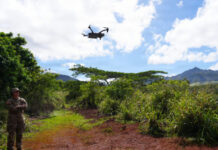
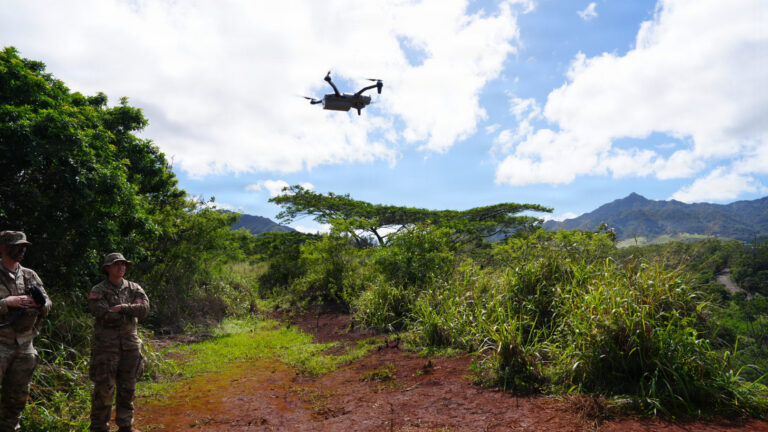
Drone imagery is one of the most widely discussed applications for field AI, but its use at scale remains limited. Before a model can analyze new imagery, relevant data must be selected and labeled, and the model must be trained, tested and evaluated. Its performance still needs to be monitored after deployment.
What typically happens during a mission is inference: a model that has already been trained is applied to imagery it has not seen before. That processing may happen onboard or on other equipment, depending on where computing resources are available. Local processing can reduce delays and reliance on communications links. Temporarily storing data can keep work moving when a connection drops, but it does not update the model or replace a separate retraining process.
A faster answer does not automatically make for a better decision
Logistics offers a concrete example. An AI system can pull together information on fuel, water, food, medical supplies and transport capacity that would otherwise be scattered across several systems. Rather than checking those systems manually, staff can see sooner where a shortage may be developing and what information is still missing.
AI agents may also help sift through large volumes of information, but selecting a model is only the first step. The system needs enough context to distinguish a useful signal from noise, as well as clear limits on the data and tasks it can handle. If operators must verify every result from scratch, generating an answer faster does not save them time.
Trust begins with the data, not the confidence score
A model can report high confidence and still be wrong. Its inputs may be incomplete, come from unverified sources or have been deliberately manipulated. And when field data differs significantly from the data used in training, performance can decline without the problem being obvious to the operator.
A useful system should therefore show, where possible, where its information came from, what is missing and when a result needs further verification. Monitoring for declining performance, testing in representative conditions and training users are as important as the model’s initial performance. The decision remains with the human operator, who needs enough information to judge whether the output is worth relying on.
Between a successful demo and routine use, someone has to take ownership
Small businesses and suppliers new to defense can bring in technologies already tested and refined in commercial markets. Working with the military, however, brings different security requirements, procurement rules, clearances and limits on access to representative data. Organizations such as AFWERX, the Defense Innovation Unit and In-Q-Tel can help connect those suppliers with the defense sector, but a successful pilot does not guarantee long-term adoption.
Involving acquisition teams earlier would help settle responsibilities before the prototype is finished: who will test it independently, who will integrate it, who will train users, and who will keep it maintained and updated. Without those answers, even a successful demonstration can remain a one-off.
The final measure is not how sophisticated the model looks, but what it measurably improves in the field: less time spent searching for information, earlier warning of a shortage or a clearer understanding of uncertainty. If the system needs infrastructure the unit does not have or makes operators redo the analysis, it has not made the leap from demonstration to useful capability.