















Last month, the U.S. Army published How the Army Fights, a warfighting guidance issued by Gen. Christopher LaNeve—the service’s vice chief of staff and nominee for chief of staff. The document defines four pillars for prevailing in a multi-domain operations (MDO) fight against adversaries armed with advanced reconnaissance, drones, and precision munitions: convergence, strike, close battle, and endurance. While the geometry of the battlefield has undeniably shifted, LaNeve’s message is blunt: ground maneuver is not dead.
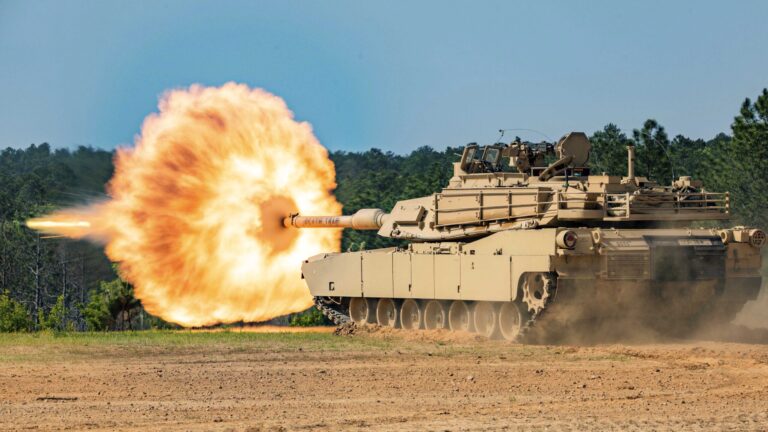
Yet a stark gap remains between the Army’s vision and the hardware currently in its Armored Brigade Combat Teams. Today’s combat vehicles are largely analog machines retrofitted with digital add-ons, epitomized by the 45-year-old Abrams. After decades of layering new sights, armor, and electronics onto a 1970s chassis, the tank has reached its physical limits—prompting the Army to cancel the M1A2 SEPv4 in 2023 and accelerate the clean-sheet M1E3.
Close Battle and Mobility: Shedding 16 Tons to Survive the Modern Battlefield
The war in Ukraine has upended assumptions about passive armor. Cheap first-person view drones, fiber-optic loitering munitions, and top-attack anti-tank missiles have exposed the limits of bolt-on cages and external active protection systems, which add parasitic weight, raise the tank’s silhouette, drain electrical power, and create blind spots. In the M1A2, three of the four crew members still sit in the turret beneath thin roof armor. The M1E3 addresses these threats by design: an unmanned turret with an automated ammunition handling system relocates the three-person crew into the better-protected hull, while an integrated hard-kill active protection system provides 360-degree and high-angle top-attack defense.
That redesign also tackles an acute mobility crisis. Equipped with the Trophy Active Protection System, the fielded M1A2 SEPv3 weighs over 76 tons—exceeding the capacity of most European and Indo-Pacific bridges and pushing tactical bridging and recovery assets to their engineering margins. The result is predictable chokepoints easily targeted by enemy precision fires. Targeting a combat weight of roughly 60 tons, the M1E3’s 14-to-16-ton weight reduction is designed to restore the strategic, operational, and tactical tempo required for large-scale combat.
A Networked Node, Not an Island: Open Architecture and Hybrid Power
In an MDO environment, convergence demands that platforms plug seamlessly into the broader kill web. Whereas upgrading the SEPv3 requires lengthy depot overhauls, custom power converters, and tangled wiring harnesses, the M1E3 incorporates a Modular Open Systems Architecture (MOSA) from the outset. Software-defined upgrades can be fielded in weeks rather than years, and integrated battle management and automated targeting aids allow the crew to act on feeds from unmanned aerial systems and robotic ground vehicles without cognitive overload.
Endurance presents an equally pressing challenge. The M1A2’s AGT1500 turbine engine burns fuel even at idle, tethering armored brigades to slow, conspicuous divisional fuel convoys that are prime targets for loitering munitions. The M1E3’s hybrid diesel-electric powertrain cuts fuel consumption by 50 percent and shrinks the logistics tail. High-capacity batteries enable silent watch—running sensors, communications, and counter-UAS suites with the engine off—and allow short-distance movement with a near-zero acoustic and thermal signature, while a high-voltage architecture provides surplus power for future upgrades.
The Cost of Standing Still and the Industrial Base
While some critics argue that constrained defense budgets should prioritize air defense, long-range fires, and munitions stockpiles, advocates contend that deferring the tank is a false choice. Sustaining the aging M1A2 fleet requires escalating custom engineering patches and depot overhauls whose costs will soon outstrip the amortized development and procurement price of the M1E3.
Fielding the new tank also carries major industrial stakes, providing a predictable workload for the Joint Systems Manufacturing Center in Lima, Ohio, and its nationwide supply chain—transforming a 20th-century overhaul depot into an advanced manufacturing hub. Because future land wars cannot be won solely with stand-off fires or cheap consumable mass, close battle remains, in LaNeve’s words, “not a relic of an earlier age.” With the Army having defined how it intends to fight, the burden now falls on Congress and Pentagon leadership to field the M1E3 and give the force a tank capable of executing that vision.