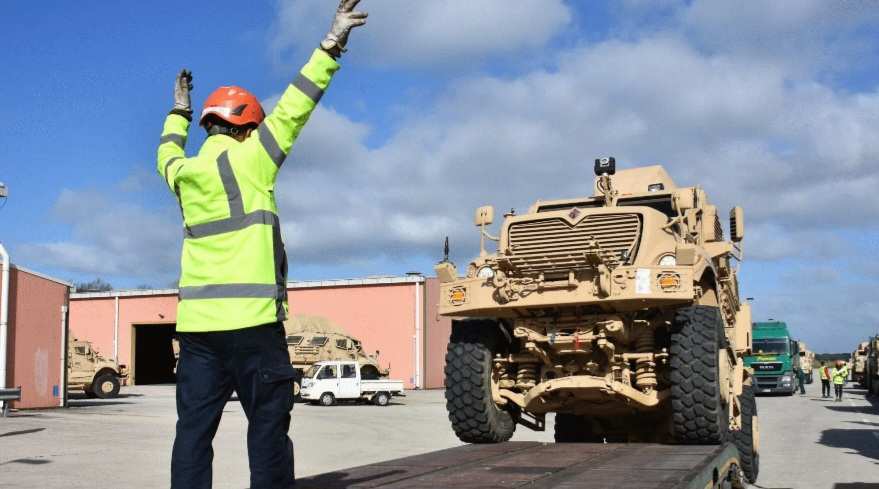
“Think about Ukraine as an island … we are not allowed to cross the border,” the AMC’s deputy Lt. Gen. Christopher Mohan told Breaking Defense during a December 2023 interview.
“Their lines of communication are contested, like we know we’re going to have in the South China Sea, so we should look at it from that same lens,” he later added.
The AMC team has spent the past two years, in part, overseeing the transfer of more than $13 billion in equipment and weapons to Kyiv and helping the Eastern European nation maintain those weapons from a distance. Some of that maintenance support has included a phone-a-friend model, or telemaintenance, a setup Mohan and some acquisition officials contend will be critical to supporting the US force in the Indo-Pacific, and potentially partner nations using US equipment.
While walking a friendly nation through repairs by phone is hardly a new model, Mohan said the service previously didn’t have a “codified” process in place, and leaders are now reflecting on just what doctrinal changes they need to make to take this model down to the tactical level.
“How do we sustain exquisite weapons systems, future weapons systems and current weapon systems in a highly lethal, very dispersed battlefield?” the three-star general asked. “And then, how do you couple that ability to do that over-the-shoulder telemaintenance with autonomous delivery, for example?”
That potential use of drones, autonomous vessels and robots to provide spare parts to the battlefield is one area Mohan is keen on diving deeper into this year. He said he is looking to “bake” them into exercises in the Indo-Pacific region in 2024.
Pieces Already On The Board
In addition to a look at telemaintenance procedures, Mohan and other leaders are continuing to grapple with an array of stockpile questions after watching Ukraine burn through munitions provided by US and other friendly nations. One key to any future US engagement could be, for instance, US Army Prepositioned Stockpiles [PDF], or APS, that the service currently has seven spread out around the globe.
Those are designed to be used for everything from large-scale exercises to quickly outfitting soldiers with items like M1 Abrams tanks or wheeled vehicles if a military conflict arises. That list includes APS-1 designated for the US, APS-2 for Europe, APS-3 afloat, APS-4 for Northeast Asia, APS-5 for Southwest Asia, APS-6 for Army South and APS-7 for Army Africa.
Mohan said he is a proponent for expanding land-based equipment numbers in the Indo-Pacific region to reduce transit times and avoid hurdles like agricultural inspections. But it has to be done very “carefully.” (The service recently said it plans to keep additional military equipment in Australia for that very reason).
“When that APS is floating around on a ship that says, ‘US Navy’ on the side of it, we have a lot of decision space [but] when put it in other countries, the complexity from a geopolitical standpoint, goes up,” Mohan said.
Part of that calculus, he added, involves simply drilling down to what APS is and isn’t, and reducing the logistical footprint and/or need for fuel, water and even ammunition. Then enters in the geopolitical work of striking bilateral deals with countries in the region over what they will allow on their shores and how it’s sustained.
“We’ll have a different formula for each country that we want to operate in from a sustainment standpoint,” he added. “Country X [may be] really interested in us being able to put humanitarian assistance, disaster relief stuff on the ground … [but] not so much for lethal aid. We’re gonna have to work through that.”
Stockpiling Vs. Rapid Production
While prepositioning stocks in key areas will remain a topic for internal and external stakeholders, the Army and senior most Pentagon leaders are also debating just what equipment levels it needs to have on hand versus having the ability to quickly scale production.
As one senior US senior defense official put it, the wars in Ukraine and Gaza have only propelled that debate.
“Is it a stockpile or is it a production line that’s hot or cold or warm?” the official told a small group of reporters at the Pentagon in early December. “Is it one or the other? It’s probably a mix.”
That conundrum is not relegated to the Army, but senior leaders inside the service are focusing on that question as they weigh just how much to invest buying weapons and ramping up production lines like the 155mm rounds used in Ukraine and ones better suited for the vast distances in the Indo-Pacific region. Those investments include boosting the service’s organic industrial base (OIB) and enabling industry to increase production capacity.
Army acquisition chief Doug Bush is one of those people working the issue. Although he is a proponent for boosting Army stockpiles as an “insurance policy” and deterrence, at a Defense One event on Dec. 7, 2023, he discussed the tradeoffs between manufacturing and storing those weapons and having the machines and components in place to quickly produce them if needed.
When it comes to supporting a larger munitions stockpile, he explained that it comes at a cost for housing them, moving and maintaining the rounds, especially those precision rounds.
“Artillery shells are relatively easy to maintain over time but when you get into precision weapons and have a lot of computer parts … that’s not an insignificant cost,” Bush told the audience.
“There’s a balance there between how much you want on the shelf that you have to kind of pay for keeping in inventory … versus what you can start producing when you need it,” he later added.
The “long-pole in the tent” to this latest munition ramp up, has been acquiring the machines and tooling to produce them, Bush said. There’s always concern, though, over having to “mothball” those machines and subcomponents, and if the service doesn’t need to scale production for 30 years, an entirely new weapon system is needed.
One potential way to reach a compromise between stockpiling and production: production outside the US.
Mohan pointed to Pentagon plans to support additional US weapons and parts being produced abroad like the recent announcement with Australia to produce Lockheed Martin’s Guided Multiple Launch Rocket System (GMLRS) munitions down under. Or a recent deal with India to co-produce Stryker armored vehicles there.
Such future deals in the Indo-Pacific region could also be less sexy and focus more on niche manufacturing capability to help support the prepositioned stocks and lessen the strain on domestic production, the three-star general said.
“That might not be perfect, but it could be just good enough,” Mohan added.