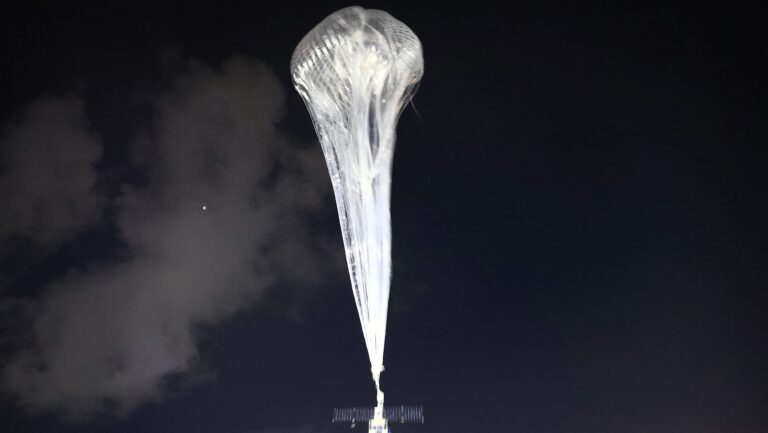
After scrapping a large-scale high-altitude balloon demonstration in the Indo-Pacific last year and redirecting the assets to the Middle East, the U.S. Army has drawn several lessons for future experiments. The balloons were used in support of U.S. Central Command operations, although officials have not disclosed the locations or specific mission scenarios.
“We were asked to pivot and combine experimentation with operations. We made that shift and supported missions in CENTCOM,” said Andrew Evans, director of the Strategy & Transformation Office within the Army’s intelligence staff. He said the systems were effective for the missions assigned to them.
From a handful of balloons to simultaneous swarms
The Army has tested high-altitude balloons several times over the past few decades and has renewed efforts in recent years to use them for battlefield sensing and communications.
Past tests generally involved one or two balloons. For 2026, the Army had planned to experiment with more than a hundred high-altitude balloons over waters in the Indo-Pacific. That plan did not go ahead, but smaller swarms were used in the CENTCOM region.
“From a scale perspective, we went from one or two to dozens simultaneously,” Evans said on the sidelines of the Association of the U.S. Army’s annual conference. The experience exposed three categories of challenges involved in operating autonomous balloons in a theater with active military operations.
Transport and storage create early pressure points
The first challenge was logistical: transporting the balloons to the Middle East and finding suitable storage conditions. Their sensitivity to temperature and environmental conditions creates additional handling and storage requirements, Evans said.
The second challenge concerns staffing and operations. The Army and joint force will need to consider more carefully what personnel structure is required to support these systems and which services vendors can provide.
Industry companies offered assistance, but moving capabilities between theaters with different requirements revealed potential friction points: what the military must manage itself and what can be provided by industry. Amid ongoing regional operations, the military had to retain control over how the systems were used to ensure compliance with applicable authorities and rules.
Evans also noted that few personnel are trained to operate the balloons. The lessons learned will inform future planning.
Airspace coordination remains a persistent concern
The third challenge involves airspace control. Integrating uncrewed platforms into airspace shared with crewed military aircraft and commercial planes continues to pose difficulties.
The official did not elaborate, but said the challenges were not new; they were a recurring observation.
Balloons, solar gliders or pseudo-satellites?
Army leaders believe they need stratospheric sensing capabilities, but have not yet decided what kind of platform should provide them.
Options under consideration include balloons, solar-powered gliders and pseudo-satellite systems. “It’s unclear. No decision has been made,” Evans said.