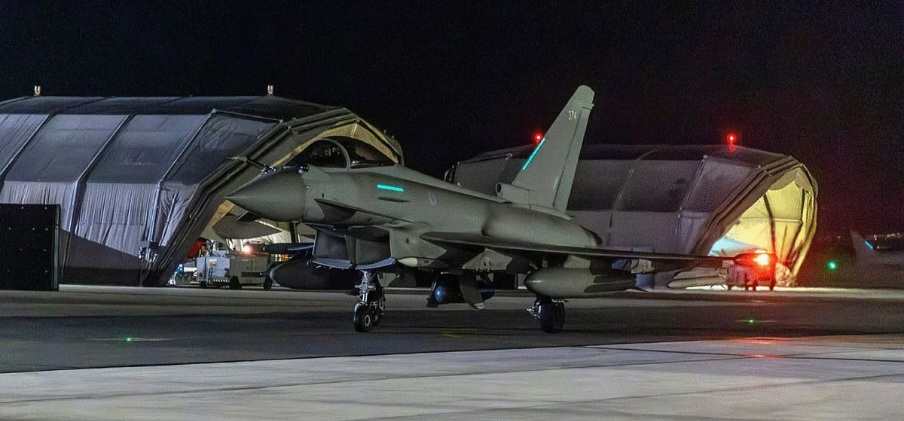
The strikes, launched by the two nations on Thursday evening with support from Australia, Bahrain, Canada and the Netherlands, were in response to a series of Houthi attacks on maritime shipping vessels in the Red Sea, officials from both countries have stressed, and were meant to degrade the militant group’s capabilities. And, analysts agree, no more than that.
“There is no clear indication at all that the US and UK have moved from defense to offense in the region against the Iranian proxy network,” said Behnam Ben Taleblu, senior fellow at The Foundation for Defense of Democracies think tank. “Operation Prosperity Guardian still is centered around a defense mission and denying the Houthis the ability to successfully target and harass commercial vessels.
“Make no mistake, this was not an escalation by Washington and London. This was an attempt to defend freedom of navigation and impose costs on the Houthis as well as attempt to achieve some sort of parity with the group for the 25-plus attacks” it has purportedly conducted since Oct. 7. (The US has stressed Thursday’s strikes were independent of Prosperity Guardian, which officials say is purely defensive in nature.)
The Biden administration deemed the strikes necessary as a means of sending a “clear message that the United States and our partners will not tolerate attacks on our personnel or allow hostile actors to imperil freedom of navigation in one of the world’s most critical commercial routes.”
In the aftermath of the strikes, the UK Ministry of Defence said today that “detailed results” are under examination, “but early indications are that the Houthis’ ability to threaten merchant shipping has taken a blow, and our commitment to protecting the sea-lanes, through which some 15 [percent] of the world’s shipping passes and which is vital to the global economy, has been amply demonstrated.”
Analysts told Breaking Defense that the strikes are significant largely because they are the first of their kind, on the part of Washington, since USS Nitze, an Arleigh Burke-class destroyer, launched cruise missiles targeting three radar missile sites along Yemen’s Red Sea coastline in 2016.
Even so, the newest strikes do not represent a switch in strategy by the US and its allies to abandon their defensive posture in the Middle East, escalate matters to the point of agitating Iranian proxies or widen a regional conflict, said the experts.
“These strikes were telegraphed well in advance, and appear to have been targeted only at military capabilities, such as radar sites and weapons storage sites,” said David Des Roches, associate professor at the Near East South Asia Center for Security Studies. “There are no reports of strikes against Houthi leadership or command centers.
“This would indicate that the Biden administration and the coalition it has built is focused on the narrow goal of preventing further attacks on civilian shipping, not on entering the Yemen conflict in a big way or overthrowing the Houthi occupation of northern Yemen,” he said.

The UK Royal Navy’s HMS Diamond, Type 45 destroyer fires Sea Viper missiles in the Red Sea. (UK MoD)
Bryden Spurling, senior research leader for defence and security at RAND, said that there “was clearly reluctance [on the part of Washington and London] to strike the Houthis despite the threat they pose to one of the world’s most important waterways.”
He suggested such political thinking “reflects broader caution from the US and UK about the risk of widening the Middle East conflict,” and considered such risk “low” on the basis that “no country on either side of the dispute really wants things to escalate further, even after these strikes.”
Kristian Coates Ulrichsen, Fellow for the Middle East at Rice University’s Baker Institute, struck a similar tone.
“There remains no regional appetite, on either side of the Gulf, for an escalation of the Israel-Hamas conflict, and the strikes in Yemen go against the de-escalatory dynamics that have been so evident since 2022,” she said in a statement to Breaking Defense. “Much may depend on whether the strikes were a one-off or will be part of a larger campaign, and of how and where the Houthis respond.”
The Houthi response has been swift, at least in terns of rhetoric, with the militants Supreme Political Council saying today, “all American-British interests have become legitimate targets,” according to CBS News.
The New York Times, quoted a senior Houthi official, reacting to the US and British strike campaign, as committing, “the biggest folly in their history.”
Those comments fit with analysts who say that the Iranian backed group is unlikely to be deterred by the strikes.
“I would be surprised if the Houthi’s don’t retaliate in some fashion because they don’t typically take a step back … and this [move by the US and UK] really fits into their domestic narrative and portrayal of themselves as standing up against powers attempting to dictate into ‘our’ region,” said Douglas Barrie, senior fellow for military aerospace at the UK-based International Institute for Strategic Studies think tank.
Recent Houthi history, including surviving a civil war and the Saudi-led intervention means the group “probably” holds “a lot of faith in their own resilience,” so deterrence won’t work, suggested Spurling, though cautioned “they’d be foolish to take lightly the power the US and its partners can bring to bear.”
In a call with reporters on Thursday evening after the strikes, a senior US official appeared to acknowledge the strikes are unlikely to be the end of things.
“You know, as to whether this will merely degrade or also deter, I guess I can’t do better than what the President has said, which is that he will not hesitate to direct further measures to protect our people and the free flow of international commerce as necessary,” the official said. “So this may well not be the last word on the topic. And when we have more to say and more to do, you will hear from us.”