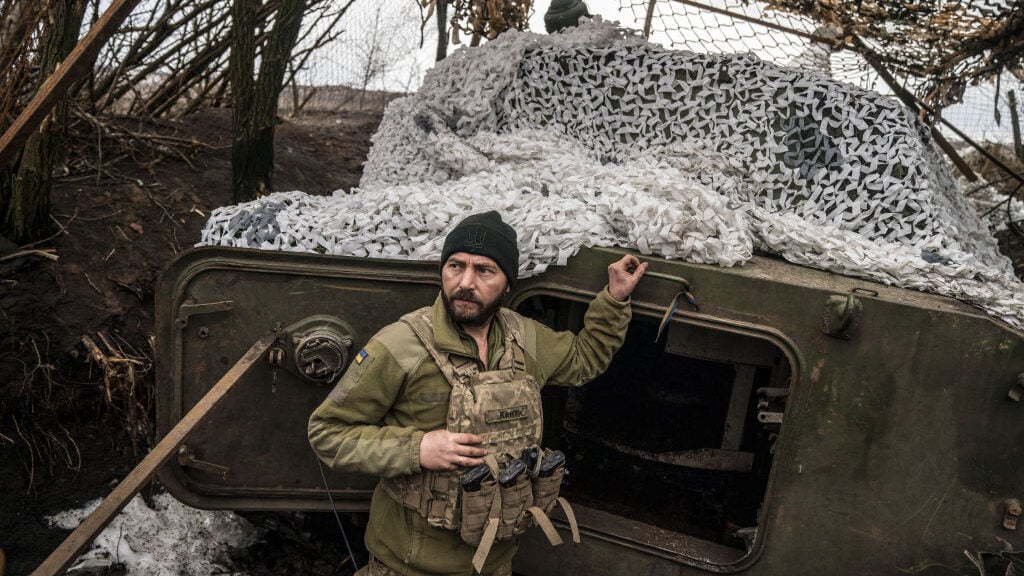
The war has not gone the way Russian President Vladimir Putin has hoped, but it’s far from over. In this op-ed, Joshua Huminski of the Mike Rogers Center for Intelligence & Global Affairs says that leaders in Washington, Kyiv and capitals in between must face tough questions, now, about what the future of the conflict will hold.
As the war in Ukraine enters its third year this month, the conflict poses a number of key questions for Kyiv and its international allies – ones that could determine the course of the war over the next several years, as it looks increasingly likely to last at least that long.
For months now both sides have settled into a tragic and costly stalemate, and it is unlikely the frontlines will move that much in 2024. From Russia’s side and barring any significant battlefield developments or indeed political change within the Kremlin—President Vladimir Putin will assuredly win reelection in March—the “special military operation” will continue with the Kremlin pursuing maximalist aims.
Ukraine, of course, will continue the defense of its homeland, with the aid of Western weapons and, crucially, ammunition regardless, at least for a time, of political machinations, particularly in Washington.
But larger, strategic questions about the conflict and its course remain and are coming into sharper and sharper relief as America’s attention is pulled to the Middle East. With the threat of domestic “Ukraine fatigue” rising, here are four considerations that policymakers from Washington to London to Kyiv must keep front and center in their calculus.
What is Kyiv’s Theory of Victory?
The central question, and one that Ukraine cannot answer alone, is what its theory of victory? From this question all other answers flow. As the war enters its third year, Kyiv and its Western backers agree that victory is necessary, but there is no clear path from here to victory, or what precisely constitutes a militarily achievable, politically viable victory.
The present course of action suggests that neither Kyiv nor Moscow will achieve their maximalist objects—the recovery of all territories including Crimea for the former or the subjugation of its neighbor for the latter. The war risks heading toward a much longer conflict than Western capitals had recognized or were willing to accept until very recently. Consequently, short-term planning and policy thinking focused on red herrings like specific arms platforms and not what “winning” meant in practice.
In the absence of a clear Ukrainian or Western strategy, the balance would seem to favor Russia in the near-term: If it cannot conquer the entirety of Ukraine, it can certainly keep the country off-balance and drain resources. This may well constitute a measure of victory within the walls of the Kremlin but will fail to live up to Putin’s rhetoric of total victory. Indeed, reports suggest that Putin remains intent on achieving the war’s maximalist original aims, even if he recently said—almost certainly disingenuously—in an interview he’s “ready” for a dialogue with Washington about Ukraine’s fate.
For Ukraine, continued survival and independence is in its own way a significant victory, as is the unification of the country’s national identity. These are, however, coming at a high price. The extent of Ukraine’s losses is estimated to be high, and its remaining forces have been at war for nearly two years. Mobilizing additional soldiers, as the armed forces has requested, will prove increasingly difficult politically for President Volodymyr Zelenskyy, even more so if progress is not seen or believed. That Ukraine will fight on is not in question.
While the frontlines according to the now former Ukrainian military commander Valerii Zaluzhnyi, are at a stalemate, successes are nonetheless achieved. Tactical and operational wins, such pushing Russia’s Black Sea Fleet from Sevastopol and downing of Russia’s AWACS A-50 aircraft continue to degrade the Kremlin’s forces and boost Ukrainian morale, and re-shape the broader strategic context, such as the Black Sea’s operational environment.
But what, in the end, is the balance Kyiv is willing to strike between what it wants to achieve (and at what cost) and what it actually can?
How Will Brussels Proceed With Ukraine’s NATO Dream?
Regardless of, and in the absence of, decisive battlefield successes, it is imperative that Ukraine’s path toward membership in NATO and in the European Union continue to make progress. Brussels is working towards this end, as are key drivers in Berlin and Paris. This is an almost entirely bureaucratic and long-term effort, but it is critical to ensuring Ukraine’s future security and defense.
Accession to these multilateral bodies is a significant signal of Western political commitment and resolve to Ukraine’s future. NATO membership, for example, is in many ways a precursor for European Union membership with the former providing security guarantees for the latter’s economic integration.
The pathway forward for Ukraine’s entry into NATO requires careful consideration and calibration from Brussels, particularly on security guarantees and Article 5 commitments. Policymakers across Europe and in Washington will have to weigh difficult factors like what affect any such discussion will have on Russia’s operational plans and whether accession for an at-war nation is even plausible.
EU integration and the reconstruction of the country will prove more challenging as Russia continues to launch missiles and drones against critical infrastructure such as Ukraine’s power grid. Making the business case for investing in Ukraine is certainly more difficult given the attendant risks.
Does Ukraine Reconstitute Forces Or Go On The Offensive?
The answer to this question for Kyiv is naturally not binary, but it will dictate how Ukraine allocates forces and increasingly uncertain resource flows. This answer is intimately tied to pace and consistency of aid from the United States. At present the uncertainty over whether the United States will continue to support Ukraine and at what scale sharply curtails Kyiv’s ability to forward plan for the mid-term.
While Europe can and will step in to the gap, European defense industries are lagging now. Production will increase and deliveries will pick up in the latter half of the year but are insufficient at present to offset any downturns from America.
Kyiv will likely adopt a strategy of “active defense” in the words of one American defense official. Under this approach, Ukraine’s forces will hold current defensive positions while reconstituting its forces, train and retrain soldiers, and integrate newly arriving equipment. Kyiv’s armed forces will, at the same time, probe for weaknesses in Russian lines while exploiting long-range strikes against Moscow’s rear operating and logistics positions. This will allow Ukraine to challenge and ideally prevent Russia from concentrating its forces.
This “active defense” strategy will, however, face political pressures to demonstrate progress on the battlefield. Certainly, within the United States the debate about supporting Ukraine becomes much more difficult—given the lack of familiarity with military and defense matters—if progress is not clearly being made on the battlefield.
The speed with which the narrative about Ukraine’s counteroffensive shifted from underserved optimism to hopeless pessimism is instructive. It is easier to support an ally on the march than one on the defensive or retreat.
Will the West’s Arms Delivery And Political Will Continue?
The onus for answering this question lies almost exclusively, but not entirely, in Washington. Europe’s commitment to Ukraine, absent outliers like Hungary, remains solid. The current European Union support package to Ukraine, while stalled, will eventually advance.
America’s commitment is, however, much less clear. The political sclerosis in the United States and the possible re-election of former President Donald Trump are introducing a complicating variables into the equation of Ukraine’s defense. Congress is, at the moment, tying additional aid to domestic priorities such as the southern border. Trump has made no secret of his desire to end the war in Ukraine, which would almost certainly entail a suspension of aid and support. His recent comments about his willingness to uphold Article 5 for NATO countries that do not meet the 2 percent of GDP spending (and inviting Russia to “do whatever the hell they want”) do not inspire confidence about America’s direction under his leadership.
American political unreliability is, therefore, creating Ukrainian strategic uncertainty. While Europe is working to fill the gap, continental defense industries have not yet met expectations or commitments and likely cannot fully fill the void left by an American suspension of support. The European Union is auditing the delivery of arms to Ukraine in response to claims that the bloc isn’t sending enough or as much as it could. Determining what remains available to send to Ukraine from Europe is vital, especially as the commitment from the United States appears to be wavering and at risk in the second half of 2024.
In many ways, what matters more about the delivery of arms is the narrative of long-term support to Ukraine that these commitments demonstrate. If Western resolve is in question, it bolsters Russian assumptions that it can merely wait out an indecisive West and secure victory in 2025 or 2026. Long-term commitments and short-term deliveries of Western military arms undercuts this narrative.
The United States and Europe also need to both accept the fact that this is a much longer-term conflict than they had expected or prepared for, and communicate this to their respective domestic audiences without hyperbole, but with candor. Challenging at the best of times, but especially when the United States, United Kingdom, and Europe, among others, are heading to the polls, but the surest way to undercut the risk of ‘Ukraine fatigue’ is to articulate what success looks like and why it matters, but not regress toward cliché and cheerleading.