In the midst of the day, Beirut was shaken by three sonic booms caused by Israeli jets, breaking glass windows and causing chaos among civilians. This display appeared designed to send a clear message to Hezbollah, as the region remains on edge, anticipating whether—more likely when—the Lebanese-based group will retaliate against Israel.
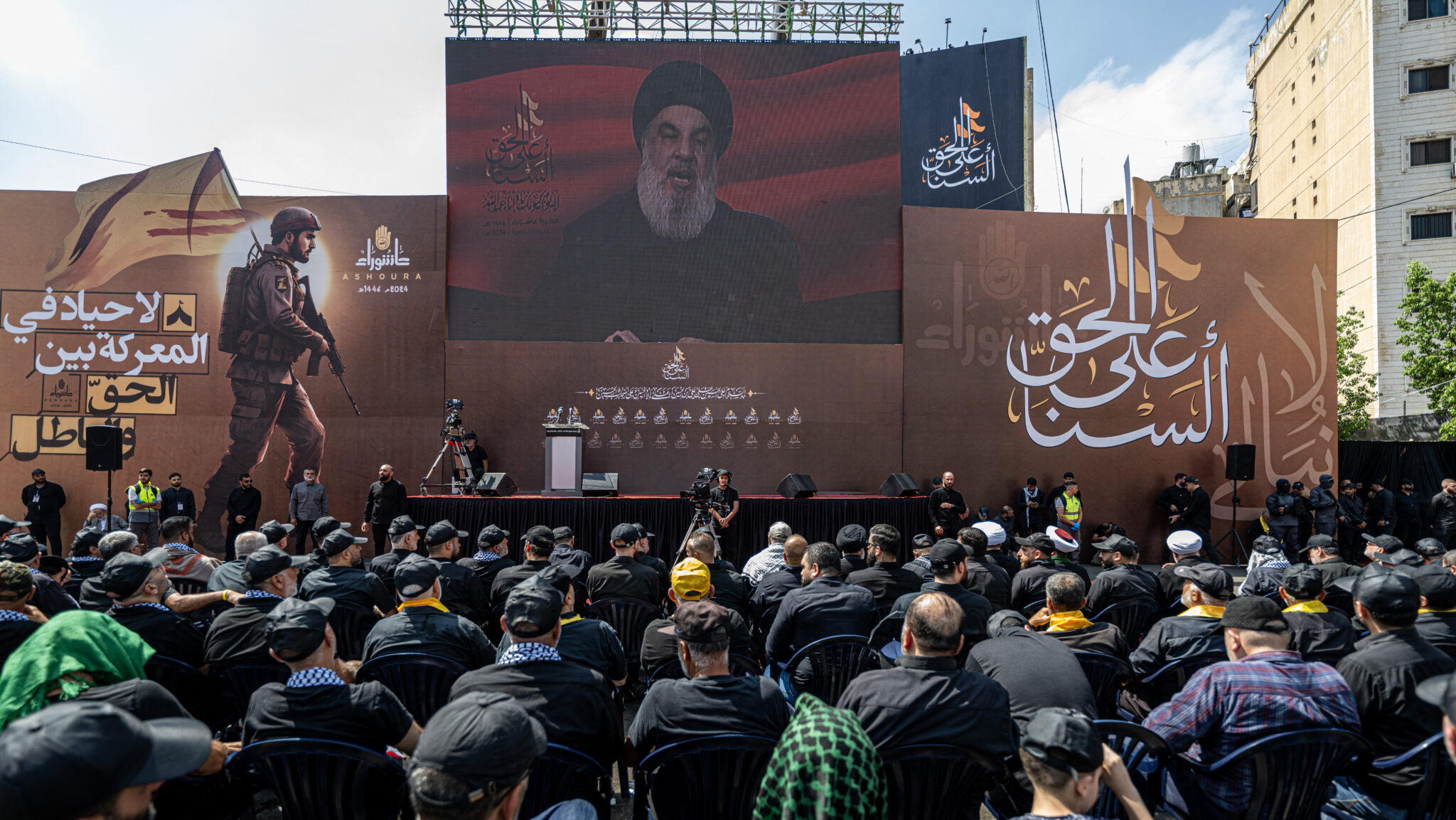
This show of force coincided with a speech by Hezbollah Secretary General Hassan Nasrallah, who was set to address the one-week memorial for Fuad Shukr, a high-ranking Hezbollah officer killed in a July 30 Israeli strike in the suburbs of Beirut. In his opening remarks, Nasrallah dismissed the Israeli actions as “very childish” and assured his audience that the conflict would come on Hezbollah’s terms.
“Our response is coming, and it will be strong and effective,” he stated emphatically. “Regardless of any consequences, the [anti-Israel] resistance cannot allow the assassination to go unpunished. God willing, our response will arise, whether independently or alongside the axis [of resistance],” he emphasized, referring to the coalition of Iranian-backed groups.
Although Nasrallah did not provide a specific timeline for the retaliation or confirm whether it would be a coordinated attack from both Iran and Hezbollah, he mentioned that, “The Americans believed Iran would respond at dawn on Monday, but that turned out to be untrue. The Israeli anticipation of the response is part of the response itself and the punishment, as the battle is psychological, moral, and military.”
He acknowledged Shukr’s assassination as an „Israeli achievement,” yet insisted it was not a „victory.” Describing Shukr’s killing as a “significant loss,” he asserted that it would not weaken Hezbollah.
The strike on Shukr, who had been designated by the U.S. Department of State as “a Specially Designated Global Terrorist” for his alleged role in the bombing of a U.S. Marine Corps barracks in Beirut during the 1980s, marked only Israel’s second attack on Beirut since the escalation of the regional conflict following the October 7 attacks in Israel.
On the Ground: Rising Tensions on Both Sides of the Border
In South Lebanon, empty villages, ruined crops, and mounting fears about the future loom large. In Northern Israel, towns are deserted, and discussions about potential war with Lebanon are rampant. Iran has also pledged to retaliate for the assassination of Hamas political chief Ismail Haniyeh, who was killed in Tehran shortly after the strike on Shukr. Iran’s supreme leader, Ayatollah Ali Khamenei, declared last week, “We consider it our duty to take vengeance” for Haniyeh’s death, referring to him as a “dear guest in our house.”
“The current objective of the battle is not to eliminate Israel but to prevent it from achieving victory,” Nasrallah remarked. He emphasized that “no one in Lebanon or beyond should expect us to normalize [the Israeli strike on Beirut].” With the clashes intensifying along Lebanon’s southern border with Israel and rising fears that these skirmishes could escalate into full-scale war, Nasrallah argued that “the Israeli threat cannot be faced by sticking one’s head in the sand and avoiding the storm, as the enemy [Israel] operates without red lines. What is needed is confrontation, not hesitation and submission.”
In the week following these events, many countries have urged their citizens to leave Lebanon amidst increasing concerns over potential escalation. Beirut’s International Airport has experienced crowded departure terminals over the past few days as numerous individuals attempt to flee the country.
Consequently, the region—and the people of Lebanon—remain in a state of uncertainty.