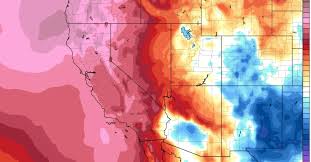
Southern California is preparing for a heat wave that is expected to bring triple-digit temperatures to much of the region throughout the week. The weather pattern, driven by weak offshore winds and a heat dome over the southwestern United States, will cause temperatures to rise steadily before peaking on Thursday and Friday. Areas within the Los Angeles Basin might reach as high as 113 degrees by the weekend, while the Coachella Valley could see temperatures soar to 119 degrees.
“We are in what’s already the hottest time of the year climatically, and we are going to be 10 to 15 degrees above normal in almost every area from the beach to the deserts,” explained meteorologist Ryan Kittell from the National Weather Service’s Oxnard office.
Labor Day saw many communities experiencing extreme heat, with forecasts indicating that the San Gabriel Valley would hit 100 degrees, and parts of the western San Fernando Valley could see temperatures as high as 103 degrees. Conversely, neighborhoods in Los Angeles closer to the coast were expected to enjoy milder conditions, with temperatures in the 80s and low 90s.
Woodland Hills, often recognized as the hottest spot in L.A., is anticipated to reach temperatures of up to 109 degrees on Tuesday, 110 degrees on Wednesday, and 113 degrees on Thursday, before slightly declining to 111 degrees on Friday. In Santa Clarita, temperatures were expected to jump from an uncomfortable 95 degrees on Monday to a steamy 106 degrees by Thursday. Meanwhile, Palm Springs, with Labor Day temperatures between 107 and 111 degrees, could see a rise to 114 to 118 degrees by Thursday.
UCLA climate scientist Daniel Swain noted that the summer of 2024 is likely to be recorded as one of the hottest or second hottest on record, even though many Californians might not have perceived it that way.
“The most densely populated parts of Ventura, L.A., Orange County, and San Diego—really, all those counties west of the mountains—had a summer that fell right in the middle of historical norms,” Swain stated.
In contrast, inland temperatures compensated for this. Swain commented that the thin margin between a record-breaking summer and a typical one could be as little as 30 miles. Areas like Palmdale and Palm Springs “remain very hot, still managing to break records.”
“If you lived on Ocean Beach in San Francisco or Santa Monica, that was not your experience,” he observed.
While summer is generally the hottest season inland, coastal California typically encounters its warmest temperatures in September or October. This week’s heat wave serves as a prime example of that trend.
“This week will likely be the hottest in L.A. city proper than it has been all summer,” Swain remarked.
Dangerously high temperatures are affecting a broad section of the country, including Nevada and Arizona. Kittell indicated that because the days are shorter now compared to June and July, desert regions experience less sunlight, resulting in smaller temperature differences between them and coastal communities.
He advised those living near the beach without air conditioning to prepare for the impending heat. “Make plans now for how you are going to stay cool,” Kittell urged.
Temperatures are expected to ease slightly over the weekend, but it remains uncertain when the heat wave will ultimately conclude.
Despite the discomfort, it is not anticipated that this heat wave will break records. The record for the first week of September was set in 2020, with temperatures reaching 121 degrees in Woodland Hills.