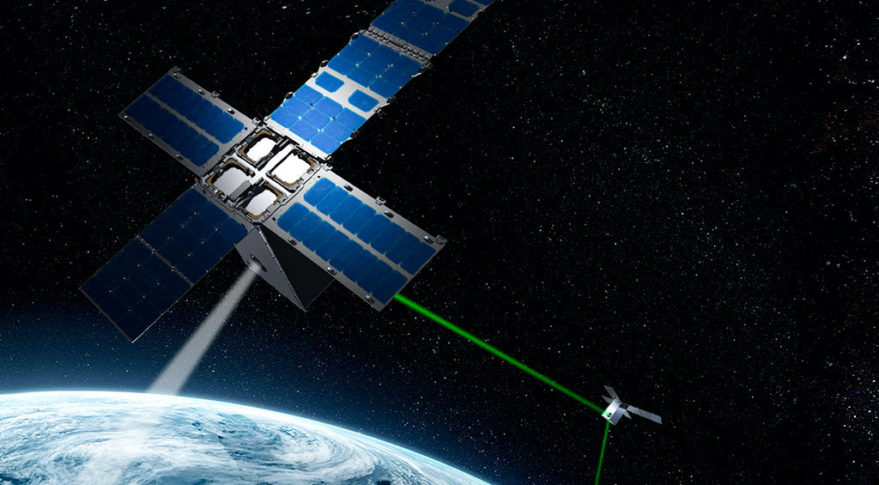
The Space Development Agency (SDA) Director Derek Tournear announced today that the agency has successfully demonstrated the capability of its optical communications terminals to connect satellites—an achievement he has recognized as a critical hurdle for the planned mesh network of data transport and missile warning/tracking satellites operating in low Earth orbit (LEO).
“To date,” Tournear stated at the annual Defense News conference, “we had not demonstrated laser communication to enable that network formation—that’s what I intended to share. But last night, we actually accomplished it.”
This on-orbit demonstration involved laser communication terminals created by the German firm TESAT, utilized on two of the four missile warning/tracking satellites launched by SpaceX last year as part of SDA’s initial experimental constellation known as Tranche 0. “They successfully demonstrated their ability to perform laser communication. They maintained and acquired links, meeting the requirements of our optical communication standards, which stipulate a link acquisition time of under 100 seconds, with an aspirational goal of less than 10 seconds. They achieved well under the 100 seconds mark but were above the 10 seconds, maintaining that link for several hours,” he elaborated.
Optical intersatellite links are essential to the SDA’s ambitious Proliferated Warfighter Space Architecture, which will integrate hundreds of satellites in LEO with various military satellites and, eventually, with commercial satellites in different orbits. Tournear noted that SDA plans to utilize “translator satellites,” also referred to as “space exchange points” by the Space Force, to link its Tracking Layer satellites to the Space Force’s resilient missile warning/tracking constellation in medium Earth orbit.
The agency is also in discussions with commercial partners about employing hybrid communications terminals on the translator satellites to integrate their constellations, including collaborations with companies like SpaceX and Amazon regarding their respective Starlink and Kuiper broadband satellites, as well as intelligence providers such as Capella, Planet, and Maxar Intelligence.
Tournear emphasized that Tuesday’s demonstration of intersatellite laser links marked the successful culmination of a trifecta of key technical challenges facing the SDA. “From my perspective, we have addressed all major challenges and mitigated risks for Tranche 1 through Tranche 0, based on our success last night,” he asserted.
The first significant test evaluated the agency’s 19 Tranche 0 Transport Layer satellites now in orbit, designed for low-latency, high-bandwidth communications using the military’s traditional Link 16 data link to transmit information to ground, air, and sea-based platforms. In November 2023, the SDA successfully demonstrated this capability by transmitting signals to ground-based radios outside the United States, amidst ongoing discussions with the Federal Aviation Administration (FAA) regarding the safety of utilizing space-based Link 16 over U.S. territory where it could interfere with civilian air traffic radar.
While SDA officials have previously refrained from revealing the location of the Link 16 demonstration, Tournear confirmed that it took place in Australia. He also highlighted that similar downlinks were successfully conducted to a U.S. Navy aircraft carrier in international waters, along with a plane on the carrier’s deck, noting the complexity and difficulty of this feat compared to a flying aircraft.
Tournear added that the SDA aims to conduct “future tests” with Norway while awaiting certification from the Defense Department and the U.S. Navy (which leads the process) from the FAA to validate that the Link 16 radios on their satellites will not interfere with civilian systems, a lengthy process according to the official.
The second challenge addressed was determining whether missile tracking from LEO is viable. Tournear explained there had been considerable discussion regarding the ability to monitor dim, fast-flying missiles in the cluttered LEO environment when the satellites themselves were rapidly moving across the horizon. “We successfully demonstrated this capability,” he confirmed. “We’ve been able to detect numerous missile launches and have monitored rocket launches, including the reentry of Starship and various other activities.”
Starship is the heavy launch vehicle developed by SpaceX for NASA missions to the Moon and eventually Mars. The Space Force is also considering using Starship for transporting cargo to distant theaters. SpaceX achieved successful reentry during the fourth test of the Starship in June.
Tournear mentioned that while SDA’s Tracking Layer satellites haven’t yet tracked a „blue” hypersonic missile flight, this isn’t due to technical issues but rather the challenge of finding suitable windows for the currently operational four SpaceX satellites. He noted that there are four additional missile warning/tracking satellites built by L3Harris in orbit that are still undergoing testing, with data collection from those expected to commence later this month.
Looking forward, the next step for SDA involves launching its next set of Transport Layer and Tracking Layer satellites, known as Tranche 1, which will provide initial operational capabilities to warfighters. These launches are anticipated around the end of the calendar year, following a delayed schedule that originally aimed for an earlier launch this month.
“We will launch around the end of this calendar year, whether that’s before or after the New Year remains to be determined,” Tournear stated, acknowledging there are still risks associated with that timetable.