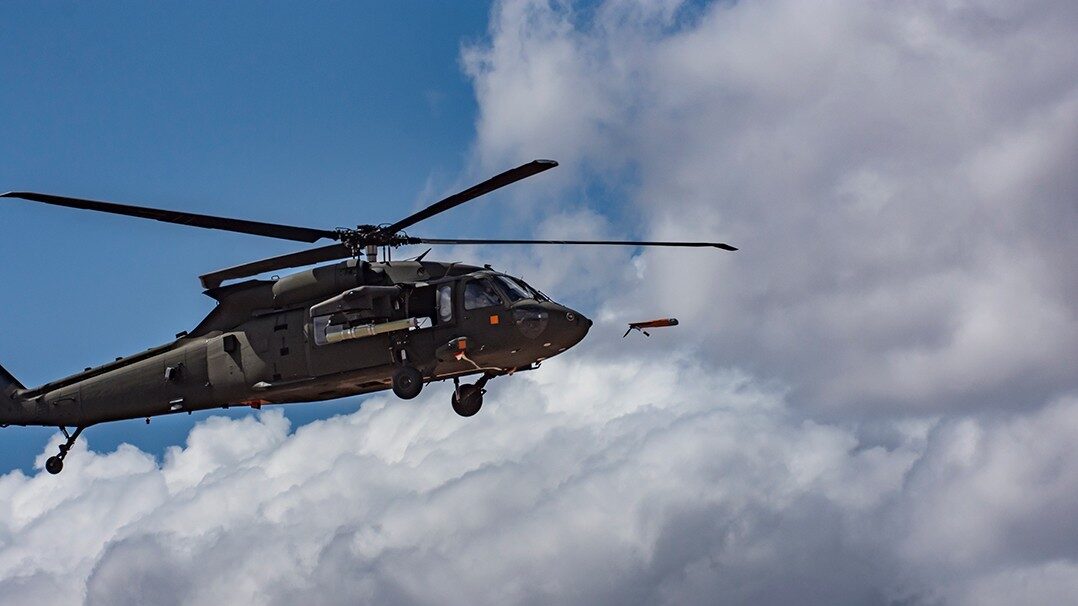
This month, the US Army is conducting extensive drone tests at Yuma Proving Ground as part of an initiative to evaluate future aviation needs. According to two one-star generals, the Experimental Gateway Demonstration Event (EDGE) 2024 commenced on Monday and is set to continue for over two weeks.
While specific details regarding the technologies being tested remain confidential, the event focuses on launched effects and unmanned aerial vehicles (UAVs). Key questions include their interoperability and resilience against electronic warfare jamming.
“We aimed to hone in on autonomy and behaviors in a contested environment,” stated Brig. Gen. Cain Baker, director of the Army Future Command’s Future of Vertical Lift Cross Functional Team. He noted that the event includes simulations of battlefield scenarios against replicated threats, challenging participating industries to complete mission sets within these parameters.
The Army has selected five companies to present 30 different launched effects and aerial drones at the event, with participation from sister services showcasing their own technologies.
Baker outlined a threefold goal for the demonstrations: to assess which capabilities perform well individually, identify effective weapon pairings, and analyze responses to threats. “The insights garnered from EDGE will directly inform our next set of requirements for launched effects or UAS,” he added, emphasizing that the outcome will drive subsequent acquisition strategies.
Adapting Strategy
As the Army works to integrate observations from the demonstration into its acquisition plans, leaders are reassessing its aviation weapons portfolio. The service has been navigating overlapping categories such as launched effects, loitering munitions, and drones, seeking clarity on each.
Brig. Gen. David Phillips, Program Executive Officer for Aviation, shared that the Army Requirements Oversight Council finalized an internal Abbreviated Concept Development Document earlier this summer. Although he was hesitant to disclose all specifics, he confirmed that the service is progressing with the search for short-range launched effects, while examining lethal payloads for medium-range options, and is in a holding pattern regarding long-range precision munitions.
For launched effects—small drones that deploy from larger platforms in mid-flight to gather intelligence or strike targets—the Army is considering three categories: short, medium, and long-ranging systems. Initially focused on medium-range development, the service has shifted to pursue a short-range variant concurrently.
The medium-range initiative involves collaboration with several companies, including Anduril Industries for the air vehicle (the Altius 700), Collins Aerospace for the mission system, and Aurora Flight Sciences as the integrator, alongside two unidentified companies developing payloads. Phillips noted that the program is working with the Program Executive Office for Missiles and Space to ensure appropriate lethality capabilities for medium-range options are developed swiftly.
Progress on a longer-range launched effect remains in the future, although Baker mentioned that the Marine Corps is testing a comparable “lethal” capability at EDGE to explore questions of connectivity and operational range.
Uncertainties remain regarding the fate of helicopter-launched long-range precision munitions (LRPM). While the Army seeks to enhance its AH-64 Apache helicopters with a longer-range weapon, it currently adopts the Spike Non-Line-Of-Sight missile system by Lockheed Martin and Israel’s Rafael as an interim solution. A planned meeting of the Army Requirements Oversight Council to address the direction for LRPM was postponed, potentially integrating discussions into the broader Abbreviated Concept Development Document.
Phillips did not provide clarity on the current alignment of LRPM within the launched effects framework but indicated that more decisions are forthcoming, contingent on technological assessments and requirement evaluations. “There’s more to be determined based on technological maturity assessments and our discussions surrounding capabilities,” he concluded.