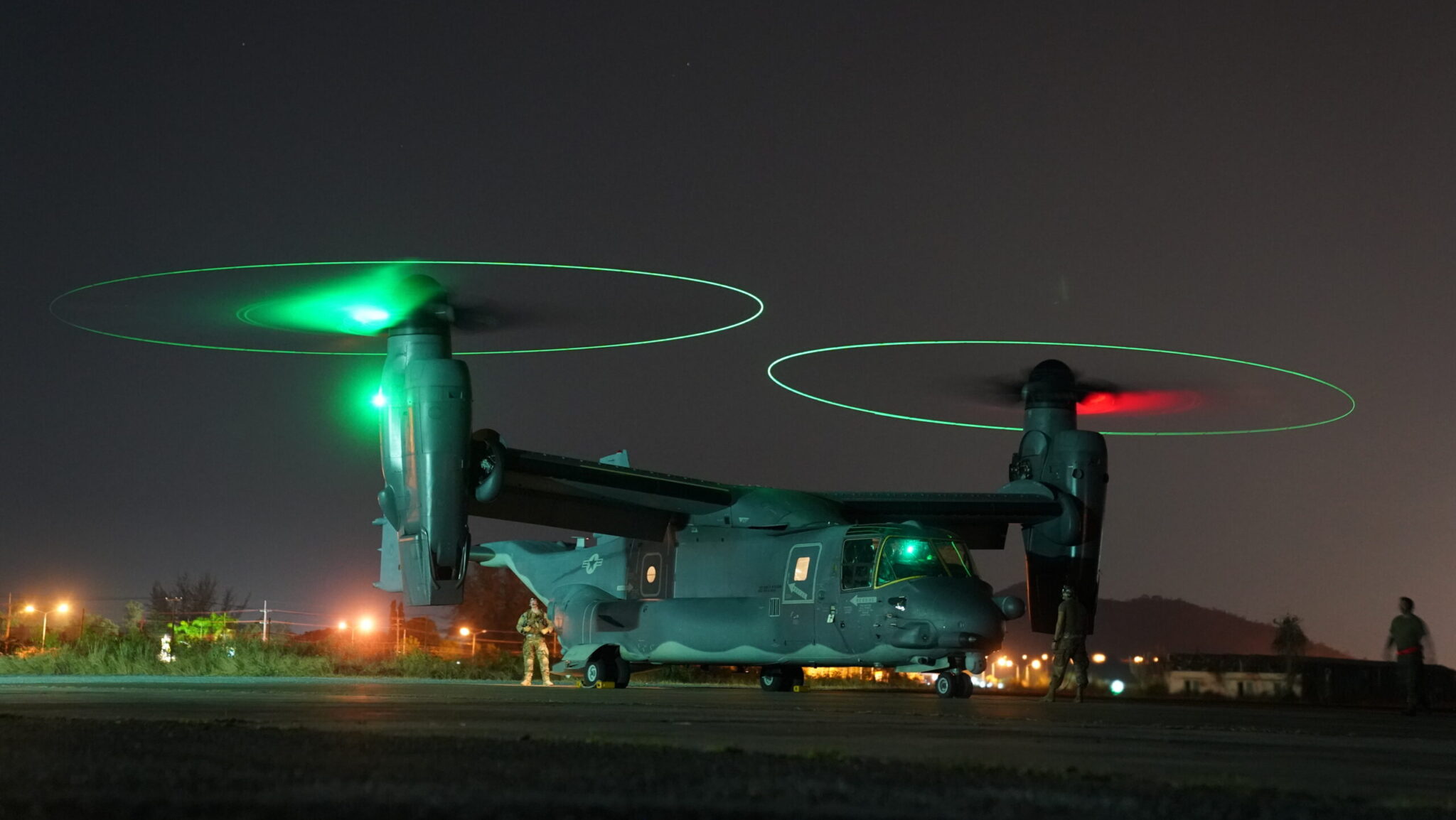
The Air Force CV-22 Ospreys are on track to be ready for deployment once again, marking the first such deployment since a tragic crash in November that resulted in the loss of eight crew members. Lt. Gen. Michael Conley, head of Air Force Special Operations Command (AFSOC), shared this update during a roundtable discussion at the Air Force Association’s Air, Space and Cyber conference.
Currently, approximately 60 percent of AFSOC’s CV-22 fleet has returned to full operational status, with expectations for the remaining aircraft to achieve readiness by late 2024 or early 2025. “The CV-22 units in Japan and the United Kingdom are almost back to full mission readiness. We will deploy out here in the coming weeks to support other geographic commanders,” Conley stated. He noted that while not all aircraft are operational yet, there is sufficient capacity and properly trained crews available to support battlefield capabilities.
Conley, who assumed leadership of AFSOC in July, opted not to disclose specific deployment locations for the Ospreys, only clarifying that they would not be sent to the Indo-Pacific or European theaters, where V-22 squadrons are already permanently stationed.
The Pentagon had grounded all Osprey variants in December following the tragic crash during a training mission off the coast of Japan on November 29. In March, the Pentagon authorized a phased return to flight for the Bell-Boeing-made tiltrotor aircraft, which included retraining crews, reviewing maintenance records, and implementing new emergency procedures aimed at enhancing flight safety.
In August, the Air Force released an accident investigation report concluding that the crash was due to a “catastrophic failure” of the Osprey’s proprotor gearbox. The report also indicated that actions taken by the aircrew contributed to the incident. In light of receiving multiple “left-hand proprotor gearbox (PRGB) chip burn” advisories, Air Force guidance had previously directed crews to land as soon as possible after three warnings during a flight. However, the new guidance now instructs crews to land “as soon as practical” after a single warning and “as soon as possible” after two warnings.
“At the end of the day, there will always be aircraft commander and crew discretion,” Conley said, emphasizing the unique circumstances surrounding each flight operation. “The environments are unique, depending on where we’re flying, what we’re dealing with. But we have tightened up the guidance to make it less ambiguous for crews.”
Historically, the Air Force has taken a more cautious approach to Osprey operations compared to the Marine Corps, sometimes suspending flight operations for safety concerns when the Marines continued their missions. Recent reports from Aviation Week indicated that the Air Force is contemplating taking over airworthiness authority for the CV-22 from Naval Air Systems Command (NAVAIR), which currently oversees Osprey procurement and support through the PMA 275 program office.
Regarding this potential transition, Conley deferred questions to Gen. Duke Richardson, head of Air Force Materiel Command. He noted that AFSOC’s relationship with NAVAIR and the Marine Corps remains strong, stating, “Over the last eight or nine months, we’ve looked at the program holistically. We’ve considered lots of things, and we’re still working through what is feasible and makes sense. I don’t think anyone’s close to a decision on whether we need to break from the current construct.”