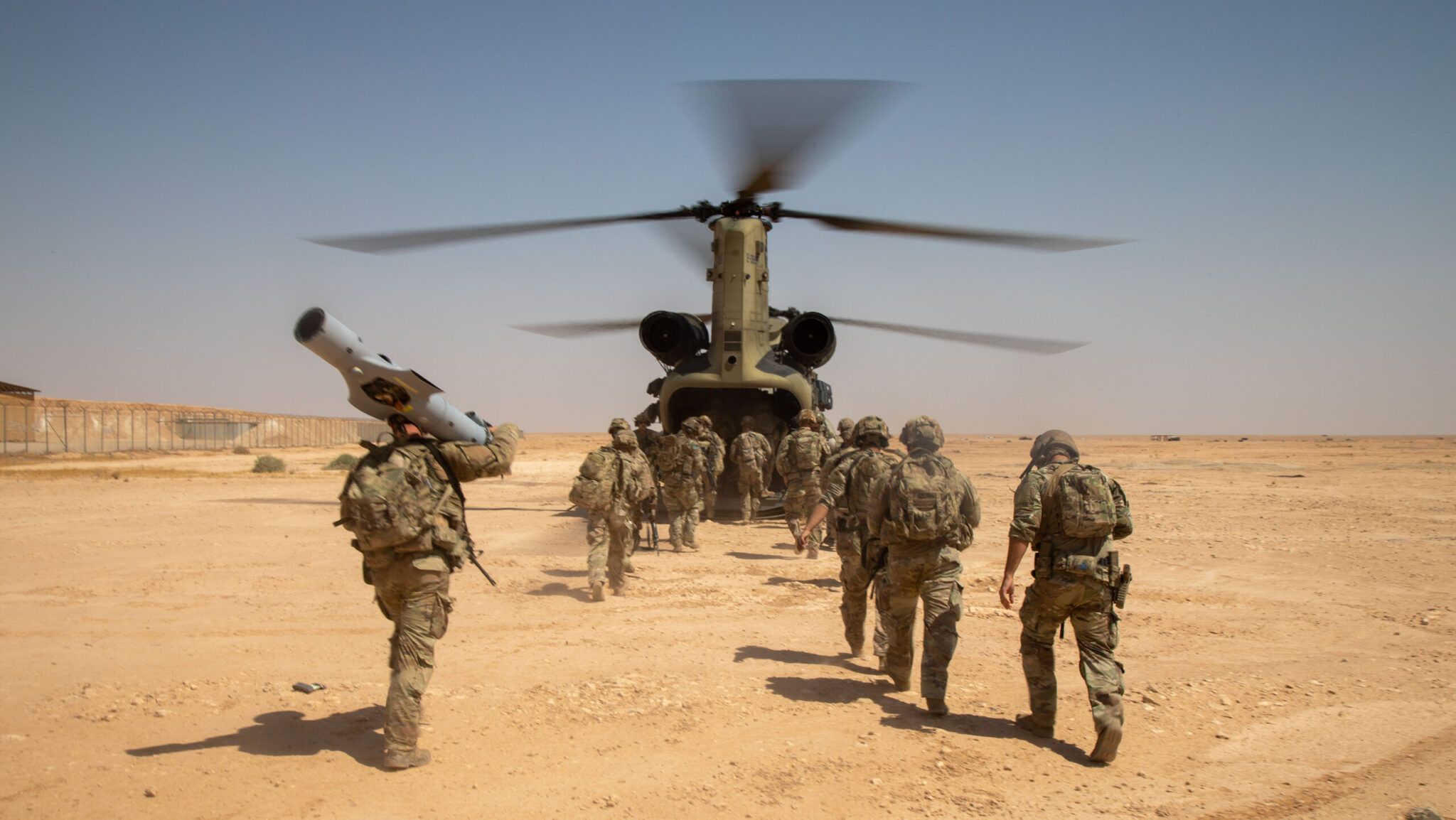
The United States has officially announced that the coalition mission in Iraq will conclude by September 2025, while emphasizing that U.S. troops will remain in the country as part of an “evolution of the military mission in Iraq.” The ongoing counter-ISIS operations will continue, underscoring the commitment to combat the persistent threat posed by the terrorist group.
A senior administration official stated, “To be clear, the United States is not withdrawing from Iraq. We are moving towards the type of productive long-term security relationship that the United States has with partners around the world.” The U.S. and Iraq have agreed on a two-phase transition plan for military operations. The first phase involves concluding the global coalition’s Combined Joint Task Force Inherent Resolve and reducing the presence of coalition forces in specified locations, with this phase set to begin this month and wrap up by the end of September 2025.
The second phase will focus on sustaining coalition support for counter-ISIS missions in Syria from Iraqi territory until at least September 2026. The official acknowledged that while ISIS has been significantly diminished, it remains a real threat in Iraq and the broader region. “Together, the U.S., Iraq, and the coalition remain committed to defeating the core ISIS threat… We plan to continue focusing on that important task as we head into the future,” the official stated.
The precise number of U.S. and coalition troops departing Iraq has not been disclosed, although Reuters previously reported that “hundreds of troops” would be leaving. Analysts interpret this announcement more as a „drawdown” than a complete „withdrawal.” Norman Ricklefs, CEO of NAMAEA Group, emphasized the importance of a conditions-based transition, hoping to avoid the kind of security vacuum seen after the total U.S. withdrawal in 2011—a situation that previously allowed ISIS to flourish.
Ricklefs commented on the enhanced proficiency of Iraqi forces, observing the significant improvements in security in major urban areas over recent years. However, he noted that the threat from a resurgent ISIS, particularly in rural regions of Iraq and Syria, remains substantial and highlighted the ongoing need for U.S. support in combating terrorism. Iraqi defense analyst Ahmad Al Sherifi agreed, noting that while Iraq’s ground forces are better prepared to confront terrorist threats, aerial capabilities and advanced technologies, like electronic warfare systems, pose challenges.
A Decade of Operation Inherent Resolve
The U.S. invasion of Iraq began on March 20, 2003, with the aim of toppling dictator Saddam Hussein. While initial military actions swiftly dismantled the Iraqi government, the conflict soon devolved into a protracted struggle against insurgency and the challenge of rebuilding local governance.
After President Obama took office in 2009, he initiated the withdrawal of combat brigades, culminating in the exit of the last U.S. troops by December 2011. This withdrawal created an opportunity for the Islamic State in Iraq and Syria (ISIS)—a group with roots in an al-Qaeda offshoot—to gain traction, ultimately leading to a series of horrific public executions and terrorist attacks that prompted U.S. re-engagement.
In response to the rising threat, the U.S. led a multinational force back into Iraq in 2014 under Operation Inherent Resolve. Through thousands of airstrikes and partnerships with local forces, including Kurdish fighters, the U.S.-led coalition successfully reclaimed most of ISIS-held territories, diminished its leadership, and reduced the overall threat level. Nevertheless, U.S. and coalition forces remained in Iraq to prevent a resurgence of terrorism, amidst threats not only from ISIS but also from Iran-backed militias and other adversaries.
The Pentagon Inspector General’s latest review of Operation Inherent Resolve notes that the underlying conditions that led to ISIS’s rise in 2014 still persist. The analysts interviewed for this report emphasize that both U.S. and Iraqi forces are hopeful that Iraq’s capabilities have improved to address the ISIS challenge with decreased reliance on international support.