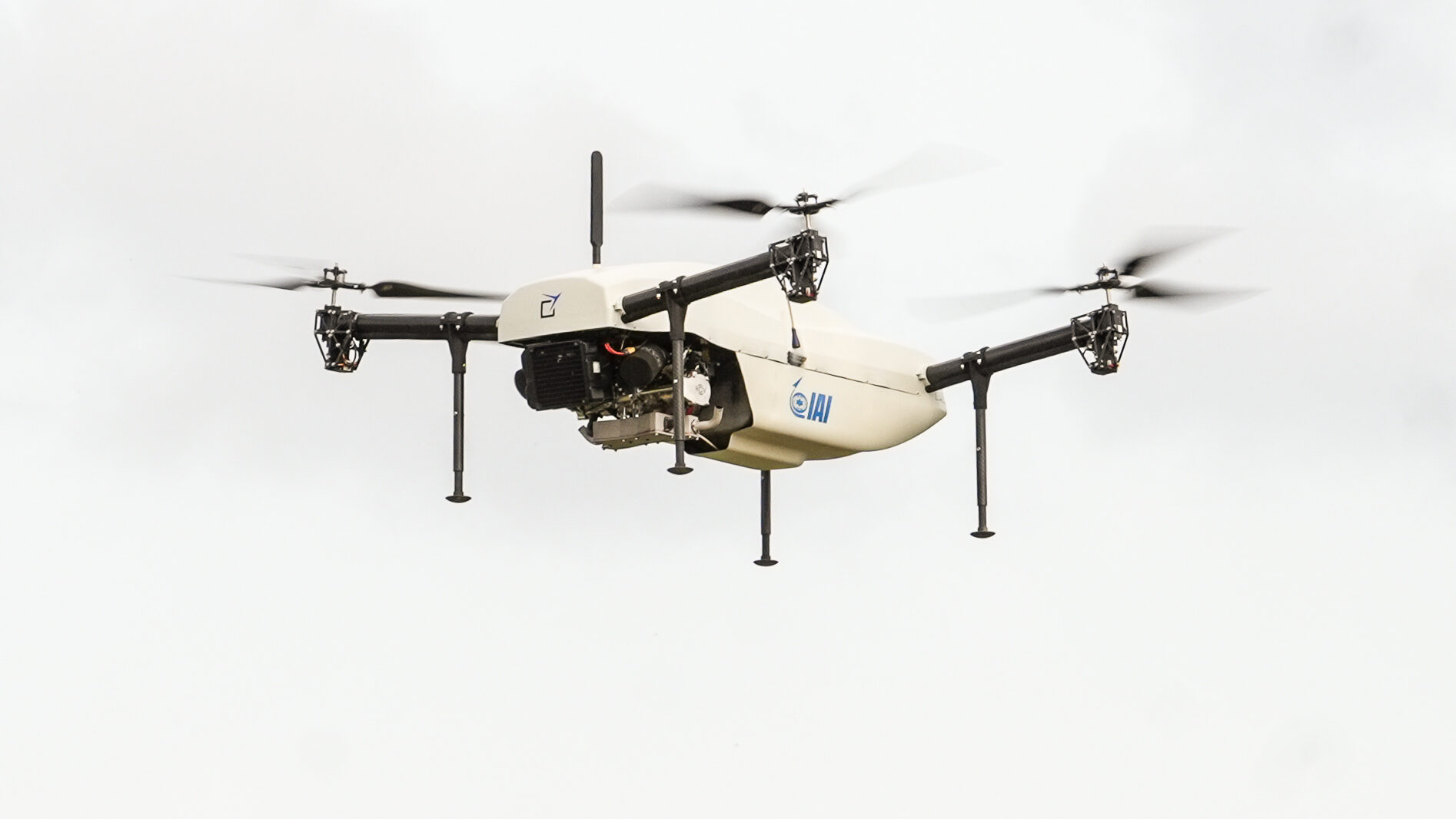
Israel Aerospace Industries (IAI) has launched a new family of quadcopter vertical takeoff and landing (VTOL) drones known as the “APUS” series, promising superior flight times and payload-to-weight ratios compared to existing designs. Developed in collaboration with Aerotor—a company in which IAI has acquired a stake—the first model, the APUS 25, will make its American debut at the upcoming AUSA conference, with plans for additional variants to be introduced in the coming years.
Moshe Levy, manager of the Military Aircraft Group at IAI, explained to Breaking Defense that the trend in small tactical unmanned aerial vehicles (UAVs) is shifting towards VTOL designs. He noted that the primary advantage of such systems is their ability to operate from virtually any surface, including naval vessels, without requiring runways or parachutes for takeoff and landing.
What sets the APUS apart from conventional quadcopter systems predominantly available in the commercial market is its enhanced payload capacity and operational range. According to company materials, the APUS-25 measures just under five and a half feet long and carries a weight of 25 kilograms (approximately 55 pounds), with a payload capacity of around 10 kilograms (approximately 22 pounds) and a flight time of up to eight hours. Depending on the chosen payload, the drone can potentially operate within a range exceeding 100 kilometers. It can also ascend to altitudes of 11,000 feet, with the brochure suggesting that noise emissions would be significantly reduced to near silence at heights above 1,000 feet.
A key innovation within the APUS design is its power source. IAI, which has a long history of developing remotely piloted vehicles, has opted for a heavy fuel engine instead of the electric power systems common in many tactical drones. This decision allows the APUS to use fuels like JP-5, Jet A1, or gasoline, making it easier for military units to maintain the drones and integrate them into existing supply chains.
“These drones are very capable,” Levy stated. „The advantage is they can carry substantial weight. It can be E/O [electro-optical] or Radar,” he added, suggesting that this size of drone may capture a significant share of the market.
Raz Geva, co-founder and CEO of Aerotor, echoed Levy’s sentiments, sharing insights on the initial market research that guided their development efforts. When Aerotor was founded in 2017, the focus was on identifying future demands in the drone market, specifically the need for endurance, heavy payloads, and logistics capacity. Geva noted, “To solve these barriers, we understood that electric drones couldn’t match these tasks.”
Through various demonstrations, the teams showcased the APUS’s capabilities, achieving milestones such as carrying an 8-kilogram payload for two hours, and more impressively, sustaining a 3.5-kilogram payload for six hours and a 4-kilogram payload for five hours. These performance benchmarks represent a notable advancement for small drones, which previously could not achieve such combinations of payload and flight duration.
Both Levy and Geva outlined a range of potential missions for the APUS, including logistics support for ground troops and naval operations that involve landing on ships. With the introduction of the APUS family, IAI and Aerotor aim to address critical operational needs in military scenarios, positioning themselves strategically within an expanding market for tactical UAVs.