The defense ministries of the UK and Canada are collaborating on a joint on-orbit demonstration aimed at monitoring satellites and space debris traversing the South Pole. This initiative is part of an ongoing Canadian pilot project designed to enhance space domain awareness.
According to a press release issued by the UK government, monitoring of space objects over the South Pole is significantly less robust compared to the North Pole. The forthcoming mission is expected to provide valuable insights that will inform future space surveillance strategies based on the findings gathered during the project.
The UK’s Defence Science and Technology Laboratory, acting on behalf of the Ministry of Defence and UK Space Command, will contribute an experimental sensor package to the project known as „Redwing.” This project is being managed by Canada’s Defence Research and Development Canada (DRDC).
“This international research cooperation provides an opportunity for joint collaboration, as well as the development of prototype infrastructure and data processing architectures,” the UK release noted.
Launched in March 2023, the Redwing project is backed by a CAD $15.8 million (USD $11.7 million) contract with a consortium led by Magellan Aerospace, based in Winnipeg. The initiative plans to deploy a small satellite in 2027, targeting an orbit around the North and South poles approximately 575 kilometers above the Earth’s surface.
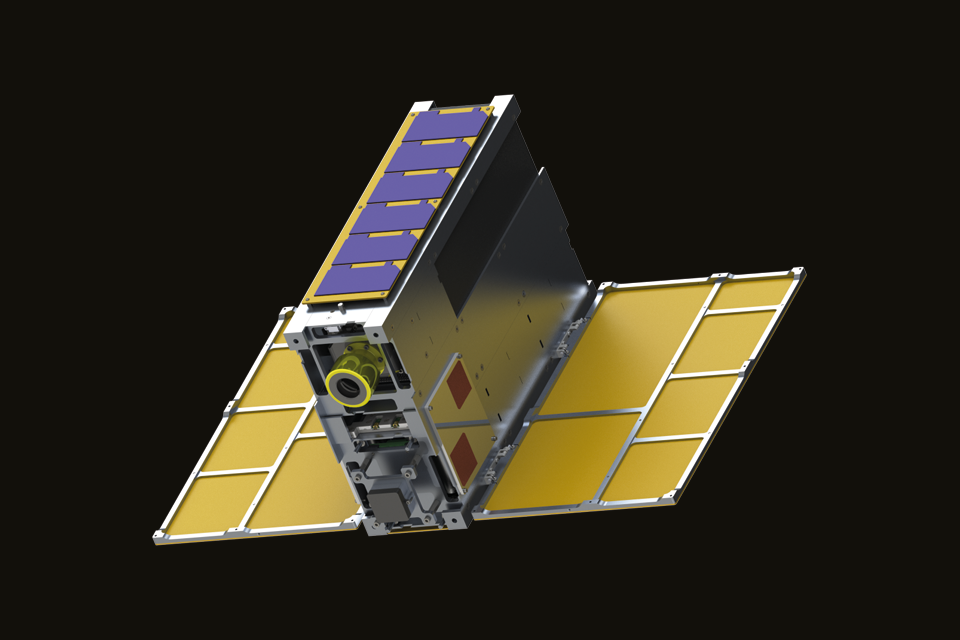
Recently, the project has activated a contract option to incorporate a subsidiary satellite, known as the Little Innovator in Space Situational Awareness (LISSA), into the Redwing project. According to a Thursday press release from the DRDC, LISSA is a nanosatellite roughly the size of a cereal box, designed to operate in tandem with Redwing at a distance of about 200 kilometers, carrying the UK’s sensor payload.
As detailed by Canada’s press release, this payload will include a short-wave infrared (SWIR) camera that captures images outside the visible light spectrum. This capability is particularly crucial for addressing the technical challenges posed by reflected light from clouds and ice during the Antarctic summer.
The Redwing initiative aims to improve space domain awareness, especially concerning mega-constellations operating at altitudes below 2,000 kilometers. Furthermore, the system will also have the capacity to monitor objects in cis-lunar orbits, which extend approximately 380,000 kilometers toward the Moon.
US Space Command has expressed a long-standing interest in enhancing space monitoring capabilities in the Southern Hemisphere, where the US military has limited radar and telescope resources. There is growing concern about maintaining oversight of space activities in the expansive area between Earth and the Moon, particularly in light of China’s aspirations for lunar exploration.