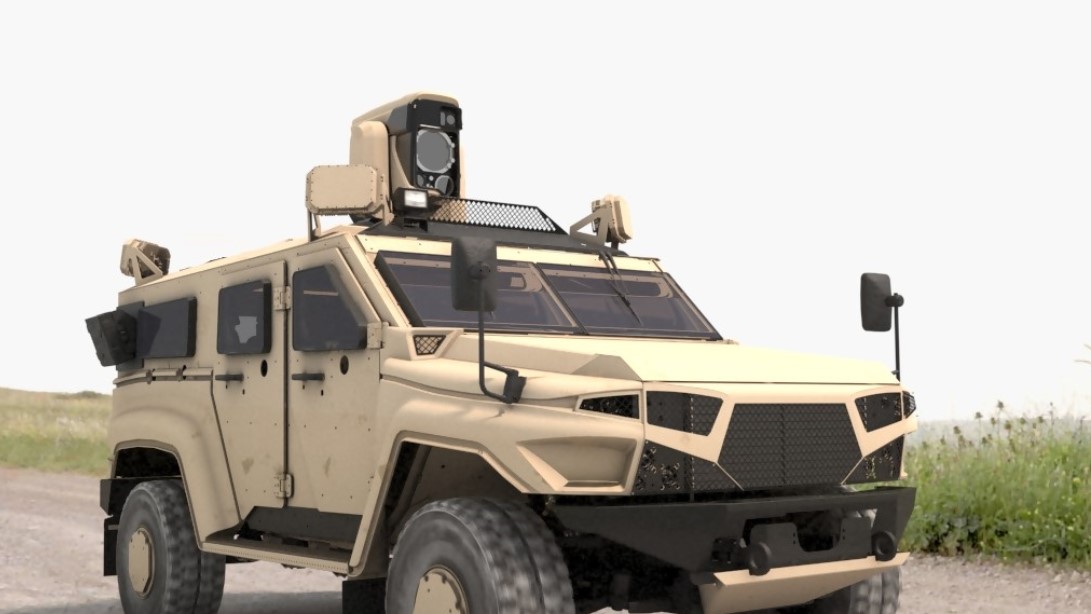
This week, Israel’s Rafael Advanced Defense Systems is launching its new Lite Beam laser air defense system, designed specifically to counter drone threats. Alongside this, the company is introducing updated capabilities for its Trophy active protection system to defend against aerial threats, including those posed by UAVs attacking from above.
Among the two systems, the Lite Beam stands out as a more striking innovation. It can be viewed as a miniaturized version of the Iron Beam anti-rocket system that Rafael has been developing for several years. The Lite Beam reportedly has an effective range of around 2,000 meters and is powered by a 10 kW laser. While many smaller commercial drones typically operate at altitudes ranging from a few hundred meters to 5,000 meters, the system is strategically designed to respond rapidly to incoming loitering munitions or kamikaze drones.
Laser defense systems do face inherent challenges, particularly the need to maintain focus on a target long enough for the laser beam to penetrate the incoming object’s exterior. To address this, Rafael has integrated Lite Beam with its Samson 30mm Remote Weapon Station (RWS), which is mounted on a four-wheeled vehicle platform. This combination would provide versatile and mobile force protection, offering a range of options for neutralizing drone threats. As Rafael describes it, “These solutions provide maneuvering forces with robust force protection and flexibility against a wide range of airborne threats, including UAVs.” However, it remains unclear whether the Lite Beam system is already operational.
On the other hand, the Trophy system has been in active service and has proven its combat effectiveness with the Israel Defense Forces’ Merkava tanks since 2011. It is also employed on U.S. Abrams tanks and was recently selected for deployment on Leopard 2 tanks in Germany and Norway.
Historically, Trophy has mainly focused on countering threats from anti-tank guided missiles (ATGMs) and rocket-propelled grenades (RPGs), which typically strike vehicles from the sides. The latest updates will enable the system to address emerging aerial threats from above, a tactic increasingly utilized by drones and loitering munitions against ground vehicles.
These enhancements derive from practical experience gained over a year of conflict in Gaza, where Trophy has been deployed on hundreds of platforms amid intense combat scenarios. The prevalence of drones and UAVs launching munitions from above has underscored the need for improved defense mechanisms. Israeli tanks were even retrofitted with temporary “pergola” cages during the Gaza conflict to protect operators; however, a more systematic solution is now necessary.
Rafael asserts that the Trophy system has successfully intercepted airborne threats, including ATGMs, RPGs, and UAVs, thereby enhancing the survivability of armored vehicles.
Additionally, Rafael will showcase its modular Counter-Unmanned Aerial Systems (C-UAS) capabilities, which feature advanced detection and interception technologies.
In its statement, the company highlighted that its cutting-edge technology is operational on over a dozen platforms worldwide, including Armored Personnel Carriers (APCs), Armored Fighting Vehicles (AFVs), and Main Battle Tanks (MBTs). It has consistently exhibited adaptability and reliability in complex combat situations, providing comprehensive protection for vehicles and their crews.