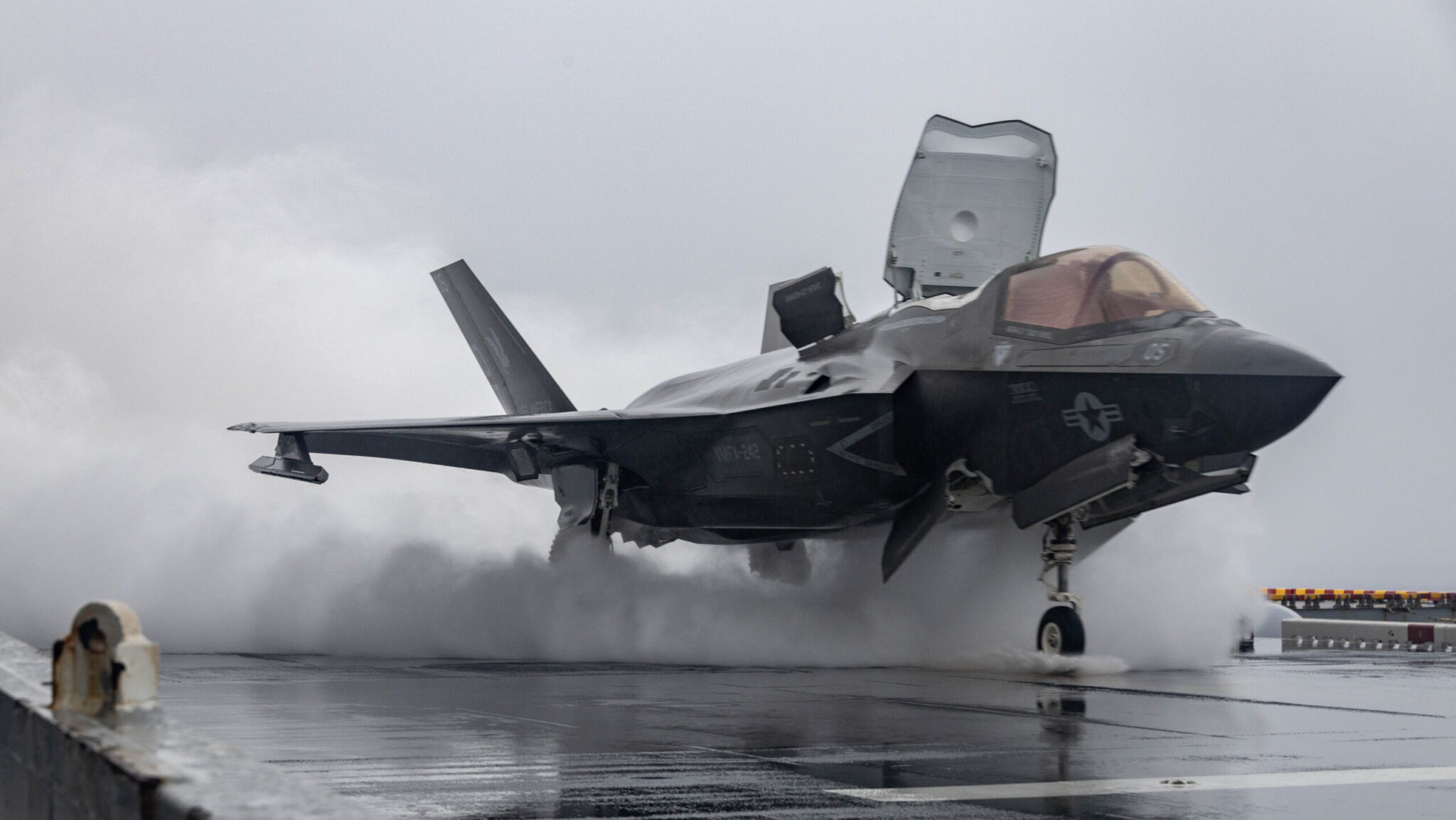
The U.S. Marine Corps has disclosed that the F-35B stealth fighter, which captured headlines after going missing for nearly a full day in September 2023, experienced a technological disappearance due to an electrical malfunction. However, despite the malfunction, the Marine Corps has held the pilot responsible for the aircraft’s eventual crash.
On September 17, 2023, while attempting to execute a missed approach in challenging weather conditions, the pilot ejected from the jet near Joint Base Charleston, South Carolina. According to the Marine Corps’ report, there was an “electrical event during flight” that affected multiple onboard systems, leading to periods where both the helmet-mounted display and the panoramic cockpit display were non-operational. Nevertheless, the service maintained that the aircraft remained airworthy at the time of ejection.
“The pilot incorrectly diagnosed an out-of-controlled flight emergency and ejected from a flyable aircraft,” the Marine Corps stated, pointing out that heavy rain and electrical malfunctions contributed to the situation.
Following the pilot’s successful ejection and safe landing, the F-35B continued flight autonomously for over 11 minutes, thanks to its advanced automatic flight-control systems, before crashing approximately 64 nautical miles northeast of the airfield in Williamsburg County, South Carolina. The extended duration of the jet’s flight raised concerns as military officials scrambled to locate the aircraft. Joint Base Charleston even sought assistance from the public to find the missing fighter, leading to a surge of humorous commentary on social media and bewilderment among politicians.
While the F-35 is designed to evade radar detection during combat, the circumstances surrounding the crash meant that the stealth jet operated with an activated transponder that transmits its position. The electrical issue, the jet’s low observable coating, and its descent beyond the range of air traffic control radar all contributed to the loss of radar contact and the prolonged search.
The report indicates that the crash resulted in no injuries on the ground but did lead to property damage, affecting forested land and crops in the area where the F-35B went down.
The aircraft belonged to Marine Fighter Attack Training Squadron (VMFAT 501) under the 2nd Marine Aircraft Wing, and the pilot was qualified to conduct the scheduled flight. The Marine Corps noted that no punitive actions were recommended against the pilot. Although the pilot received a new command nearly a year later, they were relieved of duty a few months after assuming the role.
The investigation clarified that the electrical malfunction was not related to maintenance activities. Russ Goemaere, a spokesperson for the F-35 Joint Program Office, stated that the F-35’s electrical power system functioned as intended during the incident and that the aircraft remained fully controllable. He emphasized that the safety of F-35 pilots is the top priority and that collaboration with military services and industry partners would continue to ensure the safety of warfighters.
Lockheed Martin, the manufacturer of the F-35, directed requests for comment to the Marine Corps and the Joint Program Office.