Attacks utilizing swarms of armed unmanned aerial systems are no longer a concept confined to science fiction.”
Emmanuel Chiva, the director of France’s defense procurement agency, issued this warning at Euronaval, one of the largest defense expositions in the country, which took place in Paris earlier this month.
Since Chiva’s statement, Ukraine has experienced a series of drone assaults from Russia, while Israel prepares for a potential third wave of drone and missile attacks from Iran. Additionally, unmanned surface vessels (USVs) have targeted both commercial and military ships in the Red Sea, and Ukraine has successfully countered Russia’s Black Sea fleet using similar emerging technologies.
In response, the defense against unmanned aerial and maritime systems emerged as a primary theme at this year’s Euronaval, where officials detailed France’s strategy and industry representatives presented their defensive technologies.
General Thierry Carlier, Chiva’s deputy, emphasized the importance of keeping pace with these emerging threats, drawing from experiences in the Red and Black seas. The 2024-30 Military Program Law allocates €5 billion ($5.3 billion) towards ground-to-air defense, which encompasses counter-UAS equipment.
Due to the upcoming Paris Olympics and Paralympics, the anti-drone operations during the events are estimated to require „20,000 hours of surveillance, ten times more than for the 2023 Rugby World Cup,” stated General Stéphane Mille, commander of the Air and Space Force. A report from the National Assembly indicated that 355 unauthorized drones were detected during the Rugby Games, predominantly operated by amateurs, leading to 81 arrests.
As the risk of drone attacks increases, global firms, including those in France, are investing heavily in developing countermeasures. This involves the complicated task of detecting threats, categorizing them, and relaying that information almost instantaneously to systems capable of responding.
Erik Van Kimmenaede, Thales’s marketing director for surface radar, noted to reporters before the event that „automation is essential for rapid response.”
Cost-effectiveness also plays a crucial role in these developments. Thales introduced the E-Trap system, designed to neutralize Class 1 drones, which was showcased at Euronaval but used discreetly during the Olympics. Developed with France’s DGA, the E-Trap uses a powerful microwave antenna to emit a quick electromagnetic pulse that disables the essential electronic components of a drone. It can effectively neutralize individual drones or swarms.
In parallel, Safran Electronics & Defense collaborated with Hologarde on the Skyjacker solution for countering drones. Utilized during the Paris 2024 Olympic and Paralympic Games, this system can spoof drones from distances of up to six miles by manipulating their satellite navigation signals.
Chiva informed a National Assembly defense committee that „at least three” of France’s FREMM frigates will be outfitted with the Skyjacker technology. He noted the potential for deploying significant firepower against drones at sea, particularly in swarm scenarios, and mentioned the establishment of an anti-drone task force in response to developments in the Red Sea.
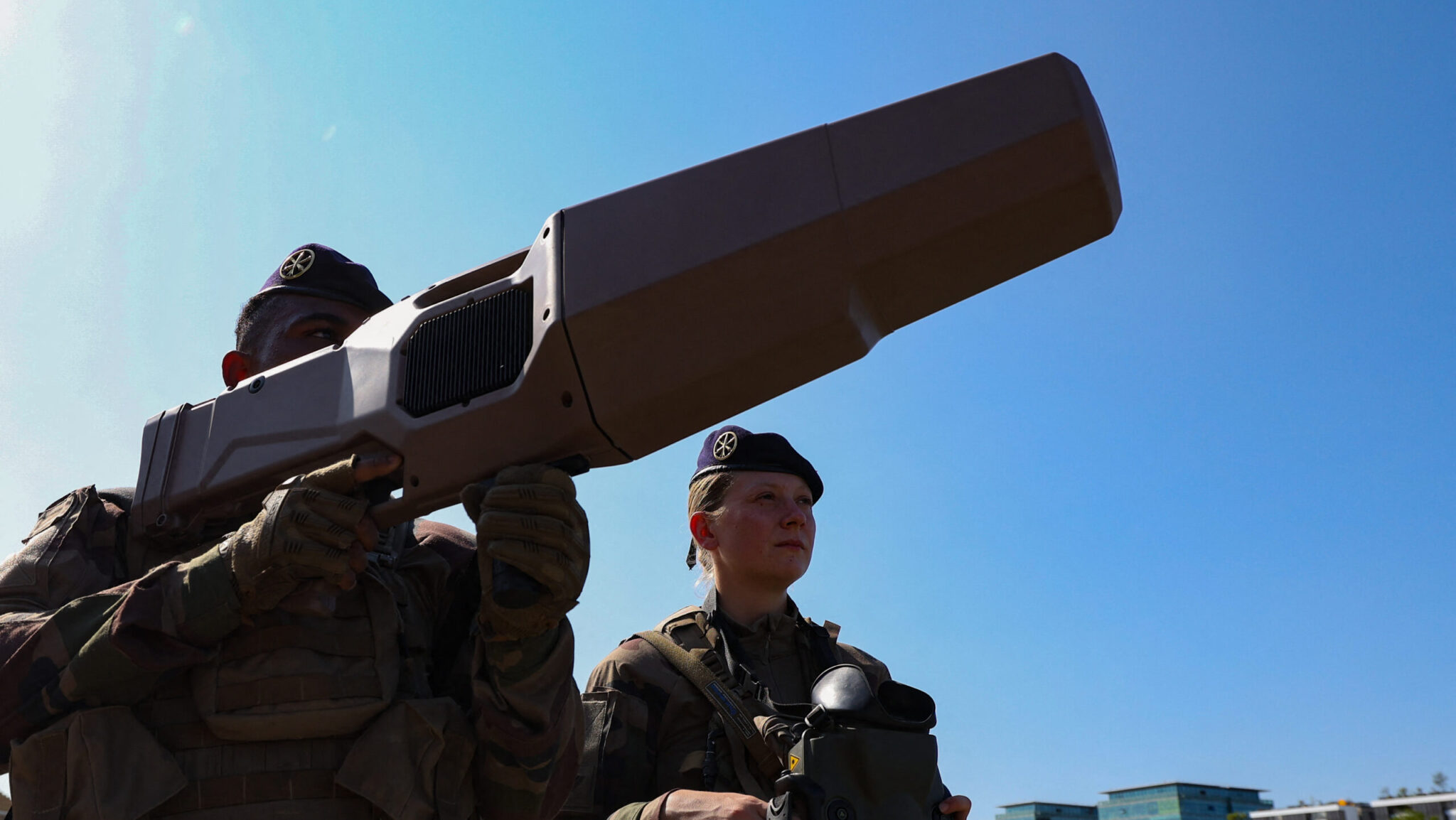
Additionally, MC2 Technologies, a smaller firm specializing in micro and nanotechnologies, displayed its counter-UAS systems at Euronaval, including the Nerod jammer gun, which disrupts communications between drones and their operators. Reports indicate that 80 of these guns have been supplied to French military and police forces, with an additional 500 distributed to clients in various regions, including Asia, Africa, Europe, and the Middle East.
MC2 Technologies also provided its Neptune and Majes counter-drone systems to the French Navy, which effectively used them to neutralize a UAV recently.