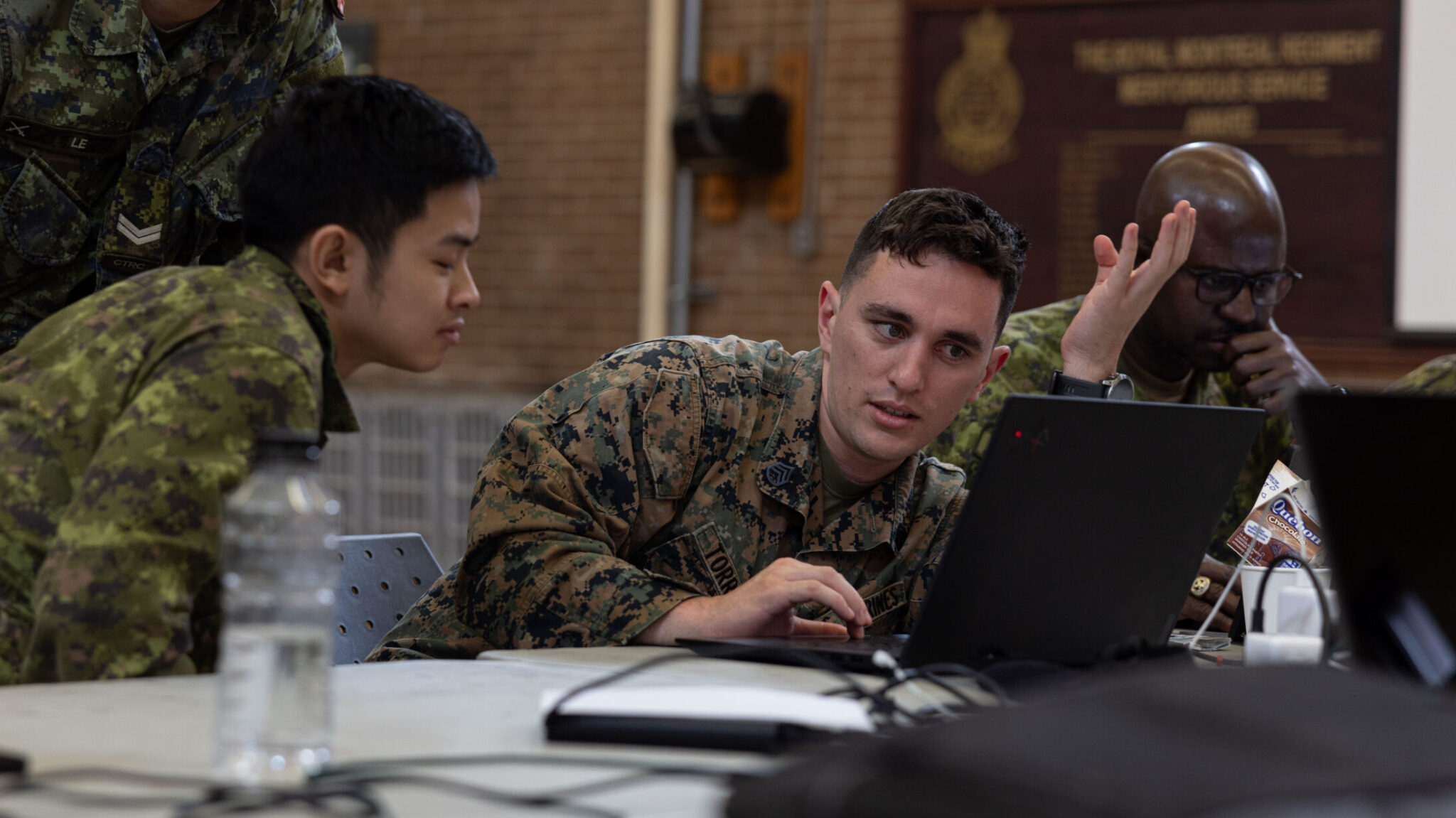
As leaders from NATO countries and their allies work to securely share more data, the Pentagon and the Canadian Armed Forces have announced the successful completion of a federated identity, credential, and access management (ICAM) connection between their armed forces through a joint pilot program.
While this is a relatively small step, Ross Ermel, the defense chief digital officer for the Canadian Armed Forces, shared this week that when he and his team “took this to the warfighting use case—keeping it general for now—and they realized the possibilities of logging in and sharing, it was a light bulb moment.”
ICAM, which has been implemented in recent years throughout the US Department of Defense, is a system that verifies users’ identities and determines their access levels when logging into information systems. With this federated connection, users from both the US and Canada were able to securely access data from the other country via a shared existing platform, according to Pentagon acting chief information officer Leslie Beavers, who didn’t disclose the specific platform used in the pilot.
“Identity management enables those clouds—people, organizations, equipment within those clouds—to trust each other and collaborate effectively,” Beavers asserted. She emphasized that this is crucial for unlocking the modern capabilities that are essential for both the Department of Defense and its allies.
Beavers also recounted her experiences while serving in the US Air Force, where she often encountered issues connecting to necessary systems. This motivated her to enhance interoperability not only within the DoD but also with international allies.
“I couldn’t understand why, as an Air Force member traveling to various locations, nothing would work—and it drove me nuts. That’s why I’m extremely passionate about addressing these foundational challenges and solving them through collaboration,” she explained.
This cooperation, Beavers noted, was facilitated through her partnership with Ermel.
“If we can’t communicate and trust each other on a nation-to-nation and entity-to-entity level, we won’t achieve the interoperability we seek for the future,” he added, highlighting that ICAM interoperability is “absolutely vital.”
With the US and Canada now connected through a federated ICAM system, Beavers stated the next step is to expand this capability to all NATO countries and other allies.
“We’re starting small with the US and Canada. We’re developing the recipe, the playbook, and the necessary technology and policies. Once that’s in place, we aim to scale this to 32 nations and extend it to other allies and partners, but we need everyone’s support,” she urged. “I encourage everyone to focus on the essential tasks at hand so we can resolve this issue and unleash the potential of NATO.”