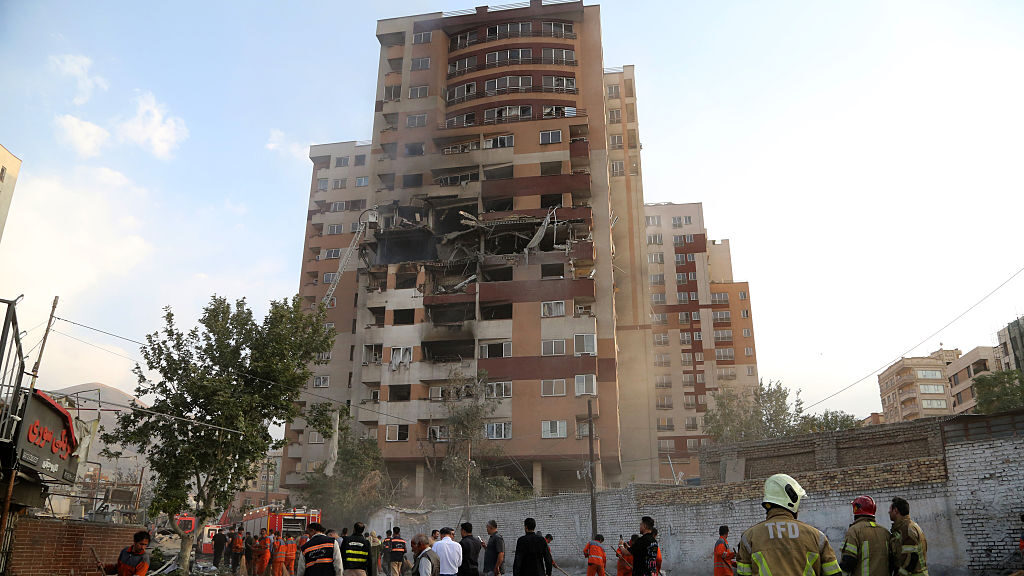
Tel Aviv, Israel – In the early hours of Friday, Israel launched a series of airstrikes on Iran, targeting key military commanders and officials, as well as nuclear sites, the Israeli military announced.
Massive Initial Wave of Strikes
The initial wave of what the Israeli government dubbed „Operation Rising Lion” involved over 200 aircraft and around 330 munitions to strike more than 100 targets, according to the Israel Defense Forces. However, strikes continued later on Friday, and US President Donald Trump indicated online that more “brutal” attacks were to come.
Israel’s Objective
Israel’s Prime Minister stated that „the purpose of this unprecedented attack is to hit Iran’s nuclear facilities and its military capabilities until we remove the threat to us.” Concurrently, US Secretary of State Marco Rubio distanced the US from the strikes, asserting that Israel acted independently.
Key Iranian Commanders Eliminated
During the initial wave of strikes, the IDF reported the elimination of the Chief of Staff of the Iranian Armed Forces, Mohammad Hossein Bagheri, as well as the head of the Islamic Revolutionary Guard Corps (IRGC), Hossein Salami. In addition, the head of the IRGC’s Air Force, Amir Ali Hajizadeh, was killed, the IDF said. Israel also believes other key IRGC commanders were killed.
Nuclear Sites Targeted
The IDF also targeted nuclear sites, including multiple strikes against the Natanz nuclear enrichment facility.
Iranian Retaliation
Iran sought to retaliate by launching drones targeting Israel, but as of this report, the drones had not reached Israel and may have been intercepted en route.
US Response
The strikes occurred a day after reports that the US was preparing to evacuate State Department personnel from Iraq and other countries in the region due to escalating tensions with Iran. „Tonight, Israel took unilateral action against Iran. We are not involved in strikes against Iran, and our top priority is protecting American forces in the region,” stated US Secretary of State Marco Rubio.
Israel’s Rationale
Israel’s Chief of Staff Lt. Gen. Eyal Zamir said Israel had been preparing for the operation for an extended period, stating, „We have begun this operation because the time has come, we are at the point of no return. We cannot afford to wait for another time to operate; we have no other choice.”
The Israel Defense Forces accused the Iranian regime of „waging a direct and indirect campaign of terror against the State of Israel, by funding and directing terrorist activities via its proxies across the Middle East, while advancing toward obtaining a nuclear weapon.”
Timing of the Strikes
The Israeli strikes took place two days before the US and Iran were scheduled to meet in Oman for the sixth round of indirect talks regarding a possible nuclear deal. They also followed Iran’s censure by the IAEA.
Iran’s Pre-emptive Warning
Iran had condemned the IAEA resolution and declared its readiness for a potential war. „We are ready for every scenario and have a military strategy,” said Salami, the IRGC commander, on Thursday, hours before his reported death.
Sirens and Alerts in Israel
Israelis were awakened by nationwide sirens just after three in the morning. Israel’s Home Front Command also sent out alerts to phones, advising people to remain close to bomb shelters.
State of Emergency Declared
Following the alerts, Israeli Defense Minister Israel Katz stated that Israel had carried out a preemptive strike on Iran, adding, „A missile and drone attack against the State of Israel and its civilian population is expected in the immediate future.” He declared a state of emergency and instructed the country’s civilians to obey commands of the IDF’s Home Front Command.
Background of Conflict
Israel has faced off against Iranian-backed proxies and partners throughout the ongoing conflict that began with the Hamas attack on Israel on Oct. 7, 2023. Hezbollah, a key ally of Iran, began its attacks on Israel on Oct. 8, and the Houthis in Yemen also initiated attacks on Israel and ships in the Red Sea in October and November 2023. Iranian-backed militias in Iraq also carried out drone attacks on Israel throughout 2024.
Israel and Iran exchanged direct blows twice in 2024, with Iran using hundreds of ballistic missiles and drones to attack Israel on April 13 and Oct. 1. Israel retaliated in both instances, striking air defenses in Iran.
Israeli Air Force Expansion
Israel has been expanding its air force in recent years, signing deals to acquire a new squadron of F-15s in 2024 and a third squadron of F-35s. Israel also agreed in 2022 to buy four new KC-46 Pegasus refuelers.