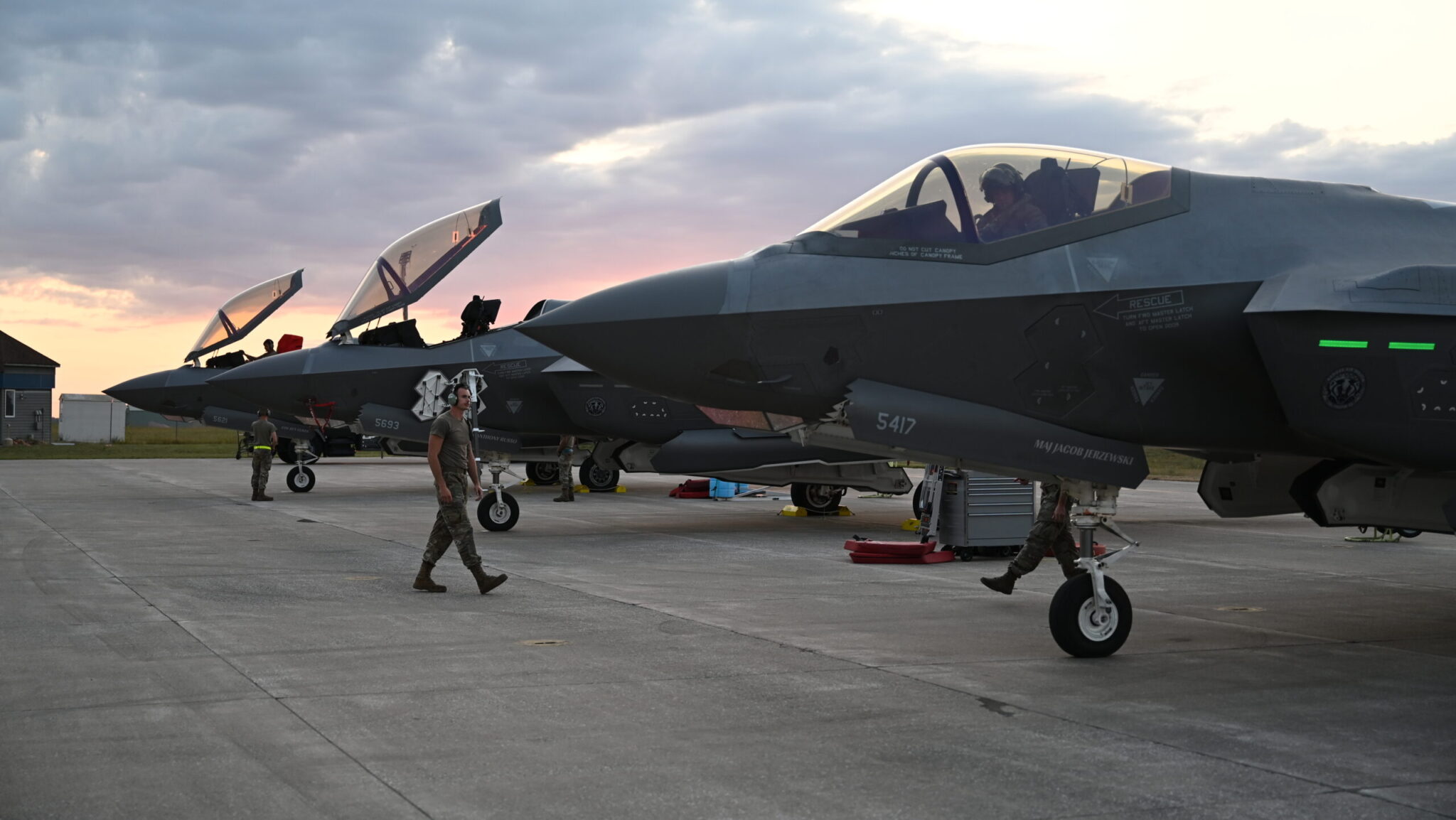
NATO members who do not operate the F-35 are exploring opportunities to support the maintenance and repair of the alliance’s F-35 aircraft within their own countries, according to Michael Williamson, president of Lockheed Martin International.
Enhancing Alliance Interoperability
Speaking at the Royal International Air Tattoo (RIAT), Williamson revealed that during the recent NATO Summit in The Hague, Netherlands, some countries „making the decision not to buy F-35 had approached [Lockheed Martin] to build facilities and repair parts so another F-35 can land at their air bases, be repaired, and fly out.” This move could significantly improve resiliency, interoperability, and interchangeability across the NATO alliance.
F-35 Integration
Williamson also highlighted successful exercises where F-35 aircraft from one NATO country were able to „pass information” to another nation’s command post on the ground, showcasing the growing interoperability within the alliance. He emphasized the potential of 32 NATO countries sharing real-time information from air to ground, calling it the epitome of interoperability.
Bridging the Generation Gap
Lockheed Martin’s Sniper pod could enable fourth-generation fighters to communicate with F-35s. „We’ve run tests where information from the F-35 can go directly to an F-16 with a Sniper pod,” he said.
Lockheed’s European Priorities
Williamson emphasized diversifying and investing in manufacturing facilities and leveraging commercial technologies, particularly in cyber, communications, and software.
Expanding the Supply Chain
Williamson described another focus area of Lockheed Martin: moving beyond just partnering with „great companies at the prime level” and instead investing in suppliers across multiple tiers. „We have built a series of placemats in 70 countries, gone into all of them and sent management to get an understanding of capabilities. Not all of them are in the aerospace and defense business but we can bring good companies in which adds to diversification and resilience,” he said.
Patriot Missile Production
Williamson highlighted increasing production of PAC-3 missiles for the Patriot air defense system. „For Patriot, we have not quite doubled production [but] gone over a one-third increase in production. Some key components we have found quite challenging, but we are making investments in facilities for those components so we can double capacity.”
Evolving Defense Industry
Williamson noted that the international market accounts for 40 percent of Lockheed Martin’s growth, but warned that the company and the wider defense industrial base „cannot continue to operate as they have in the past.” He stated that the traditional process of defense procurement, which can take over a decade from requirement to production, is no longer viable in the 21st century.