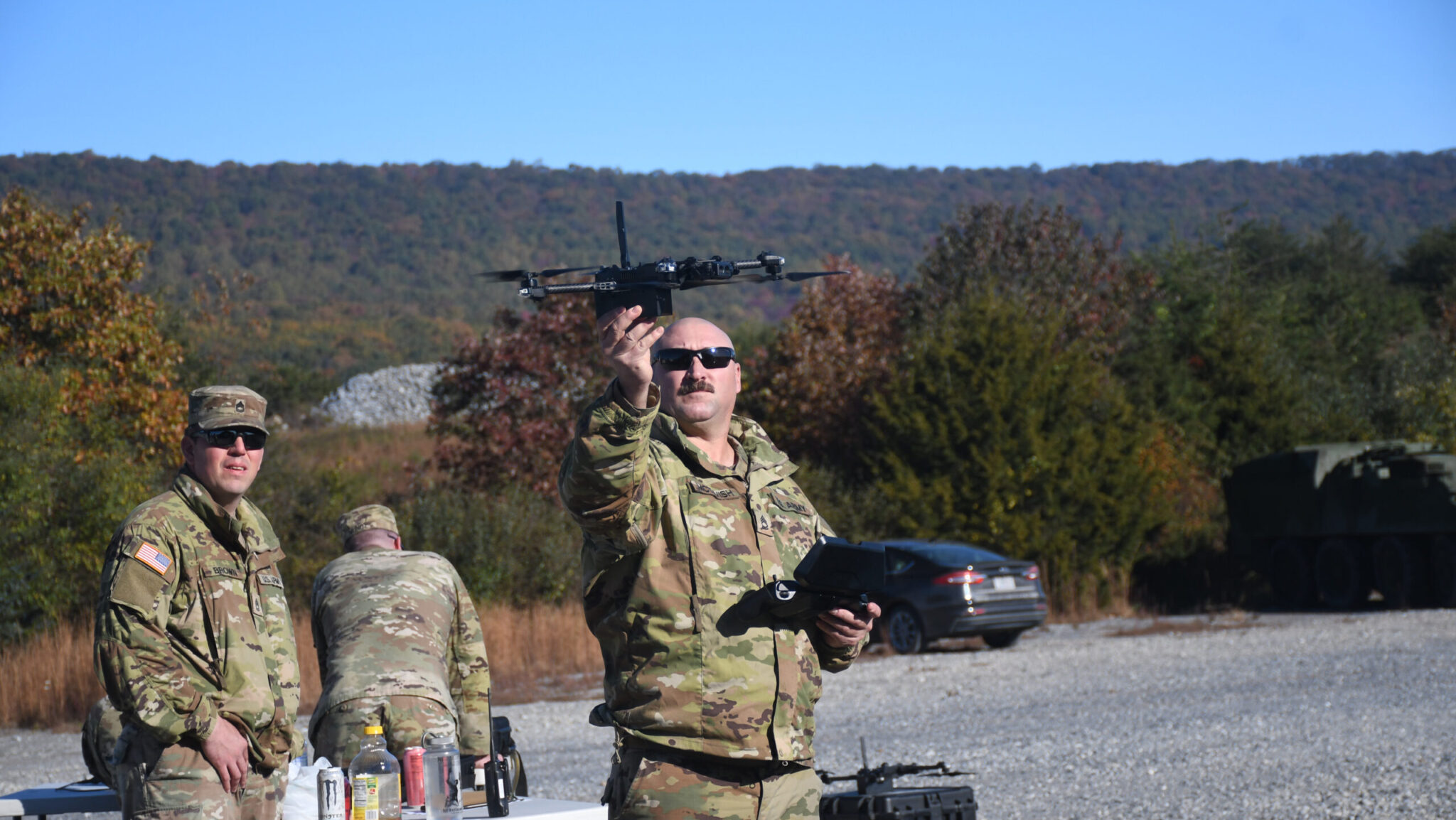
A new tactic employed by Russia in Ukraine—fiber-optic wire control for first-person view (FPV) attack drones—is rapidly outpacing current counter-UAS (C-sUAS) development, highlighting the accelerating arms race in drone warfare.
Vanaheim Caught Off Guard
Just four months after the launch of Joint Project Vanaheim, a collaborative effort between the United States and United Kingdom to „shape the future” of C-sUAS capabilities, this novel threat has emerged, catching the initiative off guard.
Ukraine’s Grim Reality
Earlier this week, a defense source associated with the Armed Forces of Ukraine warned that Russia has increasingly begun using fiber-optic wire control, enabling FPV attack drones to bypass radio frequency jammers. The source, speaking anonymously for security reasons, described Ukrainian FPV teams as the „most hunted soldiers on the battlefield,” emphasizing the unexpected challenge posed by these systems.
Fast Obsolescence
The source suggested countermeasures such as cutting the wire, shooting down the drones, or using directed energy weapons. However, they warned of an ongoing battle against obsolescence, where the deployment of sUAS and C-sUAS can now be measured in „weeks and months.”
Adapting to the Threat
Industry sources speaking at the Royal International Air Tattoo (RIAT) described ongoing efforts by the British and US Armies to replace „ad hoc” C-sUAS acquisitions with more permanent programs.
Vanaheim 3: Initial Tests
According to Gil „Waco” Griffin of L3Harris, Exercise Vanaheim 3, conducted in June at the Joint Multinational Readiness Centre in Hohenfels, Germany, involved British and US Army units testing 20 different C-sUAS solutions to „detect, track, identify, and defeat” quadcopters, the most common form factor for FPV attack drones. However, Vanaheim 3 did not include any requirement to neutralize fiber-optic wire controlled sUAS.
A Rapidly Evolving Landscape
„The fact of the matter is, if you rewind the clock six to nine months, we weren’t worried about this threat, which is kind of fascinating,” Griffin told Breaking Defense. „So, it’s evolving quickly, and I think that it’s important that we adapt quickly so we’re looking at all aspects of the threat all the time.”
Lessons from the Battlefield
Ian Menzies, L3Harris’ general manager for the Intelligence and Cyber International Division, added, „So we’ve tuned into the lessons learned from Ukraine. And the great thing about this is it’s highly adaptive at pace so we are iterating as we go literally through these demonstrations.”
Vanaheim’s Next Steps
Joint Project Vanaheim seeks a C-sUAS capability „usable by generalist soldiers, carried on the soldier or by a light vehicle, and focused on countering class 1b/c UAS including first-person view drones,” according to a UK MoD solicitation.
TTP Development
Griffin explained that the exercise provided an opportunity for both countries to develop tactics, techniques, and procedures (TTPs) for counter-UAS efforts, based on lessons learned from Ukraine and the Middle East. Soldiers were also equipped with shotguns and Smartshooter „Smash” weapon sights. Observers from Germany, Poland, and Ukraine participated.
Future Exercises
The next phase of Joint Project Vanaheim will involve eight selected C-sUAS solutions participating in Exercise Vanaheim 4 in Poland later this summer, featuring fixed-wing sUAS. Following this, a „small number” of C-sUAS solutions may be purchased for further experimentation and trials to develop TTPs, with selected solutions participating in Exercise Convergence Capstone 6 in the US next summer.
Towards a Program of Record
„The intent, we believe, is to actually establish a program of record on the back of Vanaheim. So that’s certainly what they’re trying to do to de-risk the capability that’s here at the moment,” Menzies added, referring to the British Army’s Land GBAD program, which is expected to feature a layered approach from C-sUAS to SHORAD and MRAD.