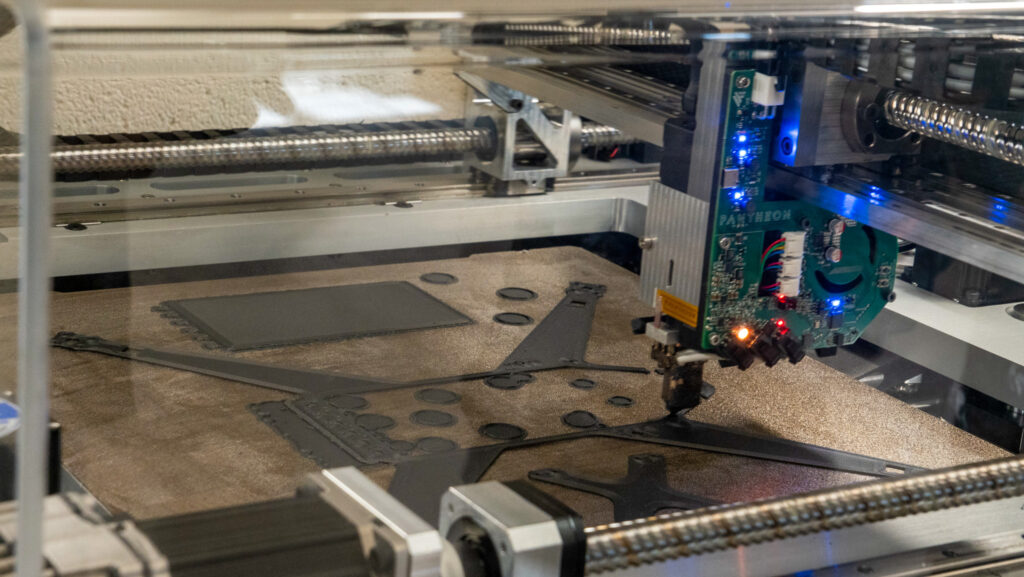
The US Army is accelerating its adoption of 3D printing, recognizing the technology’s potential to revolutionize logistics, sustainment, and even drone production. Officials outlined their plans at the recent GVSETS Conference, highlighting advancements in additive manufacturing capabilities.
From Crawling to Running: Scaling Up 3D Printing Capabilities
„Just like everything else with technology, it is kind of a crawl, walk, run. I would say [with additive manufacturing] we are in the walking stage, but we are going to be running very, very soon,” stated Randl Besse, commodity manager at the Rock Island Arsenal (RAI) Joint Manufacturing and Technology Center (JMTC). RIA has already printed at least 1,500 different components for various Army platforms.
Beyond Battle Damage Repair: A Fully Qualified Approach
Jason Duncan, maintenance integration division chief at the Integrated Logistics Support Center (ILSC) of the Tank-Automotive & Armaments Command (TACOM), emphasized the goal of transitioning 3D printing from battle damage repair to a fully qualified production method. „We have been coordinating to be able to move faster and make sure we have a good process. That cutting-edge technology allows us to kind of move at the pace of change,” Duncan said.
Drone Body Bonanza: 3D Printing’s Role in Attritable UAS
The Army is also leveraging 3D printing to bolster its unmanned aerial systems (UAS) capabilities. „We started looking at new, higher volume types of equipment that would get us to be able to produce at much larger scales, talking in the scale of 10,000 drone bodies per month,” Besse revealed.
Open for Collaboration: Army Seeks Industry Partnership
With a wide array of additive manufacturing technologies already in place, the Army intends to expand its capabilities further. Brandon Pender, associate director of Ground Vehicle Materials Engineering at the Combat Capabilities Development Command (DEVCOM) Ground Vehicle Systems Center (GVSC), encouraged industry involvement. „We are open to doing our cooperative R&D agreements with any of you in the room, and happy to discuss what you could print for us. Additionally, we have our laboratories available. We have our machines available,” Pender stated. Suppliers can have prototypes printed and tested by the Army, even in „giant shapes and forms, out of aluminum and more alloys.”
Digital IDs: Solving Obsolescence Forever
The Army is also focused on establishing guidelines for certifying printed parts and components, working on validating their designs. Pender suggested that creating a „digital ID” for each part could increase supply chain availability and eliminate obsolescence. „If we have a digital recipe, we don’t have to worry about tooling, if there is a vendor to qualify. We should be thinking about how to digitally validate parts,” Pender concluded.