The Army has awarded Lockheed Martin and its industry team a $26 million Other Transaction Authority (OTA) contract to develop an integrated data layer for the service’s Next Generation Command and Control (NGC2) initiative, according to an Army announcement.
Accelerating Transformation
„Next Generation Command and Control is about accelerating transformation and optimizing the innovation of both industry and our warfighters to deliver critical Warfighting capabilities at speed,” said Jesse Tolleson, acting assistant secretary of the Army for Acquisition, Logistics and Technology. „This is not business as usual and reflects exactly what we are trying to achieve through transformation across the Army and the acquisition community.”
Integrated Data Layer for 25th Infantry Division
The OTA, awarded to Lockheed Martin Rotary and Mission Systems and its team of non-traditional innovators and commercial technology providers, aims to deliver the integrated data layer to the 25th Infantry Division within 16 months.
NGC2: A Top Modernization Priority
NGC2, the Army’s top modernization priority, seeks to provide commanders and units with a new approach to managing information, data, and command and control using agile and software-based architectures. Previously, warfighting functions were siloed with their own systems that lacked interoperability, hindering situational awareness.
Horizontal Operational Design
The Army has developed a horizontal operational design for NGC2, involving a technology stack that includes a transport layer, an integration layer, a data layer, and an application layer. The application layer breaks down silos by integrating individual warfighting functions into applications that operate on a shared backbone.
Follows $100M Anduril Award
This award follows a July announcement of a nearly $100 million contract to Anduril and its team to provide a prototype to the 4th Infantry Division for division-level scaling.
Previous Prototype Tested in March
In March, the Army tested a previous NGC2 prototype, dubbed a proof of principle, with an armored battalion and higher headquarters.
Evaluating Different Models for Shared Responsibility
“This isn’t the end of competition, this is the beginning. Through these two industry team lead agreements, we’ll evaluate different models for shared responsibility and aligned incentives during the NGC2 prototyping phase,” said Joseph Welch, deputy to the commanding general, Army Futures Command. „We don’t want to have great capabilities simply at the start — we want a durable partnership model that keeps pace with an ever-evolving American tech sector and creates continual opportunity to find and insert the best technology solutions.”
Enabling Direct Integration with the Operational Force
“By encouraging companies to self-organize and team with each other and enabling them to integrate and solve these problems directly with the operational force, we will be able to rapidly and continuously improve the command and control capabilities we deliver to Soldiers,” he said.
Awarded Through Commercial Solutions Offering
The OTA was awarded through a commercial solutions offering (CSO) for NGC2 by the program executive office for command, control, communications and networks (PEO C3N).
Continuous Vendor Engagement
PEO C3N continues to work with vendors for future capabilities. Companies can submit white papers based on capabilities for specific segments of NGC2 or the entire stack. The goal is to onboard new capabilities and vendors with superior solutions while maintaining the flexibility to offboard underperforming contractors.
Continuing to Accept Proposals
The Army is continuing to accept proposals under the CSO for potential future team lead or component integration in the NGC2 technology stack.
Integrated Data Layer Will Assess Software Options
The integrated data layer that Lockheed Martin will develop will enable the Army to assess NGC2 software options, supported by command and control Fix transport and infrastructure capabilities.
C2 Fix: Bridging Legacy Capabilities and NGC2
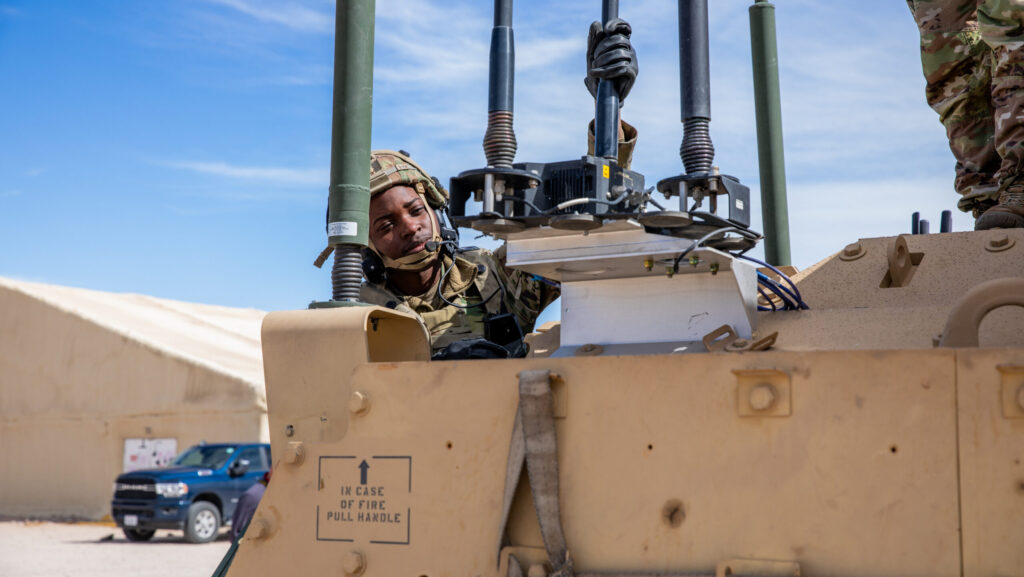
C2 Fix, initially conceived as a bridge between legacy capabilities and NGC2, involved utilizing existing equipment differently, along with some newer commercial solutions, to provide „fight tonight” capabilities. Now, officials view C2 Fix as reducing the risk to NGC2.
Parallel Prototyping Activities
Officials describe the 4th ID and 25th ID projects as parallel activities with different approaches, aiming to extract the best from both regarding NGC2 prototyping. Certain capabilities and architectures, such as transport from C2 Fix, are expected to carry over and support NGC2.