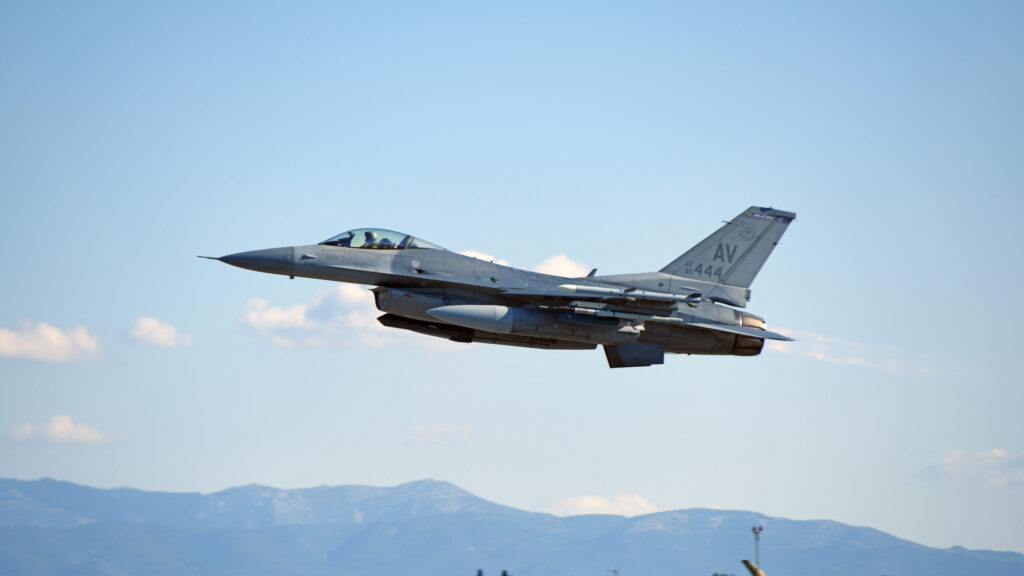
The Air Force is expediting the deployment of its F-16-based electronic warfare suite to address an urgent operational requirement in the Middle East, according to industry officials.
Urgent Requirement Validated
Northrop Grumman officials revealed that Air Forces Central validated an urgent operational need for 72 AN/ALQ-257 Integrated Viper Electronic Warfare Suite (IVEWS) systems over the summer, prompting the Air Force to field them as quickly as possible.
IVEWS: The Only EW System on the F-16
IVEWS is the designated electronic warfare system for F-16 self-protection, offering digital radar warning receiver performance and active jamming capabilities to detect, identify, locate, and counter potential threats.
Congressional Support
Congressional language in the reconciliation package added $187 million to accelerate the installation of „F-16 electronic warfare capability,” specifically aimed at mitigating risks from „Houthi-like adversaries.”
Revived Funding After Prioritization of Next-Gen Platforms
Company officials noted that previous Air Force priorities focused on future platforms, leading to funding stalls for IVEWS. However, current leadership recognizes the need to „fight tonight” with existing platforms like the F-16.
Air Force Commitment to Electronic Warfare
The Air Force affirmed its commitment to prioritizing electronic warfare capabilities, citing multiple scenarios where enhanced systems can meet operational needs. IVEWS has undergone testing in various Air Force exercises against multiple threat platforms.
$187M Boost for Qualification and Rapid Fielding
Northrop officials stated that the $187 million in funding will facilitate the completion of system qualification, hardware and software design verification tests, and trial kit proof, enabling rapid fielding.
Extensive Testing and Flight Hours
IVEWS has not yet flown operationally but has participated in several exercises, logging over 300 flight hours.
Importance of Self-Protection Systems
The changing threat environment and adversary sophistication within the electromagnetic spectrum have increased the importance of self-protection systems like IVEWS. These systems counter threats that jam GPS navigation, communications, and munitions.
Adaptability Against Modern Threats
Unlike fixed enemy radars and jammers of the past, modern threats can be activated and deactivated sporadically, requiring systems like IVEWS to help aging airframes stay current and reduce reliance on dedicated electronic attack platforms.
Mini EA-18G Growler on F-16s
Northrop officials touted IVEWS as essentially a mini EA-18G Growler on F-16s, providing powerful electronic attack capabilities to blind enemy radars and facilitate missions in enemy airspace.
Easing Mission Planning
With this jamming power on F-16s, which are more numerous than dedicated jamming platforms, mission planning becomes more manageable. While IVEWS is designed for modularity, Northrop’s focus remains on the F-16, and other services have not yet approached them about mounting the system.