In a first-of-its-kind event, the US Marine Corps tested the mettle of its communications specialists in a new competition dubbed „Thunderstruck.” According to officials, the event reflects the more demanding command and control skills Marines will require at the warfighting edge, with less support from traditional rear echelons.
Adapting to the Threat: Smaller Teams, Greater Proficiency
„We are adapting to an enemy threat. Our teams are getting smaller and more capable and must be more technically proficient, more tactically skilled and tough as nails,” Lt. Col. Brian Kerg, commanding officer for Marine Wing Communications Squadron 38, told participants during the Sept. 10 event. „The threat dictates how we must operate, and this event is compelling us to set an entirely new standard so we are ready to fight and to win.”
A Glimpse into the Future Operating Environment
In future scenarios, such as the island chains of the Pacific, smaller, more dispersed units will be tasked with defending their areas while establishing communications nodes to enable operations. This shift aligns with the Marine Corps’ Force Design initiatives, moving away from mostly static bases to a hub-spoke-node model, where forces are spread out and dispersed across the battlespace.
Staying Mobile and Connected
„If you’re detected and you can’t move, you will die. If you move and you can’t reestablish comms, you will fail,” Kerg told Breaking Defense in a recent interview. „This event tests Marines in making sure that they can, in fact, move and they can reestablish comms in a dynamic environment in which they will be operating against a pacing threat.”
A High-Tempo Operating Environment
„The days where we have 60-plus days to establish communications with a team of 200, 300 Marines are probably gone, especially when taking into consideration the pacing threat,” Capt. Ruben Pantoja, assistant operations officer for Communications Squadron 38, said in an interview. The „pacing threat,” a term often used in Pentagon circles, refers to China.
Testing Technical and Tactical Prowess
According to a fact sheet, Thunderstruck was designed to validate the Corps’ ability to operate dispersed communications in forward environments, test Marines’ ability to provide critical C2 infrastructure for distributed aviation operations, showcase skill sets necessary for integration with joint and coalition partners, provide a new training model combining physical endurance with technical problem-solving, and reinforce the role of communications Marines as critical enablers of decision dominance. Invitations went out to commanders of each communications formation within the Corps, and participation included personnel from 15 organizations across each Marine Expeditionary Force.
A Realistic Battlefield Simulation
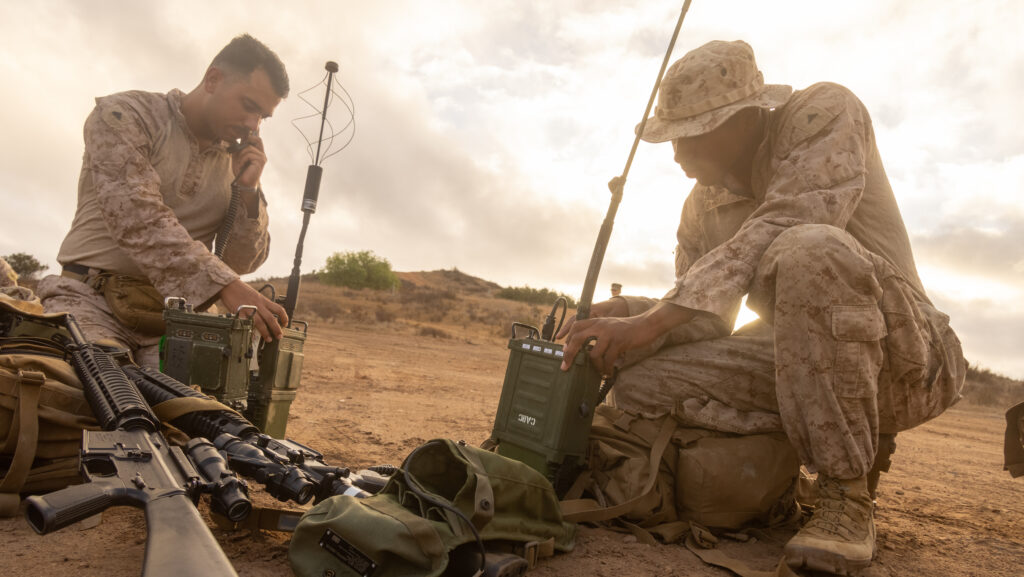
Planners for the Thunderstruck event, which took place at Marine Corps Air Station Miramar, aimed to create a realistic scenario, stressing competitors in war-like conditions to perform physical and technical tasks. The competition included a six-mile course participants had to navigate while carrying an assault load and communications equipment. Along the course, various stations tested their networking skills, with comms tasks including High Frequency voice transmission, Mobile User Objective System (MUOS) satellite communications, and data networking for information exchange.
Redundancy is Key: The PACE Plan
Officials emphasize the importance of PACE plans, or primary, alternate, contingency, and emergency communications plans. „What most units probably don’t practice in good execution with exercises, deployments, whatnot, is taking a PACE plan and flipping it on its head, knee capping it. We might have our primary and alternate setup. But rarely do we ever stress test our contingency and our emergency,” Chief Warrant Officer 2 Kelson Epperson, space and propagation engineering officer for Communications Squadron 38, told Breaking Defense.
Hopes for a Service-Wide Event
Creators of the competition from Comm Squadron 38 hope the event will grow in successive years. While Marine Corps Air Station Miramar is an ideal location, the hope is that it could rotate to different regions with varying geographic topographies. They also plan to increase the challenges and complexity going forward, potentially adding electronic warfare or offensive cyber components. Kerg said his team plans to „pitch it to headquarters Marine Corps in terms of making this thing an annual service-endorsed, service-wide event.”