Breakthrough Technology Poised to Transform Air Defense Capabilities
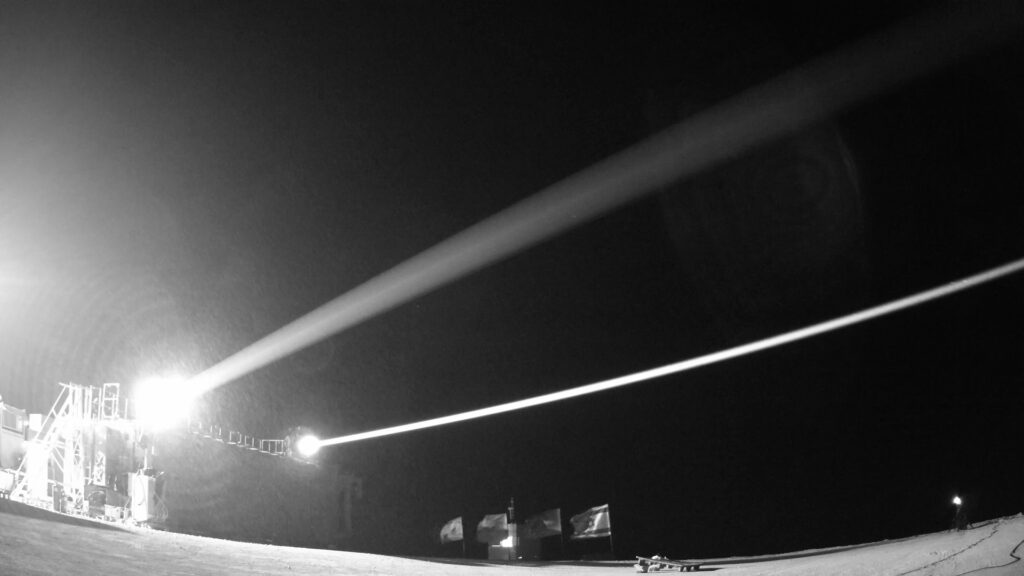
Israel has completed crucial tests on its Iron Beam laser air defense system, marking what the Ministry of Defense (MoD) and contractor Rafael have called a „final milestone” before its full deployment later this year. The Iron Beam, designed to integrate with the existing Iron Dome kinetic interceptor, has demonstrated its effectiveness against a range of threats, including rockets, mortars, aircraft, and UAVs. The MoD hailed this development as a „global technological and engineering breakthrough.”
Strategic Integration with Existing Systems
The tests, conducted in partnership with the Israeli Air Force and the Research and Development unit within the MoD’s Directorate of Defense Research and Development, pave the way for integrating the first systems into the Israel Defense Forces (IDF) air defense arrays by year-end. According to a defense official, production of the system, which also involves Elbit as a subcontractor, began over two years ago, with limited live-fire tests already underway.
A Game-Changing Military Technology
Defense Minister Israel Katz praised the laser’s performance, stating that it „places the State of Israel at the forefront of global military technology and makes Israel the first nation to possess this capability.” The allure of laser-based interception lies in its cost-effectiveness compared to traditional kinetic interceptors, particularly against smaller threats like drones or rockets. An Israeli defense official noted that the marginal cost of a laser interception, estimated at less than a few dollars, will significantly reduce the financial burden on Israel’s air defenses.
Technical Capabilities and Operational Range
The Iron Beam system can effectively burn or disable objects at a range of approximately ten kilometers, with interceptions occurring in mere „seconds,” according to the defense official. It will complement Israel’s existing multi-layered air defenses, which include the Arrow 2 and 3 systems for ballistic missile and exoatmospheric threats, the David’s Sling medium-range interceptor, and the Iron Dome for short-range threats.
Enhancing Air Defense Capacity
The Iron Beam system is expected to be deployed alongside existing Iron Dome batteries, integrating seamlessly with Israel’s command and control infrastructure. This integration will enhance the country’s ability to counter salvos of rockets and other complex threats. Moreover, the system has been tailored to mitigate the effects of atmospheric conditions like fog, which can impede laser performance.
Future Laser Defense Technologies
Beyond the initial Iron Beam deployment, Israel is exploring tactical lasers for maneuvering forces and airborne laser options. Rafael Chairman Yuval Steinitz emphasized that „Rafael’s laser system, built on our proprietary adaptive optics technology, will undoubtedly be a game-changing system with unprecedented impact on modern warfare.” Rafael has developed multiple types of laser air defenses, including a longer-range high-powered laser and a tactical laser for maneuvering forces, showcasing its commitment to this technology.
Deployment Amid Regional Tensions
This final milestone for Iron Beam comes as Israel intensifies its offensive in Gaza City and continues to face threats from Iranian-backed Houthis in Yemen. Minister Katz warned, „Our enemies from Gaza, Iran, Lebanon, Yemen, and other arenas should know: just as we are strong in defense, we are strong in offense – and we will do everything to protect the security of Israeli citizens.”