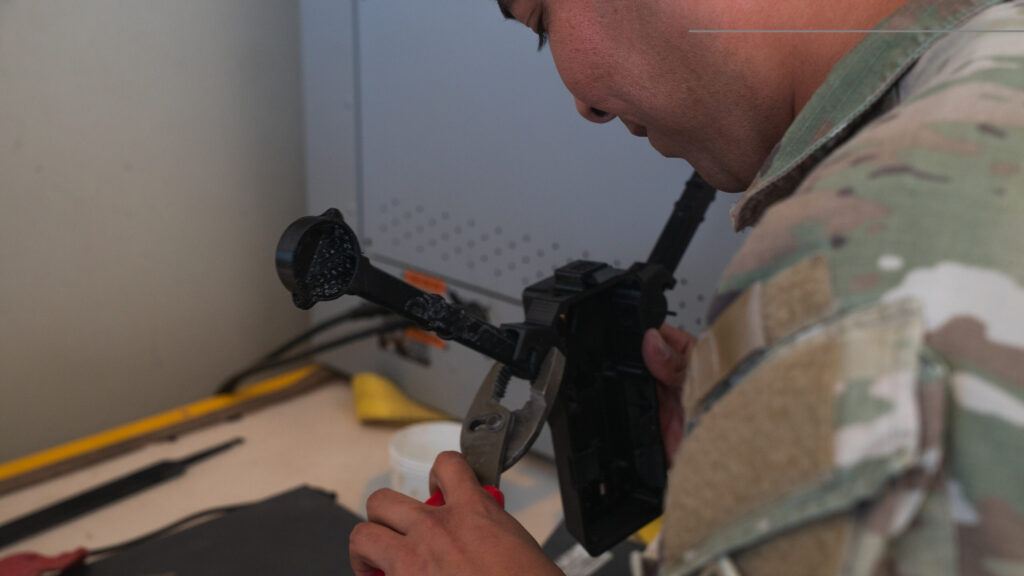
New policy empowers officers to accelerate repairs and keep equipment operational, cutting through bureaucratic bottlenecks
Army Secretary Daniel Driscoll announced today a major policy shift regarding the use of 3D printing on the battlefield. The Army is now allowing commanders to repair and send back out pieces of small 3D-printed equipment, without waiting for approval from higher-ups.
Accelerating Repairs: A Strategic Priority
„[We’re] empowering our generals to take on that risk where we have the right to repair so that they can make these very small parts to get things back on and get them back into the hands of our soldiers,” Driscoll told reporters during a media roundtable.
Concrete Examples: From Door Handles to Howitzers
Driscoll explained that commanders and soldiers in the battlefield are using 3D printers to print parts for platforms like infantry squad vehicles and M777 Lightweight 155mm howitzers. Now, instead of getting approval to use these parts from Army leaders who are not present in the battlefield, the commanders are allowed to decide if the parts are good to go out.
„We’re basically saying, ‘Hey colonel, hey general, you have to make the decision. If a door handle is broken on an ISV, you need to get it into the field. If you think that replacement door handle is sufficient, send it out.'”
Cutting Through Red Tape: An Aggressive Approach
„A lot of [howitzers] are down right now for very simple pieces that we could 3D print and have known how to 3D print, and actually have the design files to 3D print, but we haven’t done it,” Driscoll said. „So we, the Army, have kicked off a very aggressive approach to that.”
Superior Quality: 3D-Printed Parts Better Than Originals
Gen. Randy George, chief of staff of the Army, added that this change, coupled with improvements in additive manufacturing technology, has allowed for the Army to get platforms fixed and up and running at a more desirable speed. He mentioned that the „couple thousand” parts the Army has 3D printed thus far are „probably better than the original parts.”
Additive Manufacturing: A Critical Capability in the Indo-Pacific
Given the success and growing prominence of additive manufacturing, Driscoll said it will likely serve as a critical capability in the Indo-Pacific theater, explaining that because of the significant logistical challenges military forces face due to the vast geographical distances involved, the US will be under-equipped to build and ship new parts in the traditional way.
Anticipating the Future: More Funding for Additive Manufacturing
Driscoll also said he predicts that additive manufacturing will receive more funding in the fiscal year 2027 budget, especially given the imminent threat of a potential conflict with China, which the Pentagon has said could potentially happen in 2027.
„If you think of us in a protracted war with a peer or near peer [adversary]… our manufacturing, our ability to either manufacture physical things or software, the ability to update in near real time, is going to be crucial,” he concluded, according to the source.