Cutting-edge software platform to enable rapid testing of AI and autonomy capabilities from diverse vendors on real aircraft.
Ahead of the annual Air Force Association conference, Northrop Grumman revealed that its new high-tech testbed for AI and autonomy software, codenamed „Prism,” is poised to take flight „very shortly,” according to Dan Salluce, the company’s director for Advanced Autonomy.
Prism: The Key to Unlocking Autonomous Capabilities
The crucial element, Salluce explained, is the new autonomy software package, Prism, which will not only fly the testbed aircraft—a modified Model 437 Vanguard—but also allow for seamless integration of specialized software modules from partner companies. These modules can range from simple code for operating a single sensor to complex „mission planning” AI that dictates how the aircraft achieves human-designated objectives.
Open Architecture: The „App Store” for Military Drones
While Prism can safely fly a drone from „point A to point B” on its own, specialized software is required for different military missions, operational environments, under-wing equipment pods, or new onboard systems. To accommodate these add-ons, Prism is built according to an open architecture design philosophy, making it easy to add new software modules not just from Northrop, but from any company meeting the US Air Force’s common technical standards. Salluce likened this to the app store model of iPhones and Android devices, allowing users to download software from various third-party vendors.
Northrop will handle flight operations, safety, and airworthiness, allowing partners to focus on writing software.
A Win-Win Ecosystem: Beacon
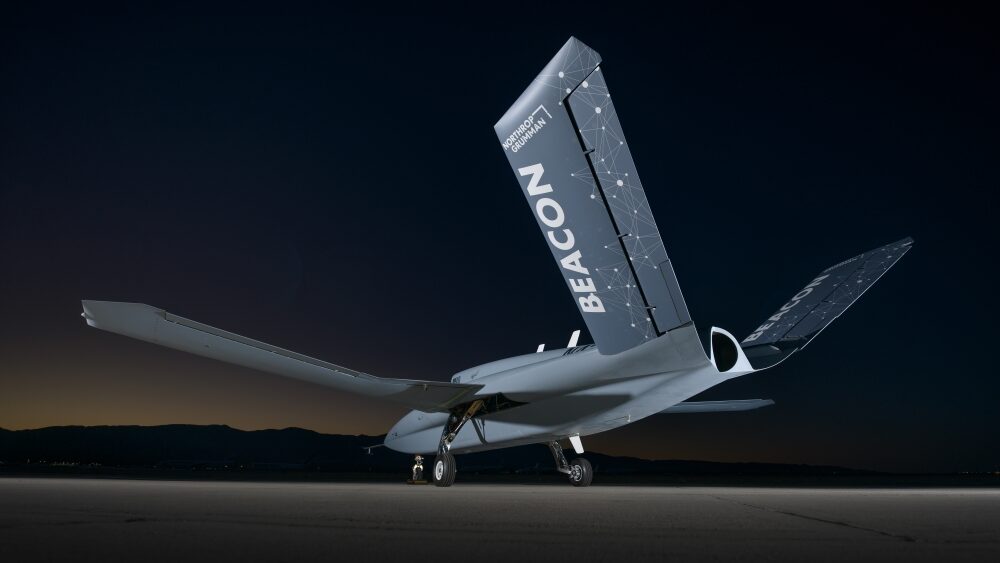
The overall „ecosystem” encompassing the Vanguard aircraft running Prism software, along with supporting ground systems, is called Beacon. Northrop has already announced six partner firms: Applied Intuition, Autonodyne, Merlin, Red 6, Shield AI, and SoarTech (an Accelint subsidiary).
These companies, primarily focused on autonomy and AI software, can leverage Beacon to flight-test their software in a real aircraft without the cost and effort of building their own testbeds or developing foundational flight software.
Salluce emphasized the market demand for autonomous testbeds, as many AI and autonomy innovators lack the resources to become hardware vendors.
Gradual Integration: From Prism to Partner Modules
The initiative, at least a year in the making, will follow a crawl-walk-run approach. Vanguard, which first flew as a manned jet last August, has been modified to run Prism. Initial flights will focus on testing Prism itself, with a safety pilot on board as a precaution. Once Prism is proven, software modules from partner companies will be integrated and flight-tested.
Salluce anticipates further news throughout the year as flight plans involving various levels of partner integration unfold, extending from 2025 into 2026. Vanguard, while initially envisioned as a forerunner for the Air Force’s „loyal wingman” Collaborative Combat Aircraft (CCA), will become a versatile flying testbed for software modules applicable to a wide range of aircraft, from high-performance CCAs to low-cost „attritable” drones and helicopters.