Stockholm Embraces Nuclear Alliance, Deploying Gripen Fighters to Steadfast Noon
In a significant move, Sweden will participate in NATO’s annual nuclear military exercise for the first time, signaling a major shift for a nation with a 200-year history of avoiding military alliances and nuclear entanglements.
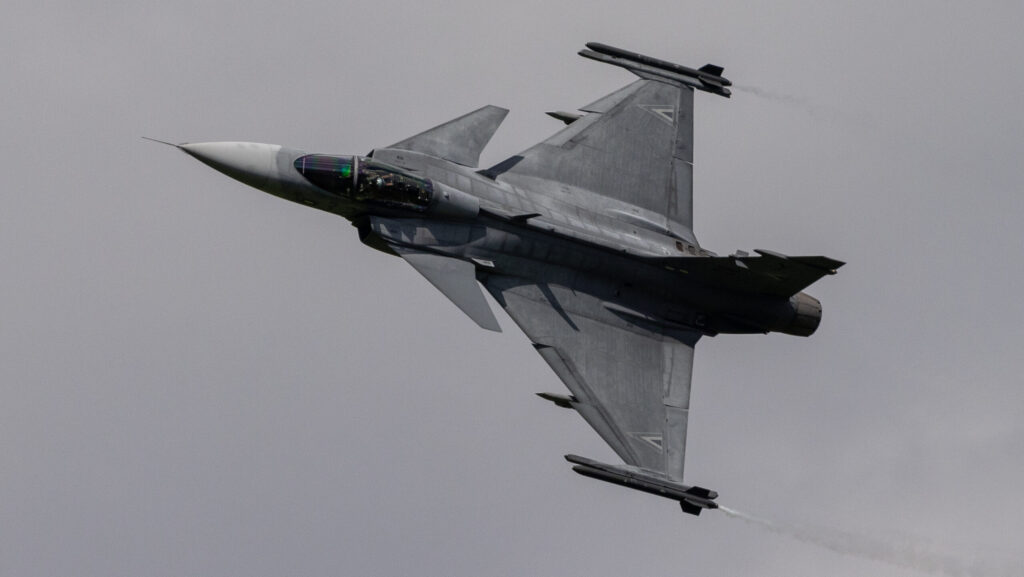
The Swedish government’s announcement on Friday, regarding the deployment of Saab Gripen fighter jets to the Steadfast Noon exercise, follows Finland’s confirmation of its participation with F/A-18 Hornets. Finland first participated last year. The exercise, hosted by the Netherlands, is set to begin next week.
NATO’s Nuclear Deterrent
Last year’s exercise involved 13 allied countries and over 60 aircraft, including nuclear-capable jets, bombers, and fighter escorts. Refueling aircraft and planes capable of reconnaissance and electronic warfare also participated in the exercise, which is designed to ensure the strength and credibility of NATO’s nuclear deterrent.
While NATO has not yet disclosed the extent of this year’s exercise, news reports indicate that 71 aircraft from 14 nations are taking part. No live nuclear weapons are used during the exercise.
„In an increasingly uncertain world, NATO needs a credible nuclear capability to prevent attacks against the Alliance. Steadfast Noon contributes to ensuring this,” Prime Minister Ulf Kristersson said in a written statement Friday.
NATO Secretary General Mark Rutte stated on Friday that the exercise „sends a clear signal to any potential adversary that we will and can protect and defend all allies against all threats.”
Embracing Nuclear Alliance
Sweden’s participation raises questions about how fully Stockholm would embrace NATO, which relies on nuclear weapons from the United States, United Kingdom, and France. At a seminar in Stockholm in June 2024, NATO’s head of nuclear policy, Jim Stokes, emphasized that „Sweden needs to communicate to its public the importance of having joined a nuclear alliance.”
Defense Minister Pål Jonson echoed this sentiment, stating, „By participating with conventional Gripen combat aircraft in Steadfast Noon, Sweden contributes to ensuring that NATO’s nuclear deterrence remains credible, robust, and effective.”
Conventional Support
While Swedish and Finnish military jets will not handle nuclear weapons directly, their participation will focus on practicing conventional support capabilities with Gripen and F/A-18 Hornet jets. This contributes to the alliance’s nuclear deterrence strategy and tactics, known as SNOWCAT (Support of Nuclear Operations with Conventional Air Tactics), holding real value.
As William Alberque, former director of NATO’s weapons control, explained when Sweden applied for membership in 2022, conventional air tactics can include escorting combat aircraft loaded with simulated or real nuclear weapons.
NATO Nuclear Mission
To ensure the security of NATO’s allies, the US maintains B-61 nuclear weapons in Europe under strict US custody, in compliance with the Non-Proliferation Treaty.
In a NATO nuclear mission, certified allied dual-capable aircraft would deliver the weapons, supported by conventional forces. Such a decision would require explicit approval from NATO’s Nuclear Planning Group, which involves the defense ministers of both Sweden and Finland, as well as authorization from the leaders of Washington and London.
It is estimated that the US Air Force stores around half of its 200 tactical B61 bombs at airbases in NATO countries Germany, Belgium, the Netherlands, Italy, and Turkey. These bombs can be carried by specially certified fighter aircraft of these nations, as well as American fighter and bomber aircraft.
B61-12 and B61-13 Bombs
Full-scale production of the new version of the non-strategic (tactical) B61-12 bomb began in 2022, with manufacturing and deployment completed at the start of 2025, according to Stockholm’s International Peace Research Institute.
The F-15E was the first jet certified to carry the B61-12 nuclear bomb, followed by the F-35A. Last year, the National Nuclear Security Administration (NNSA) confirmed certification for the B-2, F-16, and German Air Force PA-200 Tornado, with efforts ongoing to certify the Italian Air Force’s Tornado and the U.S. Air Force’s B-21 bomber.
A new variant, the B61-13, is designed to have a higher yield of around 360 kilotons, a significant increase from the 50 kiloton B61-12. The first production unit on the B61-13 is scheduled for fiscal 2026, as reported by Breaking Defense in January.