European Nation Gains „Total Access” to Air Force’s Collaborative Combat Aircraft Program
The United States and the Netherlands have signed an agreement for the European nation to participate in the development of the US Air Force’s Collaborative Combat Aircraft (CCA) program, paving the way for a transatlantic exchange of autonomous drone wingmen technologies.
Letter of Intent Signed: Transatlantic Drone Collaboration Unlocked
The letter of intent was signed by Netherlands State Secretary for Defense Gijs Tuinman at the Netherlands embassy in Washington, marking a significant step forward in defense cooperation between the two countries. “We’re really grateful and [have] been working hard with our US partners and the US Air Force to actually get into the CCA program. So for us, that’s a big thing,” Tuinman told reporters at the Dutch embassy following the announcement. “And I think it also makes the world a lot safer if in the near future, we can actually also operate CCA type of aircraft in the European theater.”
„Total Access” to CCA Program: Dutch Input on Unique Requirements
As a result of the new partnership, Tuinman said that the Netherlands has now unlocked “total access” into the US Air Force’s CCA program “on all levels,” enabling Dutch officials to input their own requirements unique to the European theater. Pointing to an expected pairing of two drone wingmen with a fighter, Tuinman said there could be a need for over a 1,000 CCA in the near future — a boon to US industry and European partners alike.
Netherlands as „Jumping Pad” to Europe: Opportunities for US Firms
Acknowledging the desire by American firms to seek customers in Europe, where a continental push for greater defense spending also comes with an emphasis on indigenous tech, Tuinman said the new partnership could serve as a pathway to sales for US companies. “I also want to express that the Netherlands is like the jumping pad for the United States to get into Europe,” he said.
US Air Force: Shared Commitment to Next-Generation Airpower
A US Air Force official told Breaking Defense in a statement that the new drone collaboration “builds on decades of U.S.–Dutch defense cooperation and reflects a shared commitment to fielding next-generation airpower.” Under the program “both nations will explore opportunities to jointly develop, test, and evaluate CCA technologies, mission systems, and employment concepts that strengthen interoperability across allied air forces,” added the official.
Foreign Buyers Eye „Increment” Two: Opportunities for Separate Use Cases
The first round of the Air Force’s CCA program is well underway, and officials have chiefly discussed its next iteration, or “increment,” as the primary opportunity for foreign buyers. An Air Force official told reporters in September that international partnerships may even result in separate use cases in the second increment that drive different designs for the US and a foreign partner.
General Atomics Agreement: Small Drones for ISR and Manufacturing Collaboration
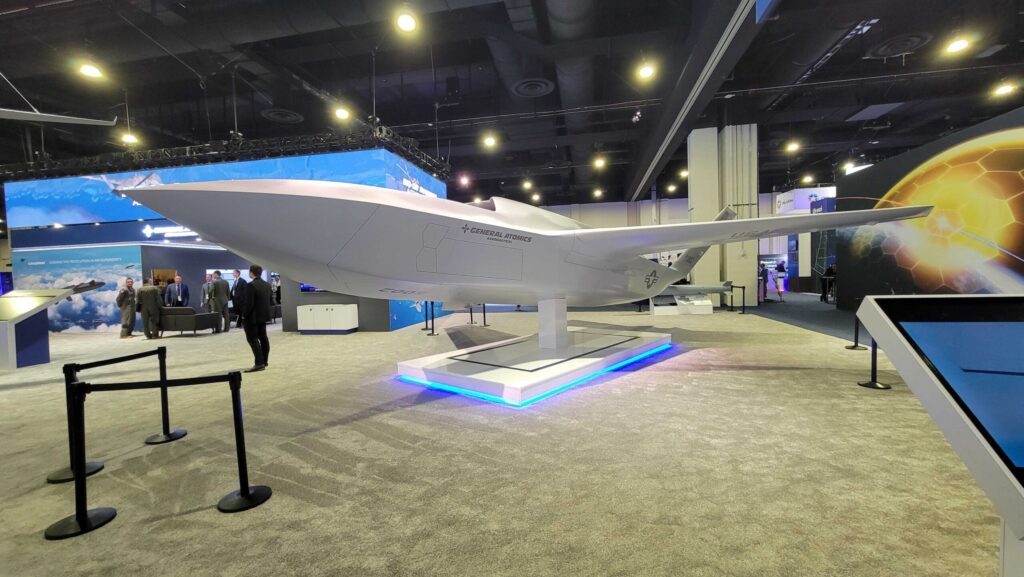
Alongside the announcement with the US, the Netherlands unveiled a separate letter of intent with the American firm General Atomics. The company said in a press release that it will initially focus on developing small drones that can provide intelligence, surveillance and reconnaissance. The agreement includes collaboration between General Atomics and the Dutch to “establish UAS [unmanned aerial system] manufacturing capability,” the release says, where the American firm has tapped Dutch company VDL Defentec for producing the small drones.
Drones for „Intermediate Layers”: Penetrating Air Defenses
Tuinman said the agreement with General Atomics would help boost production between the US and Europe, especially by leveraging Dutch “production ecosystems” that can quickly scale up manufacturing. The minister then said a key need driving the partnership is for drones that are in “intermediate layers” that can penetrate air defense bubbles and provide both surveillance and strike capabilities. The Dutch press release announcing the partnership on the CCA program says the drones developed separately with General Atomics should be able to enter service by next year.
Russian Drone Incursions: Alliance Unity Unwavering
Russian forces have recently used their own drones to violate NATO airspace, which some European officials have accused as a deliberate act of provocation that also prompts questions about the collective defense of the alliance. Tuinman said the Russian drone incursions were an attempt to divide the alliance, but stressed they would not be successful, pointing to shared sacrifices like a cemetery for American soldiers who died fighting in World War II near where he grew up. „So that’s in my memory,” he said, adding that „our futures are intertwined and connected, and nobody can drive a wedge between those.”