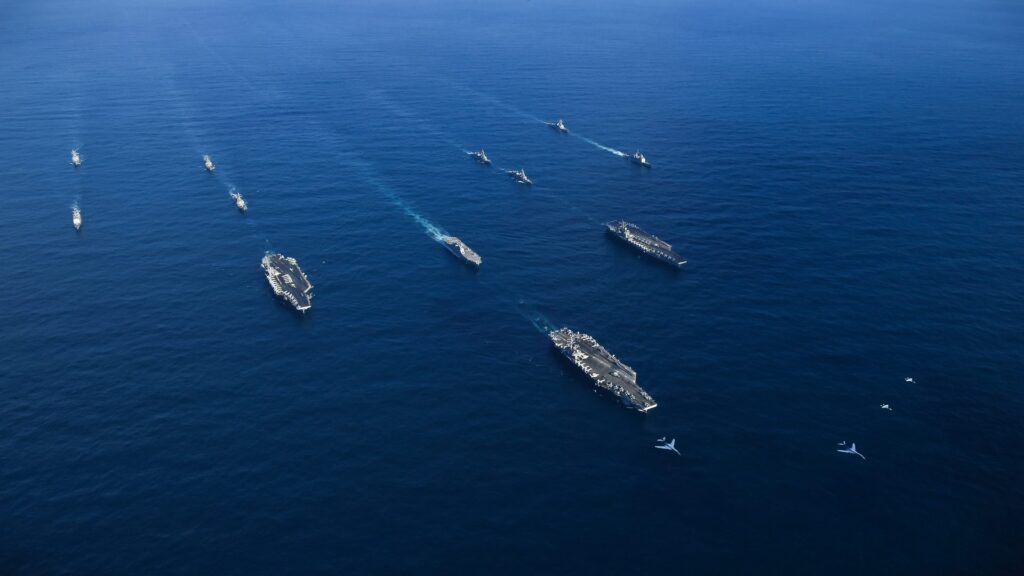
Future operations will require a persistent presence inside the enemy’s reach, Admiral Koehler emphasizes.
Future operations in the Indo-Pacific will require persistent activity inside the enemy’s reach, according to a top naval commander.
Persistent Domination of the Battlespace: US Navy’s Priority in the Indo-Pacific
„Just as speed is a defining characteristic in our modern battlespace, we also need persistence. And what I’m talking about here is persistent power projection and persistent domination of the battlespace leading to a denial of the adversary’s objective,” Adm. Stephen Koehler, commander of U.S. Pacific Fleet, said during a presentation at AFCEA’s TechNet Indo-Pacific conference in Hawaii Tuesday.
Operating Within the Enemy’s Weapons Engagement Zone: A Necessary Strategy
„It means forces are able to execute prolonged operations against evolving threats and our forces are able to operate inside the enemy’s weapon engagement zone, or WEZ … We must not be deterred from operating at the time and place of our choosing. To do so would succumb to an adversary area denial strategy and cede battlespace, and I refuse to do that.”
Taking Calculated Risks: Entering the Enemy’s Engagement Zone is Essential
Koehler noted that part of his remit within USPACFLT is to bring the fight forward to the enemy on their turf.
Overcoming the Enemy’s Greater Weapon Range: Maneuver and Innovation are the Solutions
If „the fighter that you’re fighting has a longer reach than you have, then if you don’t maneuver, if you don’t work different ways to get in there, he’s going to pummel you. But that doesn’t mean you don’t fight him and that’s not what militaries do,” he said. „We work inside the weapons engagement zone, that’s how you affect the fight, and that’s our job.”
Emerging Technologies: Essential Tools for Persistence in Enemy Territory
Operating forces within the range of enemy weapons, with the needed persistence to have an effect, requires ingenuity and creativity in both tactics and equipment, Koehler explained, which is why the fleet is looking at emerging technology from artificial intelligence to advances in communications and networks.
Improving Communications in Contested Environments: Adaptability and Spectrum Agility
USPACFLT „is augmenting traditional military comms with scalable, agile options for contested, bandwidth constrained environments. We continue to integrate these things like commercial SATCOM, 5 and 6G and open radio access networks into our maritime architecture,” he said. „These capabilities open our door for the rapid deployment adaptation and specific mission needs for enhanced spectrum agility.”
Commercial Cloud and Data Centers: Persistent Connectivity at the Tactical Edge
Commercial network fabric and data centers across the Indo-Pacific region will enable persistent connectivity for distributed maritime operations, Koehler said, adding they are integrating commercial cloud infrastructure and services to ensure data is processed, stored and accessed closer to the tactical edge.
Artificial Intelligence: Accelerating the Decision Cycle
Those capabilities will enhance mission readiness, survivability and ultimately, decision superiority, he said.
The fleet is also working with industry on a hybrid approach to accelerate innovation on AI with the overall goal of using these emerging technologies to get inside an adverary’s decision cycle.
Integrating AI into All Aspects of Navy Operations: From Command and Control to Target Analysis
„We are working with partners in industry and government to integrate it into our day to day functions and operations. Those include command and control, cyber, logistics, ISR, target analysis and more,” Koehler said. „We will enhance our command and control, increase our lethality and dominate in the WEZ across the entire continuum from competition to conflict.”
The Future of Naval Power: Dominating the Battlespace With the Help of Artificial Intelligence
Koehler said he envisions a future in which USPACFLT is empowered by artificial intelligence, where operators balance the art and science of warfare to make more effective decisions with superior outcomes faster than the adversary.
The Ultimate Goal: Decisive Combat Advantage By Accelerating the Cycle of Action
„A future where AI further accelerates the cycle of action between maneuver and fires for decisive combat advantage. That is the North Star I give my team every day,” he said.