A strategic partnership between giant Lockheed Martin and start-up Saildrone promises to redefine naval warfare, integrating advanced missile systems on autonomous maritime platforms.
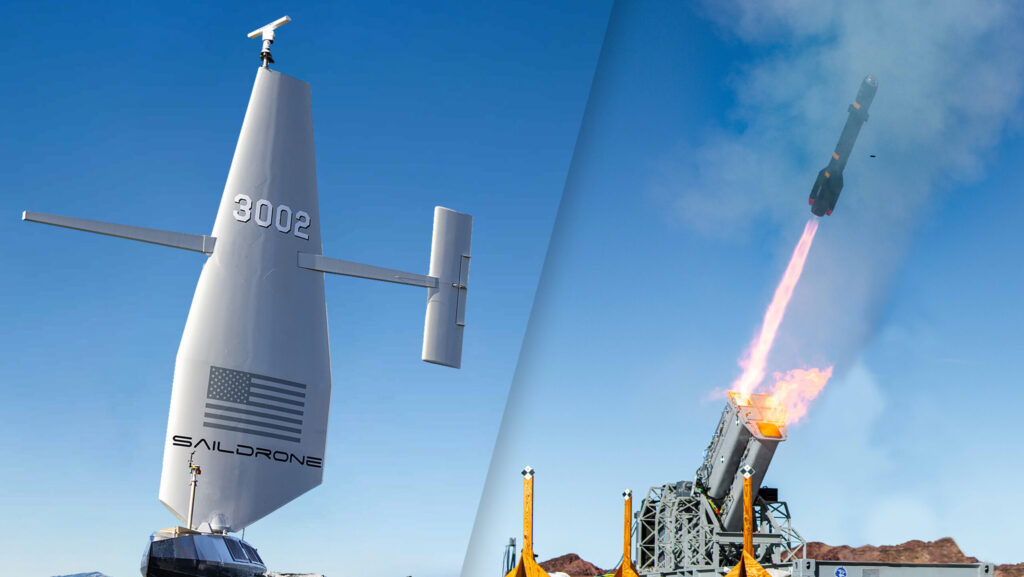
Lockheed Martin, a leading name in the aerospace and defense industry, has announced a major $50 million investment in Saildrone, a California-based maritime drone manufacturer. The goal? Equipping Saildrone Unmanned Surface Vessels (USVs) with Lockheed Martin air-to-ground missile launchers, a move that could radically alter the landscape of naval operations.
Immediate Integration and Live Fire Demonstrations in 2026
According to a Lockheed statement, cited by Breaking Defense, work will begin immediately, adopting an open architecture approach with secure command and control capabilities to integrate Lockheed Martin’s Joint Air-to-Ground Missile (JQL) Quad Launcher system onto the Saildrone Surveyor platform. Live fire demonstrations are expected in 2026. Future plans include the development of larger Saildrone vehicles, capable of supporting significantly larger payloads and capabilities, including the Lockheed Martin Mk70 VLS launcher and thin line towed arrays.
A Lethal Combination of Technologies
This strategic arrangement combines Lockheed’s missile launchers, ubiquitous throughout the Navy’s fleet, with Saildrone’s autonomous maritime drones, which have historically focused on unclassified surveillance missions. Stephanie Hill, president of Lockheed’s rotary and mission systems business, stated that together, the two companies are combining the most sophisticated commercial and defense technologies to deliver a lethal naval solution at speed and scale.
A Transformation for Saildrone
The announcement is particularly significant for Saildrone, a relatively small start-up that, until 2020, mostly worked with civilian agencies. Since then, the company has become increasingly active with the Navy and Coast Guard, participating in the Rim of the Pacific Exercise in 2020 and Task Force 59 in 2021.
Saildrone CEO Richard Jenkins told Breaking Defense that this collaboration is „transformational” for the company. „This is a fundamental repositioning of our capability for much heavier impact [and] much heavier firepower for larger ship needs.”
Jenkins’ Vision and the Changing Geopolitical Climate
Jenkins mentioned that he had initially unsuccessfully attempted to pitch this idea to the Navy in 2014. The shift in attitude from the Navy in the 2020s is no coincidence. Since 2019, the service has strongly supported the idea of building a hybrid fleet, consisting of traditional warships, joined by unmanned surface and submersible vessels of various sizes.
Parallel to the Navy’s activities, Saildrone has focused on collaborating with the Pentagon, despite its history with research and civilian institutions. The company has recruited a former chairman of the Joint Chiefs of Staff as head of its board and a retired three-star admiral as its president.
Challenges and the Future of Collaboration
Jenkins acknowledged that physically integrating a missile launcher onto the Saildrone platform will not be a difficult task from an engineering perspective. The major challenge will be the back-end work associated with the command and control of a kinetic weapon.
„Lockheed is one of the only firms that actually has the key to the entire architecture to be able to… see Saildrone’s [intelligence data] on the bridge of a destroyer or in a command center, in an encrypted and secure way, and then be able to take direct control of the effectors on board the vehicle to create an effect,” he said.
For now, the efforts to combine the technologies of the two companies remain independent research and development, which means that the Pentagon has no stake in the outcome.