Aerospace industry firms are largely locked and ready to go with their bids for the U.S. Army’s “Flight School Next” program, a crucial initiative aimed at training the next generation of helicopter pilots. Although an initial deadline was set for October 31, the program was affected by the government shutdown, and the Army now aims for a final initial solicitation at the end of November. This delay, however, does not diminish the urgency, as the program has been placed in an “exception” status, allowing work to begin “immediately” once bids are in.
Why Now? A Pilot Training Crisis Underlines the Urgency
In a context where the Army’s aviation fleet is already undergoing multiple changes, the question arises: why is the Army launching a costly, time-consuming competition with at least half a dozen bidders? The answer is simple, explains Major General Clair Gill, commanding general of the Army Aviation Center of Excellence at Fort Rucker, Alabama. Waiting any longer would lead to even higher costs without producing the desired results.
„If I could have done this two years ago, I would. There’s a lot of challenges to going through and doing the analysis,” Gill told reporters at the annual AUSA conference. „Why now? Because if we don’t, we’re going to have to recapitalize the fleet that we have, and we’re going to spend more money to create the same aviator, not a better aviator.”
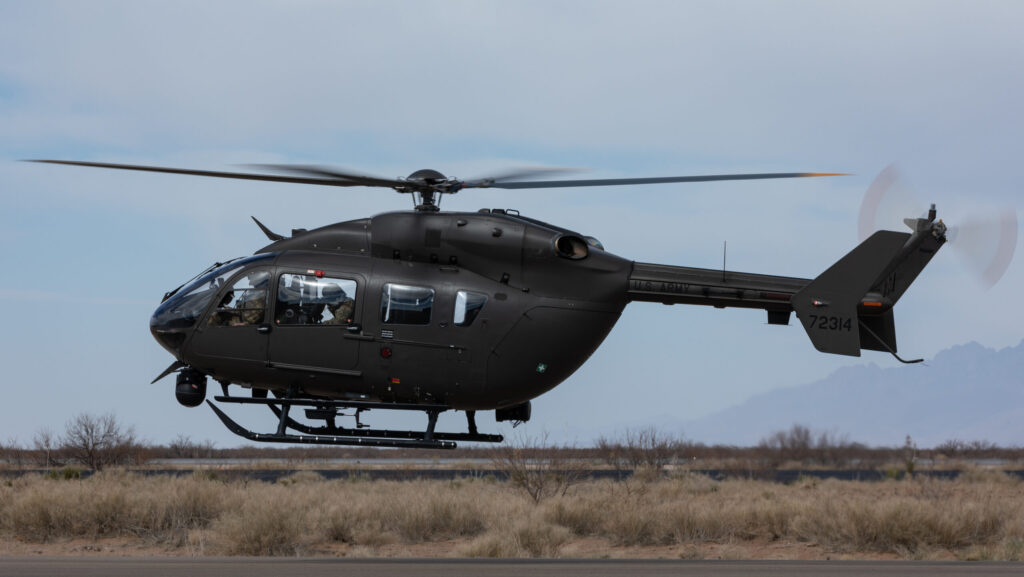
The core problem lies with the current training aircraft, Airbus’ UH-72 Lakota. Vice Chief of the Army Gen. James Mingus noted that the Lakota is „a very sophisticated aircraft that almost flies itself,” a rarity for defense technologies. This exaggerated efficiency has led to a lack of pilot familiarization with fundamental flying skills, contributing to an increase in accident rates. „One of the things that we’ve noticed over the last couple years is our accident trends are moving in the wrong direction,” Gill explained. „We have a very talented population that’s coming out. They’re inexperienced. They’re very good at systems operations. They’re not very good at flying fundamentals.” Therefore, the Army is looking for a „very simple aircraft” to get aviators back to basics.
The COCO Model and Strict Requirements: A Paradigm Shift
The „Flight School Next” program aims not only for a new aircraft but also a new curriculum, with a target contract award by the end of September 2026. It seeks to train 900 to 1,500 rotary-wing pilots per year over a performance period of 26 years.
The Army is also looking to shake up the way it acquires both the aircraft and the curriculum. According to a draft commercial solutions opening (CSO), „Flight School Next” will adopt a Contractor-Owned, Contractor-Operated (COCO) model, allowing companies to own and run the program instead of the government. In this model, prime contractors will be responsible for finances, major repairs, and logistical support, while subcontractors will handle supplying helicopters, supply chain management, component-level repairs, and most of the flight school curriculum.
One industry player noted that the reason for having a prime take care of the big-picture logistics is likely so the Army has one entity to blame if things go awry. „I’ve heard even a number of generals say the train of thought is, they want one throat to choke when things start to go, you know, get messy, and performance is bad,” Ryan Weeks, president and CEO of MD Helicopters.
The Army is requesting that the aircraft for „Flight School Next” meet a slew of requirements, with the three most prominent being: a turbine single-engine, a counterclockwise-rotating rotor system, and Instrument Flight Rules (IFR) certification. The latter, awarded by the Federal Aviation Administration (FAA), takes around 12 months to complete and requires specific equipment for low-visibility environments, anti-icing or de-icing systems, appropriate warning systems, dual generators or backup batteries, and more.
The Aviators’ Battle: Competitors and Their Solutions
Ahead of the planned deadline, six companies confirmed their intention to compete for „Flight School Next,”: Airbus, Bell, Leonardo, Robinson Helicopter Company, MD Helicopters, and Enstrom Helicopter.
- Airbus (Current Provider): The UH-72A Lakota helicopter, used since 2016, is IFR certified and has a counterclockwise-rotating rotor system, but it is twin-engine, making it unsuitable under current requirements. Steve Burns, Airbus’ Director of Washington Operations, argued that the Army should not make the training fleet more basic; instead, if changing the aircraft, it should modify the existing Lakota, which the Army has already invested in.
- Bell: The company will compete as a prime contractor with its 505 model. It is single-engine and has a counterclockwise-rotating rotor system but is not yet IFR certified, though Bell „is in the process” of obtaining the certification. Carl Coffman, Vice President of Military Sales and Strategy at Bell, highlighted the company’s historical experience in training Army aviators.
- Leonardo and Boeing (The Winning Team?): Italian defense firm Leonardo will team up with Boeing. Leonardo will serve as subcontractor, providing its TH-73 trainer, and Boeing will be the prime contractor, responsible for fleet management, major repairs, logistical support, and simulation training. The TH-73 meets all three prominent requirements (single-engine, counterclockwise rotor, IFR certified), making it the only aircraft analyzed. With over 100,000 flight hours and 40,000 autorotations to the ground, the TH-73 already has a contract with the US Navy, Marines, and Coast Guard and is manufactured in Philadelphia.
- The Subcontractors: Robinson, MD, and Enstrom: The decision to seek a less-capable aircraft has opened the competition to lesser-known helicopter firms. All propose single-engine aircraft with counterclockwise-rotating rotor systems but are not IFR certified:
- Robinson Helicopter Company: Proposing the R-66 model, known for low maintenance.
- MD Helicopters: With its 530 model, it faces challenges related to production capacity, limited to dozens annually. Ryan Weeks warned that „it’s honestly going to be a challenge for everybody” to meet necessary volumes due to post-COVID supply shortages.
- Enstrom Helicopter: Offering its 480B model, originally designed for the Army’s next training helicopter (NTH) program in the early 1990s and already used for military training in Japan, the Czech Republic, and Thailand. IFR certification is expected within approximately 12 months.
Challenges and Ambitions: The Path to a New Era
General Gill stated that Army senior leadership „supports moving fast” on „Flight School Next” but cautioned that things won’t be so easy, even before the government shutdown paused things. „They’ve told me to go fast. There are a lot of aspects that I’ve got to take into account… to do this in a legal way, do it in a way that we can budget it, get all the approvals that we need. So, [there are] a lot of factors involved that are outside of my control that I wish I could go faster,” he admitted.
Nevertheless, the prospect of a potentially lucrative business deal does not seem to deter competitors. „Just because the Army is taking longer doesn’t mean they’re going to give us a bye on [the] schedule, right? We’ve got to continue to move,” said Coffman from Bell, emphasizing the company’s continuous preparation in anticipation of a contract that will define the future of US Army helicopter pilots.