Australia, an island continent deeply reliant on global data and communications transmitted via undersea cables, faces an „existential” threat due to a critical deficit in law, policy, and capability to protect and repair these vital digital arteries in the event of an attack. This stark warning emerged from experts at the Indo Pacific International Maritime Expo in Sydney, highlighting a gaping vulnerability in the nation’s national security framework.
The „Existential” Threat Below the Waves
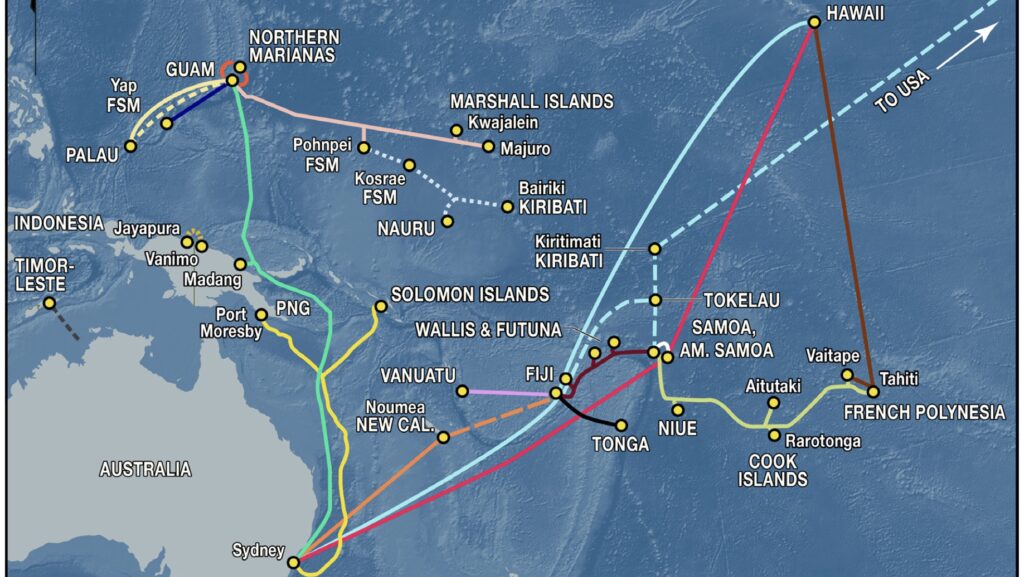
Vice Admiral Mark Hammond, Chief of the Royal Australian Navy, articulated the gravity of the situation at the expo’s opening ceremony. „Our connectivity to the global financial system and to family and friends across the world depends on the integrity of around 16 submarine cables that stretch across the seabed from continent to continent, and they plug in at various points along our coastline. This is what the sea means to Australia,” he stated.
The stakes are alarmingly high. „The reality we face is that you do not need to invade Australia to defeat Australia,” Hammond warned. „While maritime trade routes and seabed cables are our lifelines, they are also our greatest vulnerabilities. The loss of either would be an existential threat to our island and to our people.”
A Fragmented Response: No Clear Custodian for Critical Infrastructure
Despite the profound reliance on these cables, a panel of civilian experts, along with serving navy officers and commercial experts, revealed a troubling lack of preparedness. There is currently no single person or agency within the Australian government responsible for monitoring and responding to issues concerning these crucial cables. Furthermore, Australia lacks a clear doctrine for dealing with deliberate attacks on these networks and possesses insufficient commercial or military capabilities for rapid protection and restoration.
„We have no designated command. So who is responsible? Is it Navy? Is it Border Force? Is it Home Affairs? Who owns this mission? There is limited surveillance. So how do we monitor? How do we protect these zones?” questioned Samuel Bashfield, a research fellow at La Trobe University. „Do we have the protocols for industry to request naval protection? And these aren’t just policy gaps, but I would say they’re operational vulnerabilities that adversaries can and will exploit.”
Repair Reliances and Deep-Sea Dangers
The current repair mechanisms underscore Australia’s dependence on external entities. David Brewster, senior research fellow at the National Security College of Australian National University, pointed out that Australia relies on foreign commercial companies based in Fiji—a week’s sail away—to repair its cables. These repair arrangements are typically managed through „geographic clubs” of private operators. „Now the prioritization of repairs is a matter for private operators, not for countries. So we don’t have a say,” Brewster explained.
Moreover, these existing measures are designed for accidental, relatively shallow breaks, not for coordinated attacks at greater depths or across multiple locations. While India is reportedly considering building a dedicated cable repair ship, costing up to AUD$150 million ($95 million USD), Australia lacks the human expertise to operate such a vessel, making it an unlikely immediate solution.
„Increasingly, our adversaries have technology to be able to attack cables down to much greater depth, say 2,000 to 3,000 meters, using submersibles, and there’s very little protection happening through at that depth,” Brewster added, emphasizing the evolving threat landscape.
Deterrence Dilemmas: The Challenge of Attribution
The discussion also touched upon potential deterrence strategies. Asked if deterrence by example—such as publicly demonstrating the destruction of a cable in retaliation—might work, Brewster conceded it was a „valuable signal” but cautioned about the difficulties of attribution, comparing it to the complexities of the cyber domain where identifying an attacker is often challenging. This issue becomes particularly acute when dealing with adversaries less reliant on international cables than Australia.
The vulnerability of undersea cables is not a new concern for Australia. Associate Professor Sue Thompson of ANU’s National Security College noted historical precedents, recalling German military attacks on Australian communication cables in World War I and similar actions by the Japanese in World War II.
A Modern Battlefield: Russia’s Baltic Aggression as a Warning
Several speakers highlighted Russia’s repeated attacks on cables in the Baltic Sea over recent years as a contemporary warning. These incidents „really show that state actors are targeting submarine cable networks and that we should expect similar incidents in our part of the world, and that this is a defense mission,” Bashfield asserted. He criticized what he perceived as „shirking of responsibility amongst Canberra’s agencies,” arguing that „Naval protection isn’t just infrastructure policy, but it’s maritime security. It’s national security and it’s deterrence.”
However, a Royal Australian Navy source, speaking anonymously, revealed that the service has faced shrinking acquisition and operations budgets in recent years, largely due to escalating pension and medical costs, and the substantial investment in the AUKUS nuclear-powered submarine project. While the Navy would undertake the role of monitoring, defending, and repairing cables if ordered, the source indicated it would lack the necessary resources to expand beyond current limited efforts. The critical importance of undersea cables is only set to grow, especially with their integral role in artificial intelligence networks, further intensifying Australia’s urgent need to address this profound national security gap.