As the U.S. Marine Corps marks its 250th anniversary this week, a profound insight emerges from within its ranks: true innovation often springs not from headquarters, but from the ground up. This enduring legacy is vividly exemplified by the 2nd Marine Air Wing (MAW), a unit that has quietly, yet decisively, redefined modern warfighting.
A Legacy Forged in Adaptability For over 45 years, defense expert Robbin Laird has chronicled military evolution, offering a unique lens through which to view current defense issues. He points to the 2nd MAW as a living testament to the Corps’ commitment to innovation. His personal journey with the unit began in 2007 aboard HMS Invincible, arriving via an Osprey. Since then, Laird has regularly visited their crucial airbases in North Carolina (Cherry Point and New River) and South Carolina (Beaufort), meticulously documenting a profound strategic pivot.
Over the past decade, the 2nd Marine Air Wing has undergone a radical transformation. No longer primarily a counterinsurgency force, it has evolved into a formidable, technologically advanced, and highly adaptable aviation unit. Its focus has shifted dramatically from the deserts of Iraq and Afghanistan to the demanding environments of the High North, preparing for distributed maritime operations against peer competitors. This is more than just a geographical reorientation; it’s a complete rethinking of logistics, mobility, and survivability in contested battle spaces.
The Technological Vanguard: Platforms Driving Change Four state-of-the-art platforms are at the heart of this operational metamorphosis:
- MV-22 Osprey: This tiltrotor aircraft has redefined assault support. By seamlessly blending helicopter versatility with fixed-wing speed and range, the Osprey has enabled entirely new operational concepts, such as the Special Purpose Marine Air-Ground Task Force (MAGTF) and distributed operations across vast distances previously impossible with conventional helicopters.
- F-35 Lightning II: Beyond its fifth-generation lethality, the F-35 functions as a networked sensor platform, a „wolfpack” that significantly enhances the effectiveness of the entire joint and allied force through unparalleled battlefield awareness.
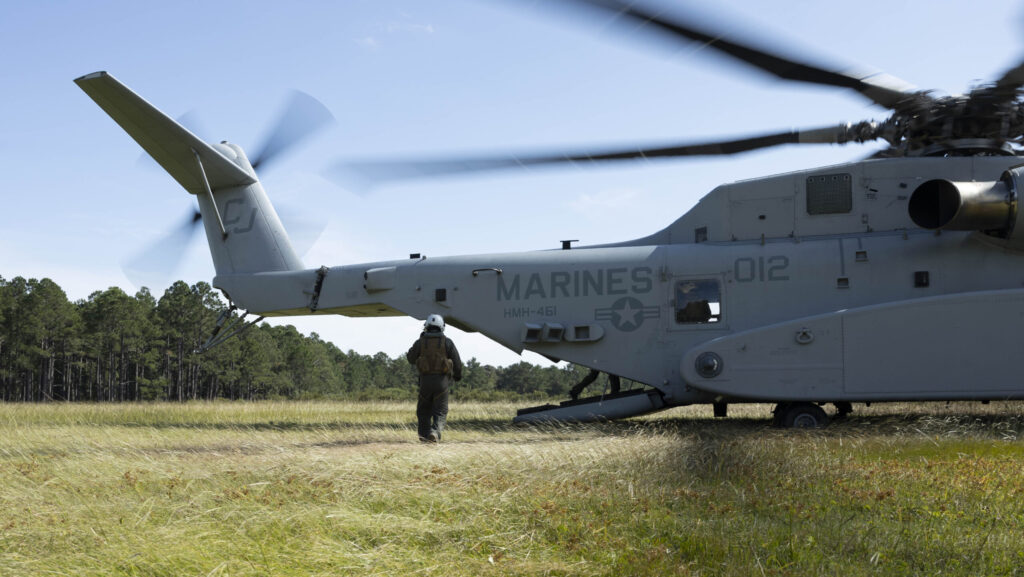
- CH-53K King Stallion: Representing a generational leap, this heavy-lift helicopter boasts a digitally native design, offering dramatically improved performance and maintainability over its predecessors.
- KC-130J Super Hercules: The indispensable enabler, this versatile aircraft provides critical lift, aerial refueling, and even fire support through its Harvest Hawk system, cementing its status as one of military aviation’s most innovative support platforms.
These aren’t merely new pieces of equipment; they demand entirely new thinking. Concepts like Expeditionary Advanced Base Operations (EABO) and Distributed Aviation Operations (DAO) necessitate agile, mobile support structures, fundamentally reshaping the traditional roles of aviation ground support and command and control units.
Innovation’s True Front Line: The „Cowbell Philosophy” Yet, as Laird observes, the most revolutionary changes aren’t occurring solely in cockpits. They’re unfolding in maintenance bays, along logistics chains, and, crucially, within the minds of young Marines working on the flight line.
Lt. Gen. William Swan, former commanding general of the 2nd MAW and now Deputy Commandant of Aviation, perfectly encapsulated this ethos with his „more cowbell” philosophy, a nod to the famous Saturday Night Live skit. Swan literally distributed cowbells to Marines who devised creative solutions to persistent problems. This wasn’t a gimmick; it was a powerful recognition that innovation must emanate from those closest to the challenges. „The Marines want to do a great job, and they want to be better,” Swan told Laird. „They want to win.”
This bottom-up approach reflects a broader shift toward mission command, empowering junior personnel to solve problems and make decisions rather than awaiting directives from above. In contested environments against peer adversaries, this cognitive agility at the lowest levels becomes a decisive advantage. Throughout this decade of transformation, one principle has remained unwavering across every commanding general: Everything exists to support the Marine on the ground. Every technological advancement, every tactical innovation, every operational concept must ultimately make Marines more effective and more likely to survive.
This isn’t mere rhetoric. It’s the organizing principle that connects the F-35’s network capabilities directly to the rifleman’s tablet, that links the KC-130J’s aerial refueling to extended patrol ranges, and that translates the Osprey’s speed into survivability for those it carries.
A Living Laboratory of Warfighting Excellence The Marines of the 2nd MAW continuously rework what a „ready force” means for the nation. They prepare, train, deploy, risk their lives, and serve with unwavering dedication. They adeptly adapt legacy platforms like the Viper helicopter while simultaneously mastering revolutionary new systems. They transform support aircraft into combat multipliers and heavy-lift helicopters into precision instruments.
Defense transformation is not about disruption for its own sake. It’s about meticulously integrating new technology and techniques into realistic, actionable operational concepts. That, according to Robbin Laird, is precisely what he has witnessed at the 2nd Marine Air Wing—a living laboratory where innovation meets operational necessity, and where new platforms are forged into unparalleled warfighting capability through the ingenuity and commitment of individual Marines.
Laird has documented these remarkable efforts in his book, 2nd Marine Air Wing: Transitioning the Fight Tonight Force, available on Amazon. It is his tribute to the many Marines he has interviewed, bringing their compelling stories to a broader audience, showcasing what focus, commitment to excellence, and relentless innovation truly look like in practice.