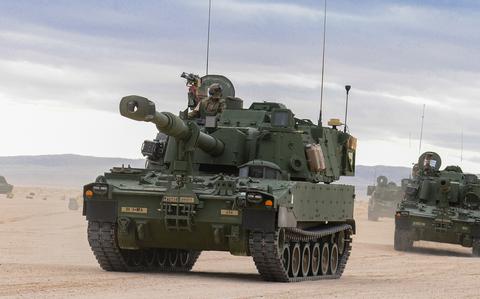
BAE Systems is set to unveil a revolutionary artificial intelligence (AI)-enabled target recognition capability designed to equip Bradley Fighting Vehicles. This technological innovation will make its debut on „several” Bradley armored vehicles at the Army’s upcoming Transformation in Contact (TiC) exercise, marking a significant step forward in modernizing ground capabilities.
A New Era for Combat Vehicles
The new system, dubbed ATR (Aided Target Recognition), promises to transform how soldiers interact with the battlefield. Representatives from BAE Systems emphasize that directly integrating AI into combat vehicles is crucial for enhancing operational effectiveness. The ultimate goal is for soldiers in Bradley vehicles to be able to detect a wide range of ground threats with increased precision and speed.
Human-Machine Synergy: The Key to Success
A critical aspect of this new technology is its focus on human-machine integration. Experts highlight that a team comprising a soldier and a collaborative AI system consistently outperforms, significantly boosting operational effectiveness. The ability for soldiers to leverage this added target recognition capability will empower them to make faster, more informed decisions in critical situations.
Virtual Training Drives Innovation
To refine the ATR target recognition model, BAE Systems utilizes its Virtual Battlespace 4 (VBS4) simulation engine. This engine generates synthetic training data that feeds and shapes the AI. This innovative approach allows for the development and testing of the system in a controlled environment before its field deployment.
From Experiment to Reality: The Army’s Vision
The introduction of BAE Systems’ ATR at the TiC exercise comes at a time when the Army has already experimented with other AI-aided target recognition tools, including during the 4th Infantry Division’s Ivy Sting experiment series. While previous tests saw the AI capacity identify a single target, the ambition is for the artificial intelligence to differentiate between multiple targets. It is hoped that BAE Systems’ ATR will demonstrate this advanced capability during the TiC exercise and eventually become an essential component of the Next Generation Command and Control (NGC2) program.
Horizontal Perspective: A Strategic Advantage
The major significance of adding such a capability to a ground vehicle lies in the ability to use AI-targeted recognition from a „horizontal view.” Previously, especially during the US’s Global War on Terror, operators relied on aerial platforms like drones for a „predator’s-eye-view” to identify threats. Integrating AI directly into ground vehicles allows soldiers to detect threats at ground level, providing a more detailed and tactical understanding of the immediate environment. The necessity for such an approach has also been underscored by the proven effectiveness of Bradley armored vehicles on the battlefield, which has driven efforts to retrain AI models for a horizontal perspective.
The Future of the Bradley Fleet: Continuous Modernization
Although the Army is just beginning to field the new ATR-Bradley system during the TiC exercises, the long-term vision is for every Bradley vehicle to be updated with this capability. Continuous modernization of these armored vehicles is deemed essential to keep them relevant and effective within an evolving threat environment.