After effectively scrapping their long-awaited long-range jammers for both air and ground platforms this summer, Army electronic warfare leaders outlined their new visions for 2026: a new aerial program and a rapid push for a new kind of ground-based EW. This strategic shift was presented by Brig. Gen. Kevin Chaney and his team, marking a significant reorientation towards flexibility and modularity.
A New Start in the Air: Lessons from the Past
„We do have a new start [in] ’26,” said Chaney, the service’s newly renamed Capability Program Executive for Intelligence, Electronic Warfare, and Sensors (CPE-IEW&S). The new aerial program is a „spin-off from MFEW-Air Large,” referring to the original airborne Multi-Functional Electronic Warfare (MFEW) program that has been in the works for over a decade.
Chaney acknowledged that MFEW „had its challenges,” blaming an old-school „monolithic acquisition approach.” In contrast, the new airborne jammer effort will aim at flexibility and openness to a wide range of commercially available options, pursuing „an incremental strategy using modular designs” that allows repeated, rapid updates as threats and technology advance. „We’re going to go out there and experiment with this capability in ’26,” Chaney said, „and see what capabilities are currently out there and what can we rapidly incorporate into various designs.”
Disaggregating Power: Survivability on the Modern Battlefield
This strategy reflects a widespread and growing preference in the Pentagon for modular, open-architecture systems that can more easily swap out aging components for the latest commercial tech. Such modular systems are also easier to disaggregate into multiple small elements, making them easy to deploy to distant places like the Pacific Islands and harder for the enemy to target on high-tech battlefields like Ukraine’s.
„We’re looking at separating our soldiers from the actual aperture or emitter to increase survivability, because once you emit, you are a target on the modern battlefield,” said Laurence Mixon, Chaney’s civilian deputy. „We are also definitely looking at means of delivering effects that are not so dependent on power, but more on technique.”
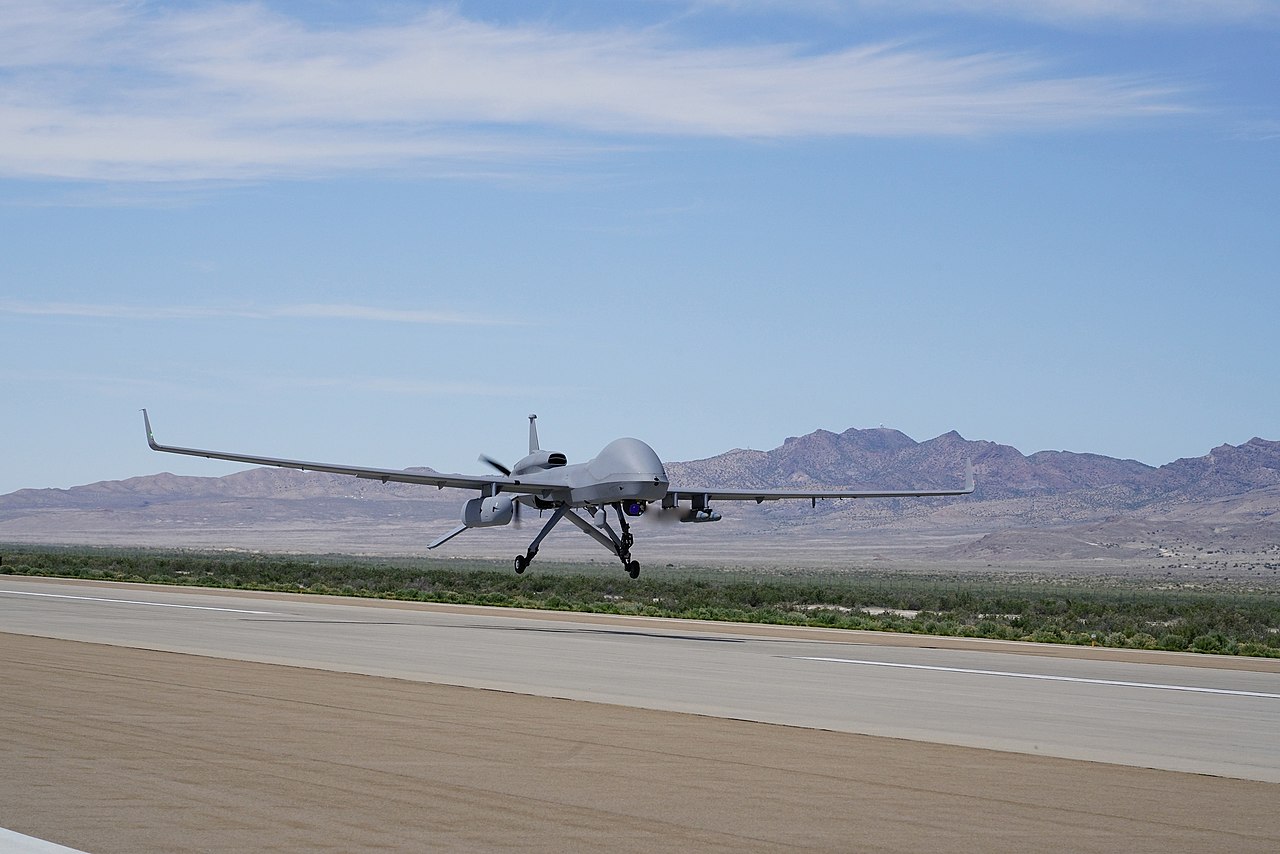
The now-abandoned plan for MFEW-Air was to build one big EW pod to go on one big drone, the Army’s Grey Eagle variant of the MQ-1 Predator. The original vision for ground-based EW at „Echelons Above Brigade” (TLS-EAB) would have taken a couple of heavy trucks. That would have made for not only difficult deployments but big targets once deployed. The new vision, however, is a mix of drones (both free-flying and tethered), ground antennas, and human operators that can all be physically separated from one another, so an enemy strike on one doesn’t wipe out everything.
Terrestrial Innovation: Extended Antennas and Tethered Drones
For the new ground-based system in particular, „we’re looking at a lot of different variations,” said Col. Scott Shaffer, the Army’s project manager. „Is it extended-range antennas… or using other things like tethered [drones]?” (Tethered drones and balloons can draw power and transmit data over cables connected to a ground vehicle, instead of relying on bulky onboard fuel and potentially detectable radio transmissions; that makes them smaller, cheaper, and harder to detect, but at the cost of limiting their movements.)
Another priority, he added, is how the new ground-based system works with the Army’s nascent family of Launched Effects, minidrones launched like rockets off a helicopter or ground vehicle and capable of carrying various payloads.
Speed and Adaptability: Rapid Prototyping and Industrial Collaboration
As with the new aerial system, flexibility and openness to commercial tech are central. „We’ll be reaching out to industry and looking at how we can integrate existing, different processing equipment, antennas, modularity, transit cases, [etc.] trying to make everything as small as possible [to fit] whatever vehicle the Army decides we want to put these kits on,” Shaffer said. „We’re trying to move very quickly over the next probably year to two years on prototyping.”
Whatever the new vehicle-borne jamming system looks like, it won’t resemble the multiple trucks of the original TLS-EAB vision. „Over the past roughly three years… we spent a lot of time and a lot of money on that system, and it became very expensive, and we had some challenges with it too,” Shaffer said. „We decided to pivot.”
Nor will the new ground-based EW approach resemble the massive Soviet-era wheeled and tracked EW systems that Russia deployed to devastating effect in the early days of its conflict with Ukraine.
„They can afford to develop these larger platforms and transport them across land” to a warzone in their own backyard, Chaney said of the Soviet/Russian model. „We’ve got to not only look at what EUCOM’s doing [in Europe], but what’s happening in INDOPACOM. So we have to come up with more modular designs that are transportable.”