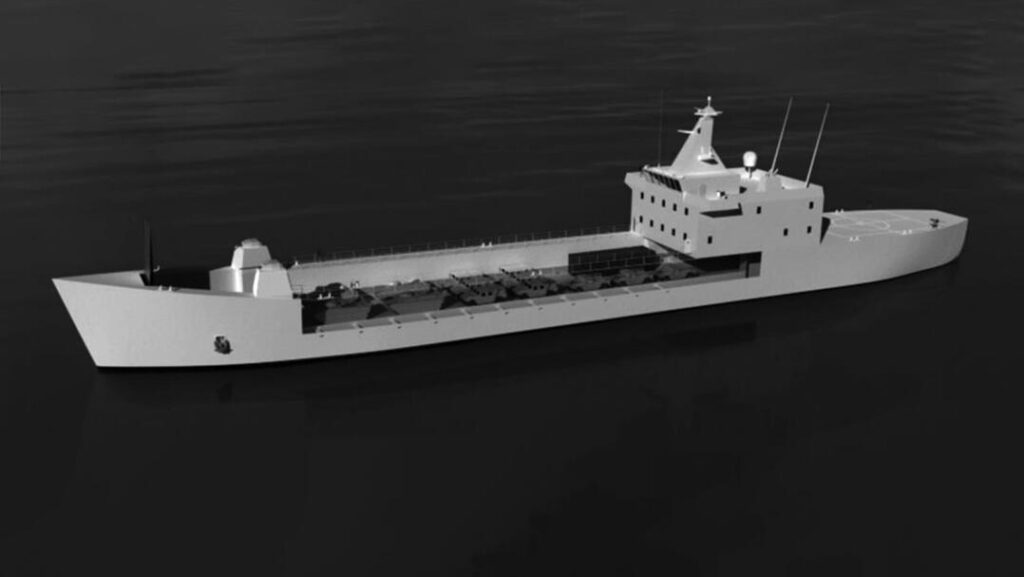
The Navy and Marine Corps have announced a strategic decision set to shape the future of amphibious operations: the Dutch company Damen’s design has been selected as the basis for a number of new vessels under the Medium Landing Ship (LSM) program. The announcement was made by senior leaders via a video message, underscoring a fundamental shift in how the Naval Forces build and operate their fleet.
A Paradigm Shift in Naval Acquisitions
Navy Secretary John Phelan described this decision as the „second major step” in a comprehensive reshaping effort, following the recent cancellation of the Constellation-class program. The selection of the LST-100 Landing Ship Transport design represents an „operationally-driven, fiscally-disciplined choice” that promises to bring essential capabilities to the U.S. fleet on a responsible timeline. Phelan stated that, alongside Chief of Naval Operations Adm. Daryl Caudle and Marine Corps Commandant Gen. Eric Smith, he opted for the LST-100 vessel.
LST-100: The Perfect Balance of Capability and Cost
The LST-100 vessel, weighing approximately 4,000 tons and boasting a range of over 3,400 nautical miles, offers the „right balance of capability, affordability, and speed to field,” according to Phelan. This platform is vital for the Navy and Marine Corps’ vision to enhance their agility in future operations.
The Crucial Role of Medium Landing Ships
Since its initial conception in the first draft of Force Design 2030 in 2019, the Medium Landing Ship (LSM) has undergone several iterations. Generally, the vessel is envisioned to shuttle Marines and their equipment through locations such as the island chains in the Indo-Pacific. The Marine Corps’ official requirement is for 35 LSMs – a number representing the ideal fleet size in the service’s view, though the final outcome depends on annual shipbuilding budgets. „The Medium Landing Ships will enable our Marines to be more agile and flexible in austere environments where there are no ports, providing the joint force the needed operational mobility within the adversary’s weapons engagement zone,” the commandant emphasized in the video message.
Lessons from the Past and the Path Forward
Last year, the Navy had to cancel an initial request for proposals for the LSM program because the responses were „simply unaffordable,” Adm. Caudle explained. Learning from this experience, the new acquisition strategy will involve a competitive process.
„We will competitively award a vessel construction manager to oversee the LSM program, drive execution, and facilitate genuine competition among multiple shipyards,” Phelan added. Details regarding the number of shipyards involved were not specified in the video, but an initial request for proposals for the vessel construction manager competition will be released in early 2026.
The Navy secured the rights to Damen’s technical data package for the ship’s design for $3.2 million. A Navy spokesperson noted that while previous contracts with Bollinger Shipyards secured the technical data package for a design based on a U.S. Army ship, the Navy is not currently planning to build any LSMs based on that design. However, a separate contract was awarded to Bollinger in September for advance procurement of long-lead time materials and associated engineering and design activities, to support whichever design was selected for the LSM program.