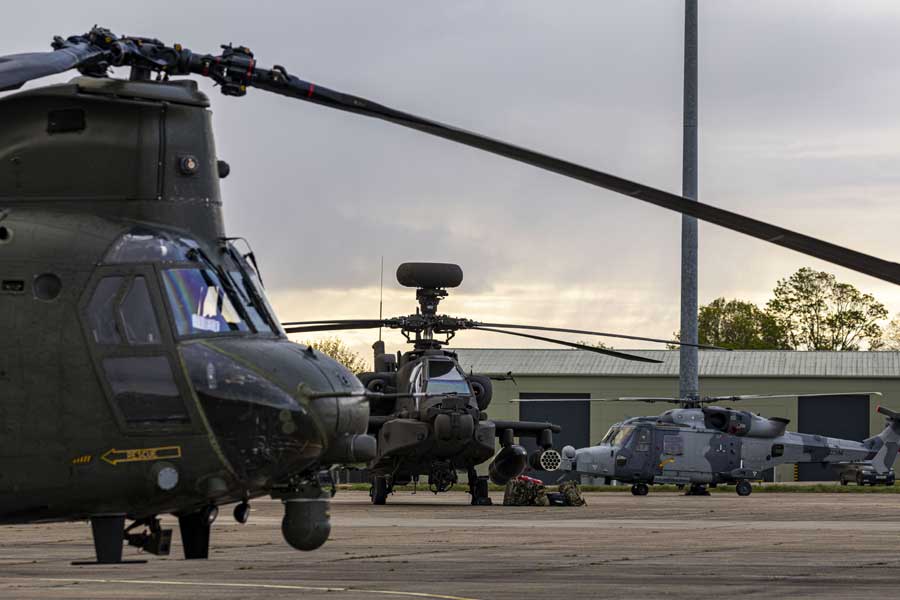
The British Ministry of Defence has launched an ambitious program, inviting seven leading defense firms – from established giants to innovative startups – to pitch concepts for next-generation drone helicopters. These robotic „wingmen,” part of Project NYX, are destined to operate alongside Apache attack helicopters, marking a fundamental shift in Britain’s aerial combat strategy. The goal is to achieve an initial operational capability by 2030.
The Tech Alliance: Who’s Competing for the Future?
The shortlist of participants, which includes prominent names from the global defense industry, demonstrates the international scope of the initiative. Among the invited companies are the UK’s BAE Systems, Lockheed Martin’s UK subsidiary, and robotics company Syos; Italy’s Leonardo; France’s Thales; Portugal’s Tekever; and America’s Anduril. The Ministry of Defence’s plan is to narrow this list down to four firms by March, selecting the partners who will shape the future of airborne warfare.
AI in Command: The „Wingman” Drone’s Role
Project NYX reflects a global trend of integrating drones into support roles for manned aircraft. These drone helicopters will not merely be remotely controlled but will utilize artificial intelligence to operate on a „command rather than control” protocol. This means they will be able to execute complex tasks autonomously while strictly adhering to mission parameters. The objective is for the new drones to perform crucial operations such as reconnaissance, surveillance, and targeted strikes. Through this, the Ministry of Defence hopes to „enhance lethality, survivability, and mission effectiveness while reducing the risk and logistical burden for human-operated systems.”
The Revolution of Modern Warfare: Britain’s Strategic Pivot
This initiative is a key component of what the Ministry of Defence refers to as „a new way of war.” By capitalizing on the power of drones, AI, and autonomy, the United Kingdom aims to complement the „heavy metal” of tanks and artillery with advanced capabilities, making its Armed Forces „stronger and safer on the battlefield.” The program, about which little was previously publicized, underscores a strategic pivot towards a modern and efficient approach to conflicts, within an evolving global security landscape.