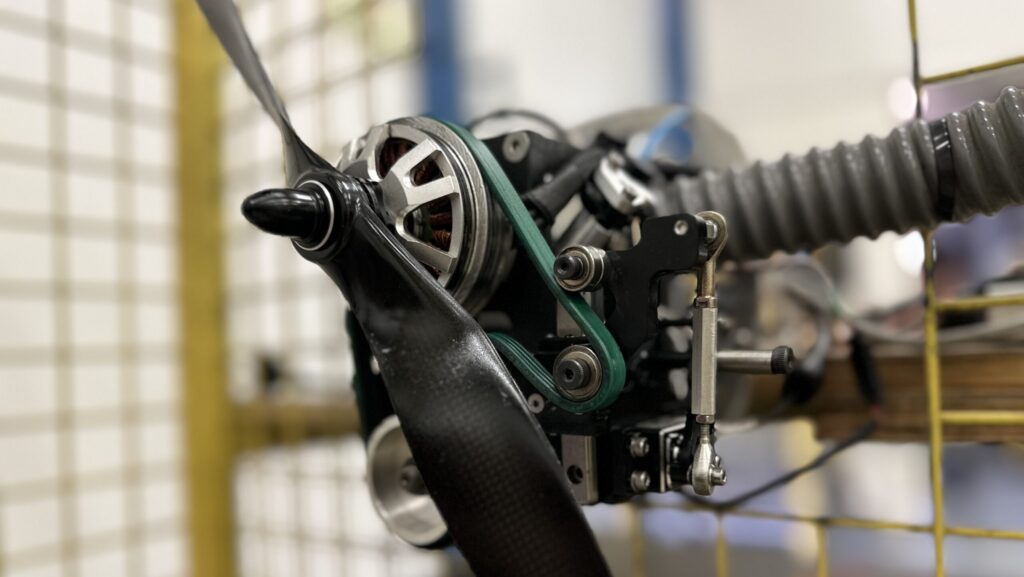
Tel Aviv – Israeli defense giant Elbit Systems has opened a new chapter in drone technology, selecting startup Lowental Hybrid to supply an innovative hybrid-electric engine. Compact enough to fit tactical drones, this engine promises a significant extension of unmanned systems’ autonomy, marking a crucial breakthrough in the UAV domain.
A Strategic Collaboration for the Future of Drones
„This achievement reflects how close cooperation between innovative startups and established defense leaders can accelerate meaningful progress in the UAV domain,” stated Doron Fridman, CEO of Lowental Hybrid. The decade-long agreement includes development, procurement, and services, with an initial financial scope of approximately $1.4 million, followed by substantial multi-year revenue from additional systems and support. Lowental Hybrid will provide dedicated engineering and integration support throughout the contract term, enabling Elbit Systems to integrate the hybrid propulsion technology across multiple UAV programs.
„Native Parallel Hybrid”: The Compact and Efficient Solution
Lowental Hybrid’s product for Elbit, dubbed „Native Parallel Hybrid propulsion systems,” brings a much-anticipated innovation. Until now, hybrid-electric technology was limited to larger aircraft. Given that all-electric platforms have shown endurance limitations – a reason why armed forces like the US Air Force have opted for hybrid-electric approaches – tactical drones faced similar challenges. However, hybrid architectures were difficult to scale down to be light and small enough. The „Native Parallel Hybrid” engine solves this problem, promising a flight duration increase of five times or even more. For example, an experimental UAV with 6 kilograms of batteries had a flight time of two hours; with the new system, a UAV equipped with 3 kilograms of batteries could fly for 10 hours, demonstrating immense potential for real-world drones.
Multi-Faceted Advantages: Stealth and Smart Recharging
The combination of electric power and fuel offers multiple advantages beyond extending range and flight duration. Fridman emphasized that UAVs can switch between the fuel engine, which may be louder, and an electric engine, with a low acoustic signature. This means the drone can operate with enhanced stealth when necessary, a vital asset for ISR (Intelligence, Surveillance, and Reconnaissance) missions. The technology also meets NATO standards for electric-stealth operation, while maintaining military-grade reliability and reducing battery dependence. Another benefit is the fuel’s ability to recharge batteries during a long flight.
Integration is relatively simple, involving „taking some batteries out and replacing them with fuel tanks,” according to company statements. The technology could also be applied to loitering munitions, which could benefit from a silent launch and rapid acceleration, followed by the use of the fuel engine for longer distances.
A Force Multiplier: A Global Market on the Horizon
The ability to remain airborne longer is a „game-changer,” Fridman affirmed, describing the collaboration as an important milestone that „enhances endurance, reliability, and simplicity of use.” Lowental Hybrid, founded in 2018, is also targeting other markets and customers in the US and Europe, solidifying its position in a rapidly expanding field of drone propulsion innovation, alongside other companies exploring solutions such as heavy fuel engines or hydrogen-powered options.