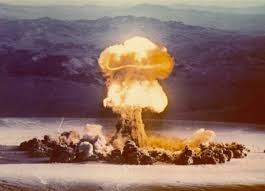
At the stroke of midnight, the last remaining US-Russian treaty capping nuclear weapons expired, ending five decades of nearly continuous, if not always harmonious, negotiated efforts to lower the risk of Armageddon. These agreements had ensured a certain mutual restraint between superpowers regarding the size of their respective weapons caches. With the formal demise of New START, the specter of a new nuclear arms race between Moscow and Washington looms large, carrying significant strategic and budgetary consequences for both sides, as experts warn.
Trump’s Critiques and the Call for a New Strategy
Immediately after initial reports suggested a potential deal between US and Russian officials to observe some of the treaty’s obligations, former President Donald Trump weighed in online. He lambasted New START as a „badly negotiated deal” and called for „our Nuclear Experts [to] work on a new, improved, and modernized Treaty that can last long into the future.” His statements underscore a vision that questions the value of bilateral agreements in the current geopolitical context.
New START: A Shield Against Proliferation and Its Decline
Signed in 2010, the New START treaty limited Russia and the United States each to no more than 1,550 deployed strategic warheads and 700 deployed strategic delivery vehicles (meaning ICBMs, submarines, and bombers). It also required significant information exchanges designed to assure each party of the other’s compliance. The 10-year accord allowed a one-time five-year extension, which the two sides agreed to in 2021.
However, in February 2023, Russia suspended its compliance with New START, claiming US and NATO support for Ukraine following Moscow’s invasion the year before made it impossible for Russia to allow required inspections of its nuclear weapons facilities. President Vladimir Putin at the time also pledged to uphold New START’s weapons caps and refrained from a formal withdrawal. Consequently, the Biden administration also continued to abide by the limits, although it took some countermeasures.
A Missed Opportunity? Moscow’s Proposal and Washington’s Silence
Fast forward to this year, and Yury Ushakov, a senior aide to Putin, stated that despite an initially favorable response by US President Donald Trump, Washington never officially responded to a September proposal by Moscow. The proposal aimed to voluntarily extend the treaty’s limitations for a year with no verification measures, according to Russia’s state-run news service TASS. A White House official indicated that Trump „has spoken repeatedly of addressing the threat nuclear weapons pose to the world and indicated that he would like to keep limits on nuclear weapons and involve China in arms control talks.” However, the final decision on the path forward will be made by the president on his own timeline.
The United States, „Untied Laces” in the Arms Race
Experts warn that should a new arms race break out, it might be Russia, not the US, that starts a lap ahead. This is attributed both to Russia’s head start on modernization and new weapons development, and the sorry state of current US nuclear modernization programs and the required infrastructure.
Rose Gottemoeller, who was the Obama administration’s chief negotiator for New START, told a Senate Arms Services Committee hearing this week that she believes the US should take up Putin’s proposal for a year-long extension. Her reasoning: the Russian military has the ability to “very rapidly” take warheads out of storage and mate them to delivery vehicles. „My whole view of keeping the US and Russia under New START limits for the coming year is to prevent them from sprinting away from us in an upload campaign,” she emphasized.
Tim Morrison, a former deputy assistant to the president for national security in the first Trump administration, highlighted that the outdated US nuclear arsenal is already threatening the military’s ability to deter a nuclear attack. By 2035, „100 percent of US nuclear weapons, the warheads and the bombs themselves, will have exceeded their design lives by an average of 30 years.” This asymmetry undermines not only arms control but deterrence itself.
John Plumb, assistant secretary of defense for nuclear and space policy under the Biden administration, stated that the US nuclear weapons complex has been neglected for many years. „Instead of continuously modernizing like good stewardship demands, the United States has unfortunately underinvested in our nuclear infrastructure for decades,” he explained, adding that new money has often been consumed by cost overruns without providing additional capability.
The Congressional Budget Office has estimated that the overall cost of modernizing and maintaining the US nuclear enterprise, including ICBMs, submarine-based missiles, bombers, warheads, and the necessary infrastructure to manufacture and test those warheads, will cost $946 billion from 2025 through 2034. „A new nuclear arms race is in no nation’s interest, but in the long run our US nuclear deterrent will only be as credible as our nuclear weapons infrastructure,” Plumb concluded.
Ankit Panda, a long-time nuclear expert at the Carnegie Endowment for International Peace, noted that Russia also faces challenges in pushing forward a nuclear buildup, in partly due to the resources it has had to extend in its protracted war with Ukraine. „Both the United States and Russia have strong incentives to not arms race. But of course, that was true during the Cold War, when, in fact, they did arms race,” he said, warning that „the loss of predictability and transparency is going to be troublesome for national strategic debates in the United States and Russia.”
A Revived Dialogue: A Fragile Hope
In a note, US European Command (EUCOM) announced that the US and Russian militaries have agreed to re-open their bilateral dialogue, suspended since 2021. This could serve as a conduit for voluntary agreements to restrain respective nuclear buildups or destabilizing activities. The reestablishment of high-level military-to-military talks follows a series of meetings in the United Arab Emirates’ capital between EUCOM Commander Gen. Alexus Grynkewich and senior Russian and Ukrainian military officials, seeking a peaceful solution to the war in Ukraine.
The China Factor: A New Dimension to the Nuclear Threat
Whether there’s a year extension to New START or not, there has been a growing chorus of advocacy—from government officials and lawmakers to independent nuclear strategists—for beefing up traditional US nuclear forces and developing new, theater-range weapons. The aim is not just to counter Russia’s nuclear modernization efforts and past treaty violations, but also to address the relatively small but rapidly growing Chinese arsenal.
China, obviously not party to New START, is believed to possess around 600 nuclear weapons, compared to America’s 5,177 and Russia’s 5,459. Beijing could reach a „maximum projected number of 1,500 warheads” by 2035, according to the Stockholm International Peace Research Institute. Critics suggest it might be time to ditch New START for a different arms control strategy, one that relies on a stronger US deterrent posture to push China to the table as well as Russia.
„Here is the reality today: Russia has been in noncompliance with New START since 2022 and continues to hold a massive numerical advantage in tactical nuclear weapons. China is growing its nuclear arsenal at a breathtaking pace. Both countries are outpacing us in developing novel, destabilizing weapons,” Senator Deb Fischer, R.-Neb., declared at a Senate Armed Services Committee hearing.
„In 2023, the bipartisan Strategic Posture Commission released its final report, which unanimously agreed that our current nuclear modernization plans – predicated on New START limits – are not sufficient to meet the new threats posed by Russia and China,” she added. Under New START, US nuclear systems have gone down by 17 percent, whereas Russia has gone up by 22 percent and China by 29 percent, according to Heather Williams, director of the Project on Nuclear Issues at the Center for Strategic and International Studies (CSIS). Furthermore, she charged, „Russia has violated at least nine arms control agreements since Putin came to power.”
Retired Admiral Charles Richard, former head of US Strategic Command (STRATCOM), warned that Russia isn’t the only nuclear threat the US military needs to be able to deter, as China in particular is rapidly expanding its arsenal. Beyond the threat of China alone, Richard cautioned about the potential for Moscow and Beijing to hit the US with a double-whammy. „I didn’t have the luxury when I was at STRATCOM of deterring our opponents one at a time. I had to look at the collective. I am very concerned about the possibility of opportunistic or coordinated aggression, either between major powers such as Russia and China and or the regional ones,” he stated, New START or not.
Trump administration officials, as well as many congressional Republicans and political right experts, argue that any nuclear arms control agreement that does not include China will put the US at a disadvantage. „At a minimum, I would include Russia, China and the United States in any arms control agreement,” Richard said. „Absent that, simply extending the New START Treaty for one year does not constrain Russia in the same way that it constrains us. It prevents us from answering the challenge that China has added to this.”
Dating back to his first administration, Trump himself has repeatedly said he is interested in negotiating a trilateral pact. Beijing, however, has shown no inclination to engage, and experts say this is unlikely to change until the PLA’s nuclear arsenal has at least reached parity with the Russian and US militaries.