Ploiești, the city once symbolizing the „drink of happiness,” now finds itself at the epicenter of a brewing storm surrounding Coca-Cola’s local production. Far from the innocent smiles of American advertisements, revelations paint a grim picture of alleged corruption, questionable water sources, and a „feudal” management style under the controversial leadership of Dragoș Nan, dubbed „Lord Nan” by some. Recent investigations suggest that Romania, particularly the Prahova region, has been transformed into a „carbonated colony” where the sparkling promise of a beloved beverage may conceal a cocktail of deceit.
The Potability Predicament: Unsanctioned Water in „The Drink of Happiness”?
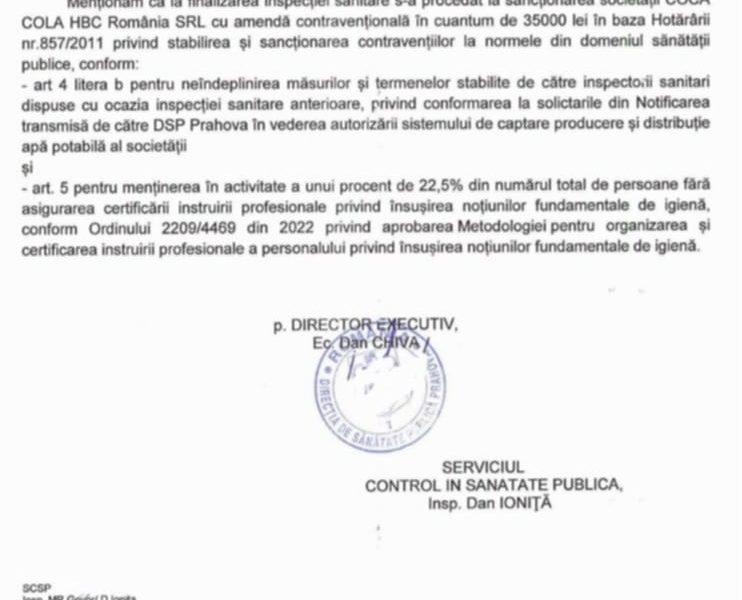
Perhaps the most alarming accusation revolves around the water quality used in Coca-Cola’s Ploiești factory. Reports indicate that for years, the plant has allegedly operated without the necessary potability authorization from the Public Health Directorate (DSP) for its eight water boreholes. Adding to the controversy, „Lord Nan” is rumored to have boasted privately about „fixing” this water issue in a crude, almost garage-like manner. When the DSP initially raised concerns, a Dr. Onuț was reportedly „sidelined” and swiftly replaced by a Dr. Pungaru George, described as „more flexible” and „fond” of Coca-Cola products, allegedly willing to sign off on illegalities.
Consumers, therefore, may unknowingly be imbibing water lacking proper legal authorization and extracted illegally, posing potential health risks. Echoing these concerns, sources suggest that even employees at the factory opt for bottled water, eschewing the plant’s own well water – a telling sign of internal distrust. The question looms large: what value does the health of a Prahovan citizen hold against a well-placed bribe in the eyes of allegedly corrupt officials?
The Reign of „Lord Nan”: Nepotism and a Climate of Fear
Dragoș Nan is portrayed not merely as a director but as a veritable feudal baron, transforming the Ploiești factory into a personal fiefdom populated by an impressive „family tree” of appointees. Nepotism, it seems, is the secret ingredient for personal success. From his wife, Valentina Nicoleta Nan – who reportedly maintains her maiden name in her email address to avoid detection and is noted for her flexible work hours and propensity for loading errors – to former brothers-in-law and an army of relatives and connected individuals, loyalty to the „Lord” appears to trump competence.
For rank-and-file employees, the atmosphere is described as one of absolute terror. Under „Big Brother Nan’s” alleged guidance, the factory has become a „penal colony” with constant audio-video surveillance, extending from entrances to locker rooms and even beyond the factory premises. Employees are reportedly monitored, reprimanded, and shuffled like pawns, living in fear of complaining or communicating with the press. GDPR regulations are dismissed as a „bad joke.” Unions, meant to protect workers, are accused of becoming „Nan’s poodles,” reportedly swallowing abuses in exchange for petty privileges. This has been termed a „managerial ethnic cleansing,” where competence is purged to make way for „obedient mushrooms” and family incompetence.
Greenwashing and Grey Deals: Recycling Schemes Under Fire
Even environmental concerns have not escaped „Lord Nan’s” alleged grasp. An €8 million investment in a recycled plastic (rPET) decontamination line, with a substantial €3.5 million (over 40%) funded by the state, is reportedly a resounding failure. The resulting resin is of poor quality, rendering the raw material into costly waste. In response, Nan allegedly orchestrated a „tailored contract” with Green Tech in Buzău to dispose of the problematic material at paltry prices for Coca-Cola, while allegedly securing „generous commissions” for himself and his inner circle, including Daniela Spiru, Ioana Brisan, Rodica Nedelcu, Miruna Giurincă, and Nelu Moldovan. This scheme, critics argue, resembles a „corner-store LLC” operation transplanted into a multinational corporation.
The Guarantee-Return System (SGR) faces similar scrutiny. „RetuRO SGR,” reportedly a creation of Coca-Cola, is described as an opaque monopoly characterized by exorbitant expenses on luxury vehicles, expensive IT equipment, and opulent headquarters, while actual recycling efforts remain minimal. Funds collected allegedly disappear, leaving citizens struggling to recycle correctly due to insufficient machines and refusal to accept certain waste. Millions of PETs are reportedly illegally dumped or improperly reused, with the Ministry of Environment accused of complicity in waste and deception.
Authorities on the Sidelines: Complicity or Incompetence?
Amidst this carousel of alleged illegalities, a fundamental question arises: where are the authorities? Why has no action been taken? Critics have repeatedly pointed to the alleged complicity of local and central authorities.
Even at high levels, „gentlemen’s agreements” appear to cover up the illegalities. Marcel Ciolacu’s 2023 discussions about „overtaxing” that would return to Coca-Cola „in the form of investment aid” raise concerns. Are these state aids being used to cement a system of corruption rather than support a clean industry? And the National Anti-corruption Directorate (DNA)? The cry „Are you sleeping, DNA? Wake up, they’re poisoning us openly!” echoes through the allegations. It suggests that institutions in Romania may be too preoccupied with collecting bribes or feigning incompetence to fulfill their duty to citizens.
„Fiscal Shock” as a Smokescreen: Management Under Scrutiny
With an irony bordering on the theatrical, Coca-Cola management consistently laments „fiscal shock” and „unpredictable fiscal measures” as the causes for declining profits, bemoaning the impact on bonuses. However, internal revelations paint a different picture, pointing to the true problem as „dubious management quality” and the „hallucinatory manner in which production, planning, and sales are actually conducted.” Contracts with „house” companies, exotic vacations paid by the company, and company cars used as personal taxis are all cited as real costs, ultimately transferred, of course, to the end consumer.
The colossal rent for a central headquarters reportedly 70% empty, and millions spent on PR studies designed to mask internal decay, complete the portrait of disastrous management. Meanwhile, the salaries of entry-level employees remain among the lowest in the industry, and they are allegedly sent home to exhaust overtime hours to avoid payment. The „fiscal shock” is thus presented as nothing more than a smokescreen, a flimsy excuse to hide a system „rotten to the core.”
The Price of „Happiness”: A Call for Accountability
How long will consumers continue to drink „poison” with a smile? How long will society accept that health, environmental future, and judicial integrity are mere bargaining chips in a „rotten gentlemen’s agreement”? From the exorbitant prices of beverages, constantly inflated under the pretexts of „guarantee-return” or „sugar tax” (which mysteriously also applies to sugar-free products), to waste managed only on paper, everything allegedly boils down to an organized heist.
The accusations suggest that Coca-Cola, under „Lord Nan’s” alleged reign, has transformed its Ploiești factory into a hotbed of incompetence and illegalities. It is time for collective awakening, demanding investigations and ruthless dismissals. The call is clear: it’s time to hit those who underestimate public intelligence not just metaphorically, but directly. Otherwise, Romania risks continuing to live in a haze of garbage and lies, where the only sweet taste will be the bitter one of regret.