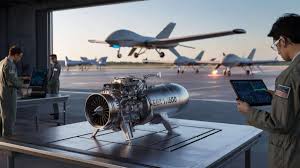
The United States Air Force has awarded contracts to a mix of engine manufacturers, a crucial strategic step to diversify the propulsion options for its forthcoming drone wingmen and other autonomous platforms. This initiative marks an acceleration of efforts to ensure air superiority through an adaptable, high-performance fleet of unmanned aircraft.
A Multi-Vendor Strategy for Diversity and Innovation
Contracts have been issued to Beehive Industries, Honeywell, Pratt & Whitney, and a team-up of GE Aerospace and Kratos. The objective is to „mature engine designs in support of conceptual designs for Combat Collaborative Aircraft (CCA) Increment 2 and other types of Autonomous Collaborative Platforms (ACP),” an Air Force spokesperson stated. This multi-vendor approach is essential to ensure the Air Force has „a variety of options to power the diverse and evolving fleet of ACP and CCA Increments.”
From Off-the-Shelf to Tailored Propulsion Solutions
For the first round, or „increment,” of the CCA program, the service opted for readily available off-the-shelf engines. However, an Air Force official previously explained that the service is now investing money to create new engine options, particularly in lower thrust ranges, to unlock more design possibilities for future drones. „We saw that there was an area [in smaller engines] we needed to make investment together. So that’s where we’re making that investment,” a top official told reporters in September, referring to a request for proposal for lower-thrust engine solutions. These new awards aim to „mature propulsion designs in different power classes in support of future ACP and CCA Increments that optimize cost, range, and mass,” the spokesperson added.
Pioneers of Autonomous Propulsion: Contract Details Emerge
GE Aerospace announced that its contract with Kratos, valued at $12.4 million, will „complete the preliminary design” of their GEK1500 engine, which offers 1,500 pounds of thrust. Honeywell, for its part, stated that its award would build off the firm’s Skyshot 1600 engine, capable of up to 2,800 pounds of thrust, though the financial value was not disclosed. Representatives for Beehive and Pratt did not immediately provide details.
Early Design Phase: Where Innovation Meets Reality
The Air Force spokesperson emphasized that these awards are for „early stages” of engine development, covering initial design with an option to complete a „preliminary design review.” „This design phase is crucial to evaluate what is in the ‘art of the possible’ before committing to the more expensive and complex phases of building and testing prototypes. The ultimate goal is to develop engines that are affordable, high-performing, and can be produced rapidly and at a large scale.”
These engine investments complement other initiatives, including previous contracts awarded to nine companies for early design work on the air vehicle for CCA program’s second increment, encompassing a broad range of concepts from attritable (designed to be expendable) to exquisite designs. It remains to be seen what final route the Air Force may choose for the second CCA round, though the intention is to winnow down the pool of vendors for eventual production deals.