With the Strait of Hormuz, off Iran’s southern coast, effectively closed, British Prime Minister Keir Starmer announced that the UK is collaborating with allies to reopen the vital waterway and safeguard commercial vessels navigating its constricted corridors. What Starmer did not explicitly detail, however, was the precise role the Royal Navy might play in any international security operation, leaving questions about London’s strategic capability and commitment unanswered.
London’s Muted Response: A Strategic Calculus or Capability Deficit?
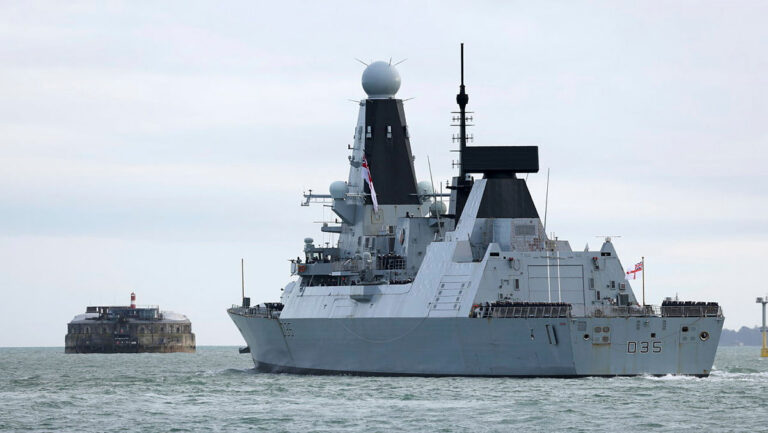
Since the US and Israel launched extensive aerial attacks on Iran on February 28, and despite Iranian retaliatory strikes that endangered British troops or facilities on at least three occasions, the UK has maintained a notably light maritime footprint in the region. The decision earlier this month to deploy a single Type 45 destroyer to the Mediterranean, a stark contrast to the more robust deployments by the French Navy, has prompted analysts and observers to question whether Britain’s stance reflects a prudent strategic calculus or the stark realities of a worrying maritime capability gap.
As UK naval expert Emma Salisbury pondered: „Why haven’t we committed to doing a similar kind of wider regional security mission to what the French have committed to? Is that because we don’t want to? Is that because we don’t believe it’s necessary, or is it because we can’t?” A Ministry of Defence spokesperson countered, stating the destroyer’s deployment „is one element of our wider approach and builds on the capabilities we’ve been deploying since January, including Typhoons, F-35 jets, air defence systems and an extra 400 personnel into Cyprus.”
The Lone Destroyer and the Carrier Conundrum
The deployment of HMS Dragon, one of the Royal Navy’s six Type 45 air defense destroyers, came after a strike on a Royal Air Forces base in Cyprus. Although the UK Defence Secretary praised the Navy for its swift readiness, it reportedly took six days for the high-tech vessel to get underway, partly due to software issues. Equipped with its Sea Viper anti-air missile system, the destroyer can fire eight missiles in under 10 seconds and guide up to 16 simultaneously, bolstering its ability to detect, track, and destroy aerial threats.
In contrast to France, which deployed close to half its fleet of major surface combatants to the Eastern Mediterranean, spearheaded by its Charles de Gaulle aircraft carrier, the UK opted not to send the Prince of Wales aircraft carrier. The Prince of Wales is currently the only available carrier, as the Queen Elizabeth is undergoing a planned refit in Scotland. US President Donald Trump initially criticized this decision, later suggesting that UK aircraft carriers were unnecessary, implying Britain would be „trying to join Wars after we’ve already won!”
A Legacy of Gaps and Budgetary Strain
Analysts suggest that deploying a significant naval force might be a challenging endeavor for the UK’s current fleet. An anonymous defense analyst noted that committing the Prince of Wales carrier would risk „bending out of shape” other operational plans, especially given that the UK’s broader strategic focus is rooted in the North Atlantic, not the Mediterranean. Former ambassador Jon Wilks emphasized that UK defense capabilities are „pretty stretched at the moment, and very much focused on Ukraine, the North Sea, the high north.”
This situation is not new. The UK was left with an airborne early warning capability gap when its E-3D aircraft were retired in 2021, a problem exacerbated by the slower-than-anticipated progress of the E-7 Wedgetail program. A recent annual report cited „challenges within the global supply chain, retention of an appropriately skilled workforce, and an increase in certification complexity” as causes for delays.
Strait of Hormuz: All Eyes on the Critical Passage
The question of British maritime capability could regain prominence as the United States seeks to rally an international coalition to protect the Strait of Hormuz and ensure oil shipping through the critical pathway. The UK Defence Secretary suggested that UK-registered ships transiting the Strait could be protected by the Royal Navy, with options to secure the strategic sea lane under consideration.
Britain also possesses mine countermeasure (MCM) capabilities, which could be instrumental in clearing any ordnance laid by Iran. Ironically, one Hunt-class MCM vessel, HMS Middleton, sailed home for a planned upkeep period just before the conflict, highlighting logistical challenges. Starmer reiterated Britain’s commitment to work with allies to restore freedom of navigation in the region „as quickly as possible.” Whether the Royal Navy’s current fleet can fully support these ambitions in an increasingly volatile regional context remains to be seen.