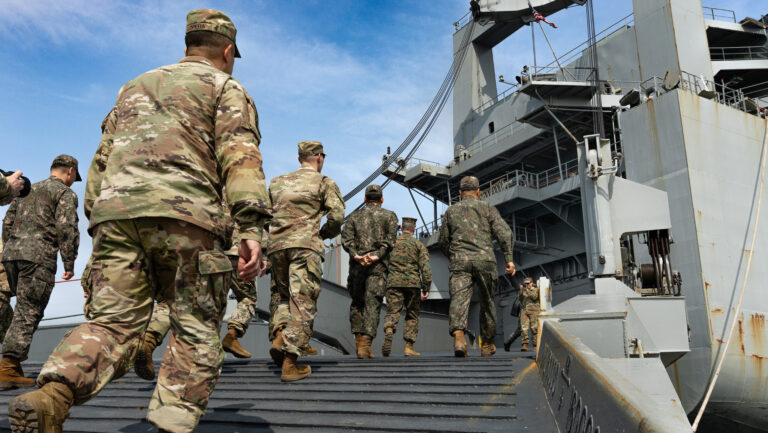
A cornerstone of American military readiness in the Indo-Pacific, the Army’s only floating Army Prepositioned Stock (APS-3) is undergoing a significant reevaluation. A year after initial discussions hinted at its potential sunset, the U.S. Army has already begun offloading much of this mobile cache’s equipment to allied land bases across the region. This move signals a potential paradigm shift in military equipment deployment strategy, adapted to new geopolitical realities and logistical challenges.
The Indo-Pacific Pivot: A Year in Review More than a year ago, Lieutenant General Christopher Mohan, a senior official within the Army Material Command, indicated that the service was considering jettisoning the mobile cache in the Indo-Pacific, known as APS-3. The idea was to disperse equipment throughout the INDOPACOM theater, a concept he then described as „pre-decisional.” The rationale behind this potential decision stemmed from the Army’s strategic choice to „double down on the INDOPACOM from a theater standpoint,” underscoring a major reorientation of U.S. forces towards this vital region.
From Sea to Land: A New Deployment Doctrine Today, much of APS-3’s equipment has indeed been dispersed, Mohan confirmed. „The idea is to put much of that ground based, and we started doing that in several countries overseas,” he stated. „The end state will be that we will have a much, much reduced APS afloat.” Arms and equipment have been steadily shipped to bases in South Korea and the Philippines. Previously, the mobile cache comprised seven ships laden with gear. The exact quantity of remaining equipment on board and further details on the ongoing offloading were not disclosed, but the significant reduction is clear.
The Final Verdict: Still in Adjudication Despite the extensive relocations, the ultimate fate of APS-3 — whether it will be fully disbanded — remains undecided. Mohan noted that „no major decisions at this point” have been made, and the matter is „still in adjudication” at the highest levels of the Department of the Army. This ongoing deliberation suggests the complex logistical and strategic implications of such a decision, which could have far-reaching effects on the American military presence in the region.
Global Reassessment: Managing Costs, Optimizing Strategy Globally, seven APSs are strategically aligned with different regions, including for Northeast Asia and Southwest Asia, as well as in the continental United States, Europe, Africa, and Central/South America. This trend of reevaluation and dispersal is expected to extend to other APS sites in the future. „What we’ve learned in past exercises and operations is [that] APS is incredibly important, but also that you can have almost too much APS, because then it’s hard to manage. It’s very expensive to maintain,” Mohan explained. „So we’re doing a lot of work to figure out what the right mix of what APS looks like, and both strategy and resource informed is what we’re after.” Thus, the U.S. Army seeks an optimal balance between flexibility, efficiency, and cost-effectiveness to adapt effectively to a continually evolving global landscape.