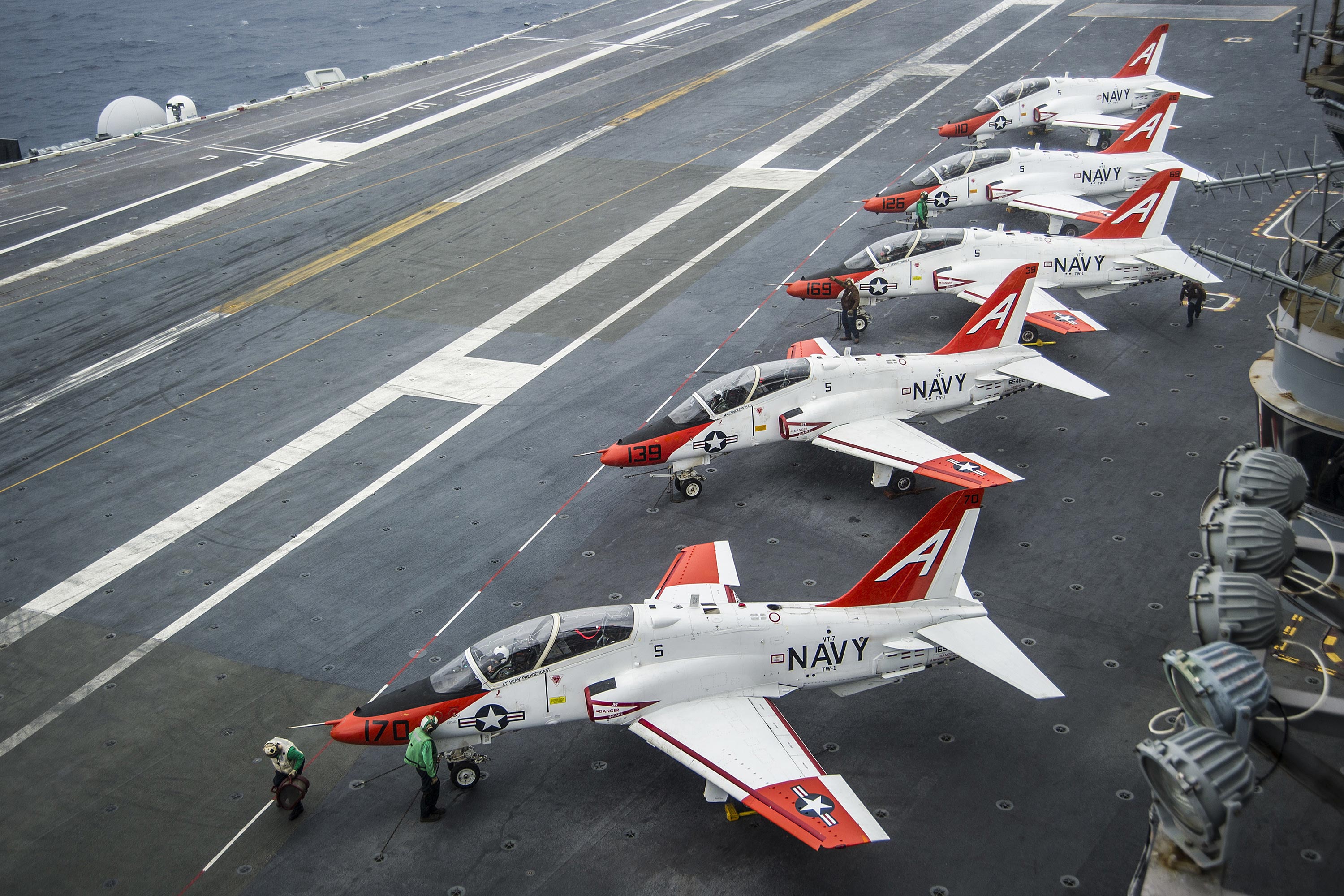
Major Paradigm Shift Announced for Aviator Formation, Emphasizing Advanced Simulation
The United States Navy is set to fundamentally transform how it trains its jet pilots, having unveiled its final Requests for Proposals (RFP) for the new Undergraduate Jet Training System (UJTS). The aim is to acquire a next-generation aircraft for „intermediate and advanced training” of Navy and Marine pilots, replacing the venerable T-45 Goshawk fleet. However, a strategic decision to eliminate actual carrier landings from the new trainer’s syllabus marks a significant departure from tradition and a profound reliance on simulation technology.
A Tactical Retreat from the Carrier Deck
The UJTS is designed to succeed the T-45 Goshawk fleet, which entered service in the early 1990s and is currently employed for pilot carrier qualification. Unlike its predecessor, the new trainer aircraft will no longer be required to conduct training on carriers or perform field carrier landing practice (FCLP) touchdowns—simulated carrier landings on an airfield runway. The Navy had previously indicated this intent in a Request for Information (RFI) in March 2025, which specified that „the UJTS air vehicle will only be required to conduct Field Carrier Landing Practice (FCLP) to wave off” (a simulated aborted landing).
Advanced Simulation Takes Center Stage
As a direct consequence of this shift, the industry will need to demonstrate and provide „unique aircraft simulation capabilities” to prepare aviators for the demanding complexities of carrier landings. This requirement underscores the Navy’s increased confidence in advanced simulation technology to replicate the intricate and risky nature of carrier operations, without subjecting the new trainer aircraft to the physical wear and hazards.
The Financial Stakes and Aerospace Race
The competition for the UJTS program is fierce. Proposals for Engineering and Manufacturing Development (EMD) with a total cost exceeding approximately $1.8 billion will be deemed „unreasonable” and will be rejected. Specific caps for initial EMD also apply: under $52.8 million for FY2027 and $181 million for FY2028.
The Navy plans to award the contract in March 2027, aiming to acquire a total of 216 aircraft. According to initial reports, four EMD aircraft will be procured before commencing low-rate initial production (LRIP) for the first seven aircraft in 2032. This number is set to increase to 25 annually starting in 2035. Among the aerospace giants expected to vie for the UJTS program are Boeing, Lockheed Martin, and SNC in conjunction with Northrop Grumman and General Atomics Aeronautical Systems Inc.
A Lifeline for the Aging Goshawks
While the Navy progresses with the UJTS program, Naval Air Systems Command (NAVAIR) announced in July that the first two T-45 aircraft had entered the Service Life Extension Program (SLEP) production line. Repairs to the existing T-45 fleet are anticipated to continue through 2036, presumably keeping these aircraft flying at least until that time. This indicates a crucial bridging strategy, ensuring essential pilot training continuity during the gradual introduction of the new UJTS fleet.