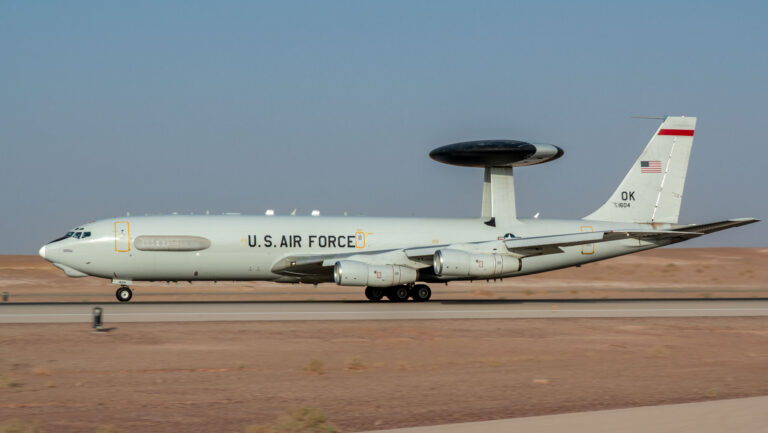
A devastating Iranian strike last Friday on Prince Sultan Air Base in Saudi Arabia has reportedly destroyed a US E-3 Sentry radar plane and damaged several KC-135 Stratotanker air refuelers, casting a stark light on the effectiveness of the US military’s “maxed out” defensive posture. The incident, which also purportedly wounded a dozen US troops, has sparked widespread concern given the Pentagon’s assurances of fortified defenses.
„Maxed Out” Defense Meets Ground Reality
US Defense Secretary Pete Hegseth stated Tuesday that US forces had „maxed out” their defensive posture in the lead-up to the conflict with Iran. He emphasized that efforts included extensive fortifications, asset dispersal, and rapid bunker construction, alongside layered air defenses. „The defense of our troops and our assets is maxed,” Hegseth asserted.
However, the reality on the ground, marked by a rain of Iranian missiles and drones, demonstrated that these measures were insufficient to protect high-value assets. A second E-3 Sentry was also reportedly damaged in the attack, compounding the impact on US aerial surveillance capabilities.
The Agile Combat Employment (ACE) Debate
The Iranian attack brings renewed scrutiny to the Air Force’s „Agile Combat Employment” (ACE) strategy, designed to disperse forces and make them less vulnerable to concentrated attacks. Initially developed in anticipation of a potential confrontation with China and refined by lessons from the Ukraine conflict, where ground-based aircraft proved highly susceptible, ACE advocates for a network of smaller, dispersed operating locations.
While Secretary Hegseth mentioned „dispersal” as part of the defensive strategy, it remains unclear to what extent specific ACE concepts have been applied in the current conflict with Iran. US operations are reportedly conducted from 15 to 20 bases in the region, with some aircraft, such as bombers, operating from considerable distances, including the United Kingdom.
Limits of Dispersal and Emerging Threats
Defense experts caution that while dispersal is a prudent strategic measure, ACE maneuvers alone are insufficient. They must be complemented by a mix of passive and active defenses and can be blunted by harsh logistical realities on the ground, as well as the constantly advancing capabilities of adversaries, such as near-real-time satellite imagery.
Stacie Pettyjohn, a program director at the Center for a New American Security, highlighted that ACE should significantly reduce the number of damaged aircraft by ensuring jets are not clustered. She also suggested the need for more hardened shelters and a more creative approach to posture and operations, including camouflage and decoys.
Tim Walton, a senior fellow at the Hudson Institute, noted that limited base infrastructure can hinder ACE application for large aircraft like the KC-135, which require long runways and bulk fuel stores. He emphasized the importance of a mix of passive defenses (dispersal, camouflage, early warning) and active defenses (ground-based and airborne air defenses).
Clayton Swope, from the Center for Strategic and International Studies, raised concerns about ubiquitous satellite imagery, which, combined with AI tools, can identify targets in near real time, eroding the advantage of subterfuge offered by ACE. He even suggested the possibility of Iran receiving satellite targeting data from partners like Russia or China, a possibility tacitly acknowledged by Hegseth.
Loss of the E-3: A Strategic Blow
The reported loss of the E-3 Sentry, a crucial asset with a powerful radar capable of spotting low-flying threats and a crew of battle managers, represents a significant blow to US air power and defensive capabilities. The Air Force had only 16 E-3 aircraft in its inventory, and their replacement with the new Boeing E-7 Wedgetail is still in transition.
Damage to refueling aircraft, adding to previous reported incidents at the same base, further exacerbates the strain on the Air Force’s airborne tanker fleet, which some officers have already labeled a „big gap” in current operations. Analyst Byron Callan expressed shock, noting the vulnerability of high-value aircraft parked on tarmacs without protection, a harsh lesson already learned from the Russo-Ukrainian War. The Pentagon is now in a race against time to protect its remaining aerial assets from further strikes.