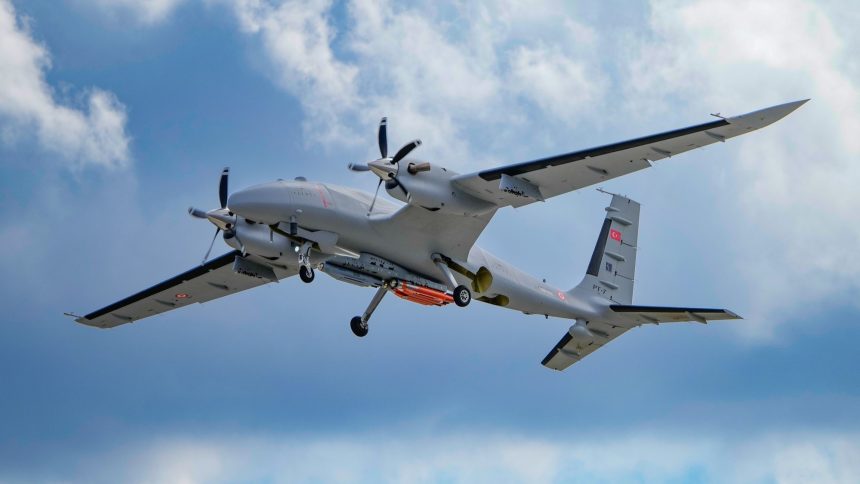
A significant strategic acquisition is set to redefine Italy’s naval air capabilities. An undisclosed number of Turkish TB3 combat drones are projected for formal acquisition in the third quarter of this year, signaling a pivotal move towards integrating uncrewed systems into Italian carrier operations. This development underscores Rome’s evolving maritime strategy, embracing advanced combat technologies for future readiness.
Cavour’s New Aerial Arsenal Takes Shape
Italy’s interest in Medium-Altitude Long-Endurance (MALE) uncrewed aerial platforms has intensified recently. Vice Admiral Giuseppe Berutti Bergotto, Chief of the Italian Navy, solidified integration plans during a parliamentary hearing last month. Speaking before the Italian Senate’s Foreign Affairs and Defense Committee on March 25, the official stated that the TB3 „can be integrated onboard the Cavour aircraft carrier to allow both surveillance and the possibility of carrying armament.” The exact quantity of drones to be acquired, however, remains undisclosed.
A Strategic Alliance: Baykar and Leonardo Partner Up
This initiative is bolstered at the industrial level by a robust partnership between Turkish manufacturer Baykar and Italian defense giant Leonardo. The two companies established a 50-50 joint venture, LBA Systems, in June. This Italy-based entity will be responsible for developing and producing drones, combining Baykar’s proven platforms with Leonardo’s extensive expertise in electronics and sensors. Future uncrewed aircraft production is slated for the Ronchi dei Legionari facility in Northern Italy, a recognized „center of excellence” for unmanned systems.
TB3: Set for European Debut
With this purchase, Italy is poised to become the first European operator of the TB3, outside of Turkey. The TB3 platform is an advanced, naval variant of the well-known TB2 drone, featuring short-range take-off and landing (STOL) capabilities. Available information from the Italian Navy indicates that the Cavour aircraft carrier can accommodate a mixed fleet of 20-24 fixed-wing aircraft and helicopters, with the F-35B serving as the primary fighter jet. Analysts suggest the TB3 will „partly replace the helicopter component rather than the fighter jets.” Expert Federico Borsari anticipates that the Italian flagship carrier could potentially carry a minimum of 20 TB3s, citing the drone’s foldable wings as a significant advantage for onboard storage.
Expanding Unmanned Ambitions Across the Fleet
Rome’s strategic shift extends beyond aerial drones. Italy is also undertaking a major overhaul of its broader naval capabilities, prioritizing the integration of unmanned systems, with a particular emphasis on locally manufactured solutions. Vice Admiral Berutti Bergotto revealed plans to acquire an Italian-made 12-meter-long unmanned underwater vehicle (UUV) for undersea surveillance missions by June. Furthermore, the country will purchase an 8.5-meter-long unmanned surface vessel (USV), the Sea Raptor, produced by Italian manufacturer Defcomm, which will be capable of equipping all Navy ships. These endeavors position Italy at the forefront of military maritime innovation, with a clear focus on automation and agile response to future threats.