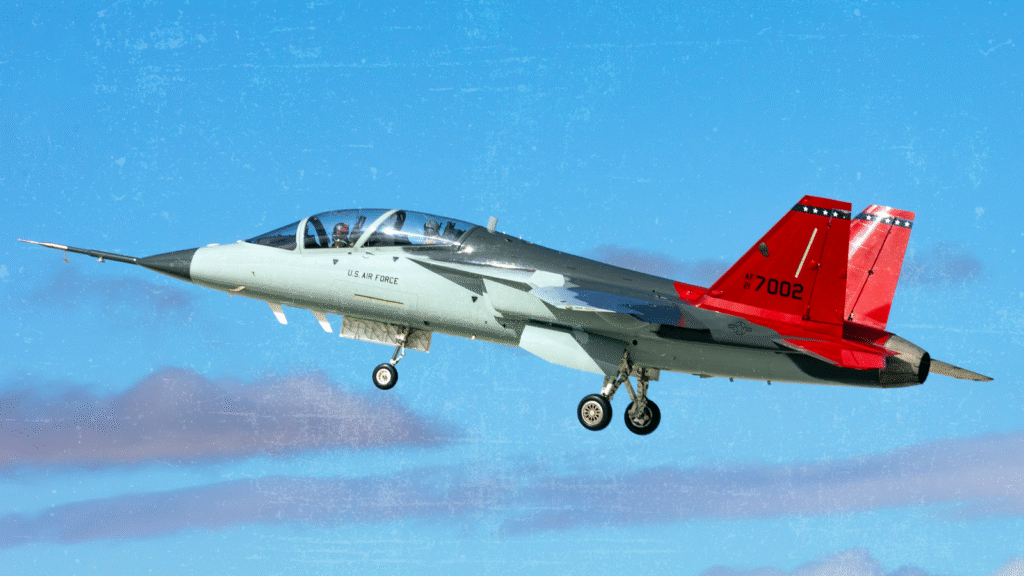
A deep investigation into the U.S. Air Force’s next-generation trainer jet reveals alarming technical deficiencies, legal disputes over data rights, and a potential multi-billion dollar „horse trade” between the government and the manufacturer.
Technical failures and pilot hazards: The aircraft that cannot fly in the rain
The T-7 Red Hawk program, developed by Boeing to train the next generation of elite pilots, is at a critical crossroads. Internal documents and interviews with military aviation officials indicate that the first 82 aircraft are projected to fly with an airworthiness risk classified as „serious.” Furthermore, concerns have emerged that efforts to rush the jet into service could increase the danger for junior pilots.
Technically, the aircraft faces limitations that are surprising for 21st-century technology: currently, the plane cannot fly in rainy conditions. Additionally, the program has struggled significantly with the ground-based flight simulator, a crucial tool for training cadets before they ever step into a real cockpit.
The battle over technical data: Major risks for long-term sustainment
A central point of friction between the military and Boeing involves intellectual property and technical data rights. Internal assessments suggest that the company’s failure to provide certain essential data amounts to „non-compliance.” This information blockade undermines long-term maintenance plans, leading the Air Force to assess the sustainment of the aircraft as „high risk.”
Without access to this data, the Air Force could become entirely dependent on the manufacturer for every repair or modification, eliminating the possibility of autonomous and more efficient fleet management. This tension highlights a systemic issue in major defense acquisitions: who truly controls the technology paid for by the public?
A multi-billion dollar horse trade: The unexpected deal between the military and Boeing
Perhaps the most startling discovery of the investigation is the existence of a potential „horse trade” agreement. Officials are considering a plan to change how the government purchases engines for the T-7, which could incur an additional cost to taxpayers of up to $1.5 billion.
In exchange for this financial adjustment, Boeing would reportedly provide technical data regarding the 747-8i jumbo jet, a program entirely unrelated to the trainer aircraft. While program officials maintain that a new „active management” regime will rectify these issues, critics point out that steering such a complex program through financial compromises and safety risks is a dangerous strategy. For its part, Boeing has reiterated that pilot safety remains „paramount” as it works to accelerate the delivery of this critical capability.