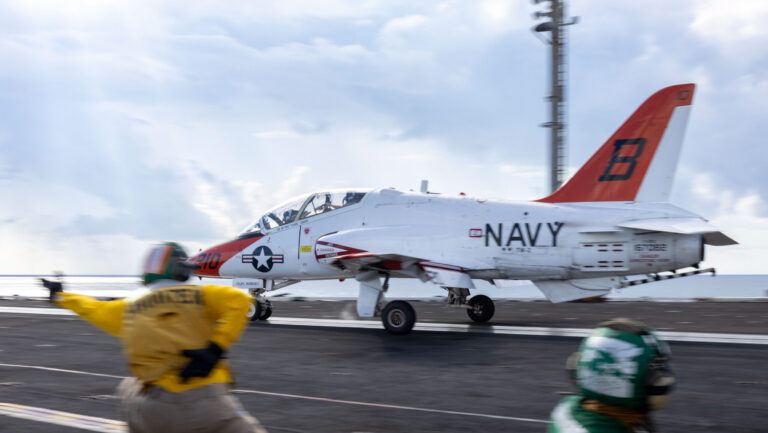
Boeing’s recent decision to withdraw the T-7A Red Hawk from the Navy’s Undergraduate Jet Training System (UJTS) competition places the service at a critical crossroads. Following Lockheed Martin’s earlier exit, only two teams remain: Textron/Leonardo and the Sierra Nevada Corporation consortium. While the Pentagon often considers restarting competitions when bidders drop out, doing so now would ignore the immediate operational risks facing naval aviation.
The aging T-45 Goshawk and the rising cost of training disruptions
The T-45 Goshawk, the mainstay of Navy and Marine Corps pilot production since the 1990s, is failing. For over a decade, the fleet has been plagued by safety concerns, ranging from physiological episodes linked to oxygen systems to mid-air engine malfunctions. Each standdown and delay in replacing this platform forces the Navy to trade long-term readiness for short-term survival, keeping student pilots in cockpits that the service itself describes as facing significant obsolescence.
Straining the frontline fleet to fill the training void
The failure to deliver a timely replacement for the trainer fleet has created a bottleneck in the pilot pipeline. Training times have stretched from 2.5 years to nearly four, resulting in a pilot shortfall of approximately 100 billets. Consequently, the operational fleet must pick up the slack, with high-end F/A-18 and F-35C squadrons forced to conduct basic training tasks. This misuse of advanced assets accelerates airframe wear and diverts million-dollar flight hours from high-end mission preparation to foundational drills.
Choosing readiness over the illusion of a perfect competition
The current field offers the Navy two distinct paths forward. The M-346N provides a mature, proven integrated training system already used by allied forces for 5th-generation pilot development. Conversely, Sierra Nevada’s „Freedom Trainer” offers a new design tailored to naval specifications. While having fewer bidders is never ideal, a rebooted competition would not fix the underlying problem. The Navy no longer has the luxury of time; it must choose a viable successor now to prevent the collapse of its pilot production pipeline.